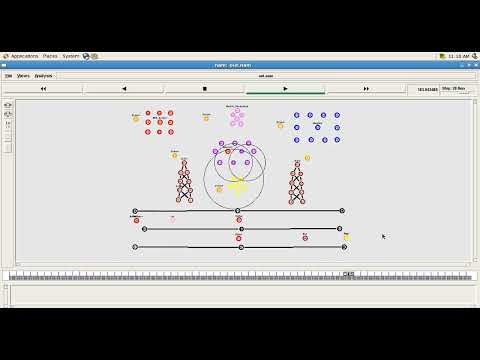
NS2 Simulation
0.0 (0 reviews) • 0 downloads
W-GeoR Weighted Geographical Routing for VANET's Health Monitoring Applications in Urban Traffic Networks
र 1000
W-GeoR Weighted Geographical Routing for VANET's Health Monitoring Applications in Urban Traffic Networks
Technical Details
Domain : Python
Database : Sqlite
Tools : Anaconda
Run Tools: VS Code
Database : Sqlite
Tools : Anaconda
Run Tools: VS Code
Secure Payment
Instant Download
GST Invoice
24/7 Support
About This Product
W-GeoR Weighted Geographical Routing for VANET's Health Monitoring Applications in Urban Traffic Networks
Abstract
The rapid evolution of Vehicular Ad Hoc Networks (VANETs) is enabling novel safety-critical applications such as real-time health monitoring of drivers and passengers. In dense urban traffic networks, however, high node mobility, obstacles, and interference make stable data delivery challenging. This paper introduces W-GeoR (Weighted Geographical Routing) — a routing framework tailored for VANET health monitoring applications. W-GeoR incorporates weighted geographical metrics (node density, signal strength, road topology, and link stability) to dynamically select optimal forwarding nodes. The protocol aims to deliver low-latency, high-reliability transmission of health and emergency data from vehicles to roadside units and healthcare centers. Simulation results show improved packet delivery ratio, reduced routing overhead, and better QoS compared to conventional geographic routing protocols in complex urban environments.
Existing System
Most existing VANET routing protocols for health or safety applications rely on conventional geographic routing, where the next hop is selected solely based on physical proximity or Euclidean distance to the destination. While simple, these schemes fail to account for link quality, node mobility patterns, or urban obstacles, leading to frequent packet loss and delays. Additionally, many existing systems treat all health data equally without prioritizing critical alerts over routine measurements. This lack of weighted decision-making reduces overall reliability and makes them less suitable for emergency health monitoring where low latency and high delivery assurance are mandatory.
Proposed System
The proposed W-GeoR protocol enhances traditional geographic routing by introducing a multi-factor weighting mechanism. Each vehicle periodically exchanges beacon packets containing its position, velocity, signal quality, buffer status, and health data priority. A weighted scoring function then determines the optimal next hop by combining:
Geographical closeness to the destination,
Link stability (signal-to-noise ratio, predicted lifetime),
Node density and traffic flow,
Priority of health data packets (emergency vs. routine).
By integrating these parameters, W-GeoR dynamically adapts to urban mobility patterns and prioritizes critical health information for faster delivery. Furthermore, the protocol can interoperate with roadside units and cloud-based healthcare servers to provide real-time driver/passenger health alerts. This approach ensures more reliable and efficient routing in high-density urban VANET environments compared to unweighted geographic routing methods.
Abstract
The rapid evolution of Vehicular Ad Hoc Networks (VANETs) is enabling novel safety-critical applications such as real-time health monitoring of drivers and passengers. In dense urban traffic networks, however, high node mobility, obstacles, and interference make stable data delivery challenging. This paper introduces W-GeoR (Weighted Geographical Routing) — a routing framework tailored for VANET health monitoring applications. W-GeoR incorporates weighted geographical metrics (node density, signal strength, road topology, and link stability) to dynamically select optimal forwarding nodes. The protocol aims to deliver low-latency, high-reliability transmission of health and emergency data from vehicles to roadside units and healthcare centers. Simulation results show improved packet delivery ratio, reduced routing overhead, and better QoS compared to conventional geographic routing protocols in complex urban environments.
Existing System
Most existing VANET routing protocols for health or safety applications rely on conventional geographic routing, where the next hop is selected solely based on physical proximity or Euclidean distance to the destination. While simple, these schemes fail to account for link quality, node mobility patterns, or urban obstacles, leading to frequent packet loss and delays. Additionally, many existing systems treat all health data equally without prioritizing critical alerts over routine measurements. This lack of weighted decision-making reduces overall reliability and makes them less suitable for emergency health monitoring where low latency and high delivery assurance are mandatory.
Proposed System
The proposed W-GeoR protocol enhances traditional geographic routing by introducing a multi-factor weighting mechanism. Each vehicle periodically exchanges beacon packets containing its position, velocity, signal quality, buffer status, and health data priority. A weighted scoring function then determines the optimal next hop by combining:
Geographical closeness to the destination,
Link stability (signal-to-noise ratio, predicted lifetime),
Node density and traffic flow,
Priority of health data packets (emergency vs. routine).
By integrating these parameters, W-GeoR dynamically adapts to urban mobility patterns and prioritizes critical health information for faster delivery. Furthermore, the protocol can interoperate with roadside units and cloud-based healthcare servers to provide real-time driver/passenger health alerts. This approach ensures more reliable and efficient routing in high-density urban VANET environments compared to unweighted geographic routing methods.
Customer Reviews (0)
No reviews yet. Be the first!
Related Products
⭐ Featured
NS2 Simulation
Reliability-Aware Multi-Objective Optimization-Based Routing Protocol for VANET
Reliability-Aware Multi-Objective Optimization-Based Routing Protocol for VANET
र 1000
⭐ Featured

NS2 Simulation
PSEBVC Provably Secure ECC and Biometric Based Authentication Framework Using Smartphone for Vehicular Cloud Environment
PSEBVC Provably Secure ECC and Biometric Based Authentication Framework Using Smartphone for Vehicular Cloud Environment
र 1000
⭐ Featured
NS2 Simulation
Notice of Removal An Improved Equal Hierarchical Cluster-Based Routing Protocol for EH-WSNs to Enhance Balanced Utilization of Harvested Energy
Notice of Removal An Improved Equal Hierarchical Cluster-Based Routing Protocol for EH-WSNs to Enhance Balanced Utilization of Harvested Energy
र 1000
⭐ Featured

NS2 Simulation
Low-Power Wide-Area Networks Comparison of LoRaWAN and NB-IoT Performance
Low-Power Wide-Area Networks Comparison of LoRaWAN and NB-IoT Performance
र 1000