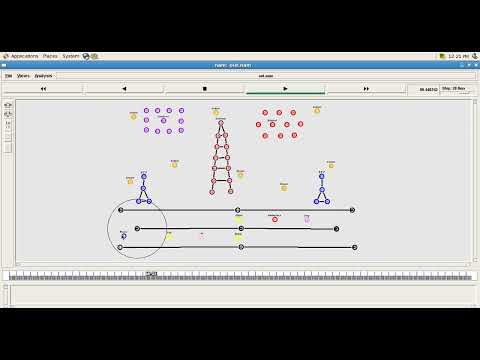
NS2 Simulation
0.0 (0 reviews) • 0 downloads
Reliability-Aware Multi-Objective Optimization-Based Routing Protocol for VANET
र 1000
Reliability-Aware Multi-Objective Optimization-Based Routing Protocol for VANET
Technical Details
Domain : NS2 Simulation
OS : CentOS Linux
Tools : VM Ware Workstation
OS : CentOS Linux
Tools : VM Ware Workstation
Secure Payment
Instant Download
GST Invoice
24/7 Support
About This Product
Reliability-Aware Multi-Objective Optimization-Based Routing Protocol for VANET
Abstract
Vehicular Ad Hoc Networks (VANETs) play a pivotal role in enabling intelligent transportation systems by supporting real-time communication between vehicles and roadside infrastructure. However, the highly dynamic topology, frequent link breakages, and varying vehicle densities pose challenges to reliable data delivery. This paper introduces a Reliability-Aware Multi-Objective Optimization-Based Routing Protocol designed specifically for VANETs. By incorporating reliability metrics alongside traditional performance measures such as latency, throughput, and energy efficiency, the protocol optimizes routing paths using multi-objective algorithms. Simulation results demonstrate that the proposed protocol significantly improves packet delivery ratio, reduces routing overhead, and enhances network stability compared with conventional VANET routing schemes.
Existing System
Traditional VANET routing protocols, including AODV, DSR, GPSR, and their derivatives, primarily focus on single-objective optimization such as minimizing hop count or travel delay. Although these methods achieve acceptable performance under static or moderately mobile scenarios, they fail to ensure reliable packet delivery under the extreme mobility conditions typical of VANETs. Many existing protocols also overlook vehicle density, link reliability, and road topology factors, which can lead to frequent route failures and increased retransmissions. As a result, overall communication reliability, especially for safety-critical applications, remains suboptimal. Additionally, few existing routing schemes use advanced optimization techniques to jointly consider reliability, delay, and energy efficiency in a unified framework.
Proposed System
The proposed routing protocol integrates reliability-aware metrics—such as link stability, signal-to-noise ratio, vehicle mobility patterns, and historical link quality—into a multi-objective optimization model. Using algorithms like Genetic Algorithms (GA) or Particle Swarm Optimization (PSO), the protocol selects optimal routes that balance multiple criteria: packet delivery reliability, end-to-end delay, bandwidth utilization, and energy efficiency. Dynamic weighting allows the system to adapt to varying traffic conditions and application priorities (e.g., emergency messages versus infotainment data). The protocol also employs predictive modeling to anticipate link disruptions based on vehicle trajectory and speed, proactively reconfiguring routes to minimize packet loss. By combining reliability awareness with multi-objective optimization, the proposed solution ensures robust, low-latency communication even in highly mobile VANET environments.
Abstract
Vehicular Ad Hoc Networks (VANETs) play a pivotal role in enabling intelligent transportation systems by supporting real-time communication between vehicles and roadside infrastructure. However, the highly dynamic topology, frequent link breakages, and varying vehicle densities pose challenges to reliable data delivery. This paper introduces a Reliability-Aware Multi-Objective Optimization-Based Routing Protocol designed specifically for VANETs. By incorporating reliability metrics alongside traditional performance measures such as latency, throughput, and energy efficiency, the protocol optimizes routing paths using multi-objective algorithms. Simulation results demonstrate that the proposed protocol significantly improves packet delivery ratio, reduces routing overhead, and enhances network stability compared with conventional VANET routing schemes.
Existing System
Traditional VANET routing protocols, including AODV, DSR, GPSR, and their derivatives, primarily focus on single-objective optimization such as minimizing hop count or travel delay. Although these methods achieve acceptable performance under static or moderately mobile scenarios, they fail to ensure reliable packet delivery under the extreme mobility conditions typical of VANETs. Many existing protocols also overlook vehicle density, link reliability, and road topology factors, which can lead to frequent route failures and increased retransmissions. As a result, overall communication reliability, especially for safety-critical applications, remains suboptimal. Additionally, few existing routing schemes use advanced optimization techniques to jointly consider reliability, delay, and energy efficiency in a unified framework.
Proposed System
The proposed routing protocol integrates reliability-aware metrics—such as link stability, signal-to-noise ratio, vehicle mobility patterns, and historical link quality—into a multi-objective optimization model. Using algorithms like Genetic Algorithms (GA) or Particle Swarm Optimization (PSO), the protocol selects optimal routes that balance multiple criteria: packet delivery reliability, end-to-end delay, bandwidth utilization, and energy efficiency. Dynamic weighting allows the system to adapt to varying traffic conditions and application priorities (e.g., emergency messages versus infotainment data). The protocol also employs predictive modeling to anticipate link disruptions based on vehicle trajectory and speed, proactively reconfiguring routes to minimize packet loss. By combining reliability awareness with multi-objective optimization, the proposed solution ensures robust, low-latency communication even in highly mobile VANET environments.
Customer Reviews (0)
No reviews yet. Be the first!
Related Products
⭐ Featured
NS2 Simulation
W-GeoR Weighted Geographical Routing for VANET's Health Monitoring Applications in Urban Traffic Networks
W-GeoR Weighted Geographical Routing for VANET's Health Monitoring Applications in Urban Traffic Networks
र 1000
⭐ Featured
NS2 Simulation
PSEBVC Provably Secure ECC and Biometric Based Authentication Framework Using Smartphone for Vehicular Cloud Environment
PSEBVC Provably Secure ECC and Biometric Based Authentication Framework Using Smartphone for Vehicular Cloud Environment
र 1000
⭐ Featured
NS2 Simulation
Notice of Removal An Improved Equal Hierarchical Cluster-Based Routing Protocol for EH-WSNs to Enhance Balanced Utilization of Harvested Energy
Notice of Removal An Improved Equal Hierarchical Cluster-Based Routing Protocol for EH-WSNs to Enhance Balanced Utilization of Harvested Energy
र 1000
⭐ Featured
NS2 Simulation
Low-Power Wide-Area Networks Comparison of LoRaWAN and NB-IoT Performance
Low-Power Wide-Area Networks Comparison of LoRaWAN and NB-IoT Performance
र 1000