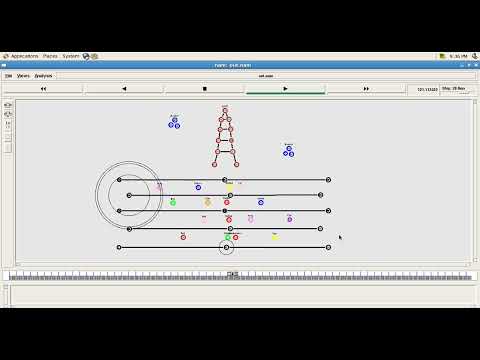
NS2 Simulation
0.0 (0 reviews) • 0 downloads
Hybrid Genetic Firefly Algorithm-Based Routing Protocol for VANETs
र 1000
Hybrid Genetic Firefly Algorithm-Based Routing Protocol for VANETs
Technical Details
Domain : NS2 Simulation
OS : CentOS Linux
Tools : VM Ware Workstation
OS : CentOS Linux
Tools : VM Ware Workstation
Secure Payment
Instant Download
GST Invoice
24/7 Support
About This Product
Hybrid Genetic Firefly Algorithm-Based Routing Protocol for VANETs
Abstract
Vehicular Ad Hoc Networks (VANETs) operate in highly dynamic environments characterized by rapid topology changes, variable link quality, and heterogeneous traffic patterns. Conventional routing protocols often struggle to maintain stable paths and efficient resource utilization under these conditions. This paper presents a Hybrid Genetic Firefly Algorithm-Based Routing Protocol (HGFA-RP) for VANETs, which combines the global search capability of a genetic algorithm with the local attraction and brightness-based optimization of the firefly algorithm. By encoding routing paths as chromosomes and iteratively improving them through selection, crossover, mutation, and firefly-based neighborhood search, the proposed protocol dynamically discovers optimal or near-optimal routes with high reliability and low latency. Simulation results show improvements in packet delivery ratio, route stability, and end-to-end delay compared to traditional and single-heuristic routing methods.
Existing System
Most existing VANET routing protocols, such as AODV, DSR, GPSR, and other position-based or cluster-based methods, rely on deterministic or heuristic path discovery. While simple and fast, these protocols can be inefficient in complex urban settings due to frequent route breakages, high control overhead, and suboptimal path selection. Single-heuristic metaheuristic algorithms—such as using only genetic algorithms or only firefly algorithms—show some improvement but often get trapped in local optima or converge slowly. Moreover, traditional approaches usually consider only limited parameters (distance or hop count), neglecting multi-objective factors like link stability, congestion, and energy consumption. These limitations reduce overall QoS and restrict VANET scalability for safety-critical applications.
Proposed System
The proposed HGFA-RP integrates the exploration strength of genetic algorithms (GA) with the exploitation and attractiveness-based convergence of the firefly algorithm (FA) to form stable, multi-objective optimized routes. Candidate paths are represented as chromosomes, with fitness functions combining metrics such as link quality, node density, velocity similarity, and predicted link duration. The GA phase generates a diverse set of potential routes through selection, crossover, and mutation. Then, the FA phase refines these routes by moving less fit solutions toward brighter (better) ones based on attractiveness and distance, ensuring convergence to high-quality paths. This hybrid mechanism reduces the probability of premature convergence and improves adaptability to network changes. Additional features include predictive re-routing using mobility patterns and cluster-assisted route maintenance to reduce control overhead. The result is a routing protocol that maintains high packet delivery ratio, low end-to-end delay, and superior route stability even under dense urban and high-mobility VANET scenarios.
Abstract
Vehicular Ad Hoc Networks (VANETs) operate in highly dynamic environments characterized by rapid topology changes, variable link quality, and heterogeneous traffic patterns. Conventional routing protocols often struggle to maintain stable paths and efficient resource utilization under these conditions. This paper presents a Hybrid Genetic Firefly Algorithm-Based Routing Protocol (HGFA-RP) for VANETs, which combines the global search capability of a genetic algorithm with the local attraction and brightness-based optimization of the firefly algorithm. By encoding routing paths as chromosomes and iteratively improving them through selection, crossover, mutation, and firefly-based neighborhood search, the proposed protocol dynamically discovers optimal or near-optimal routes with high reliability and low latency. Simulation results show improvements in packet delivery ratio, route stability, and end-to-end delay compared to traditional and single-heuristic routing methods.
Existing System
Most existing VANET routing protocols, such as AODV, DSR, GPSR, and other position-based or cluster-based methods, rely on deterministic or heuristic path discovery. While simple and fast, these protocols can be inefficient in complex urban settings due to frequent route breakages, high control overhead, and suboptimal path selection. Single-heuristic metaheuristic algorithms—such as using only genetic algorithms or only firefly algorithms—show some improvement but often get trapped in local optima or converge slowly. Moreover, traditional approaches usually consider only limited parameters (distance or hop count), neglecting multi-objective factors like link stability, congestion, and energy consumption. These limitations reduce overall QoS and restrict VANET scalability for safety-critical applications.
Proposed System
The proposed HGFA-RP integrates the exploration strength of genetic algorithms (GA) with the exploitation and attractiveness-based convergence of the firefly algorithm (FA) to form stable, multi-objective optimized routes. Candidate paths are represented as chromosomes, with fitness functions combining metrics such as link quality, node density, velocity similarity, and predicted link duration. The GA phase generates a diverse set of potential routes through selection, crossover, and mutation. Then, the FA phase refines these routes by moving less fit solutions toward brighter (better) ones based on attractiveness and distance, ensuring convergence to high-quality paths. This hybrid mechanism reduces the probability of premature convergence and improves adaptability to network changes. Additional features include predictive re-routing using mobility patterns and cluster-assisted route maintenance to reduce control overhead. The result is a routing protocol that maintains high packet delivery ratio, low end-to-end delay, and superior route stability even under dense urban and high-mobility VANET scenarios.
Customer Reviews (0)
No reviews yet. Be the first!
Related Products
⭐ Featured
NS2 Simulation
W-GeoR Weighted Geographical Routing for VANET's Health Monitoring Applications in Urban Traffic Networks
W-GeoR Weighted Geographical Routing for VANET's Health Monitoring Applications in Urban Traffic Networks
र 1000
⭐ Featured
NS2 Simulation
Reliability-Aware Multi-Objective Optimization-Based Routing Protocol for VANET
Reliability-Aware Multi-Objective Optimization-Based Routing Protocol for VANET
र 1000
⭐ Featured

NS2 Simulation
PSEBVC Provably Secure ECC and Biometric Based Authentication Framework Using Smartphone for Vehicular Cloud Environment
PSEBVC Provably Secure ECC and Biometric Based Authentication Framework Using Smartphone for Vehicular Cloud Environment
र 1000
⭐ Featured
NS2 Simulation
Notice of Removal An Improved Equal Hierarchical Cluster-Based Routing Protocol for EH-WSNs to Enhance Balanced Utilization of Harvested Energy
Notice of Removal An Improved Equal Hierarchical Cluster-Based Routing Protocol for EH-WSNs to Enhance Balanced Utilization of Harvested Energy
र 1000