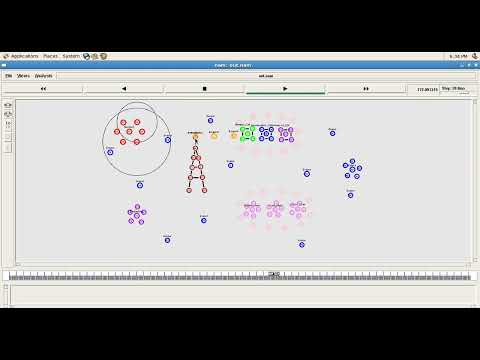
NS2 Simulation
0.0 (0 reviews) • 0 downloads
A Cluster-Based Congestion-Mitigating Access Scheme for Massive M2M Communications in Internet of Things
र 1000
A Cluster-Based Congestion-Mitigating Access Scheme for Massive M2M Communications in Internet of Things
Technical Details
Domain : NS2 Simulation
OS : CentOS Linux
Tools : VM Ware Workstation
OS : CentOS Linux
Tools : VM Ware Workstation
Secure Payment
Instant Download
GST Invoice
24/7 Support
About This Product
A Cluster-Based Congestion-Mitigating Access Scheme for Massive M2M Communications in Internet of Things
Abstract
The exponential growth of machine-to-machine (M2M) communications in the Internet of Things (IoT) has introduced severe congestion and collision problems, particularly in cellular and LPWAN access networks designed originally for human-centric traffic. Massive concurrent device access leads to random access channel (RACH) overload, increased packet loss, and deteriorated quality of service. This paper presents a cluster-based congestion-mitigating access scheme that leverages device clustering and hierarchical access coordination to manage large-scale M2M traffic more effectively. By grouping geographically or functionally related IoT devices into clusters, and appointing cluster heads to coordinate medium access and aggregate traffic, the scheme minimizes contention, reduces signaling overhead, and improves network throughput. The proposed method is evaluated against traditional random access mechanisms and demonstrates superior performance in terms of access delay, successful transmission probability, and fairness across heterogeneous device types.
Existing System
Current IoT access mechanisms primarily rely on random access or contention-based protocols (such as slotted ALOHA, CSMA, or LTE RACH), which work adequately for sparse human-to-human communication but become inefficient under massive M2M scenarios. These systems are characterized by large numbers of devices attempting to access the network simultaneously, often leading to congestion, high collision rates, and repeated retransmissions. Existing enhancements, such as Access Class Barring (ACB), Extended Access Barring (EAB), or dynamic resource allocation, attempt to control access probability but are reactive rather than proactive, often resulting in increased latency and unfair bandwidth allocation. Moreover, these systems lack efficient coordination between devices, and base stations are forced to handle individual connection requests, thereby consuming significant signaling resources. Consequently, the scalability, reliability, and energy efficiency of current access mechanisms remain inadequate for the projected billions of IoT devices.
Proposed System
The proposed scheme introduces a two-tier hierarchical access mechanism. First, IoT devices are grouped into clusters based on spatial proximity, application type, or communication patterns. Each cluster elects or is assigned a Cluster Head (CH), which acts as a local aggregator and coordinator for access requests. The CH schedules device transmissions within its cluster using lightweight time-slotting or contention-free scheduling to minimize intra-cluster collisions. In the second tier, only the CH communicates with the base station or gateway for access requests, significantly reducing the number of simultaneous access attempts and lowering signaling overhead. This approach not only mitigates congestion on the random access channel but also improves energy efficiency for devices by reducing repeated backoffs and retransmissions. Furthermore, dynamic cluster resizing and adaptive access probability adjustment are incorporated to handle varying traffic loads. Simulation results are expected to show improved network throughput, reduced latency, and enhanced fairness compared to conventional random access methods.
Abstract
The exponential growth of machine-to-machine (M2M) communications in the Internet of Things (IoT) has introduced severe congestion and collision problems, particularly in cellular and LPWAN access networks designed originally for human-centric traffic. Massive concurrent device access leads to random access channel (RACH) overload, increased packet loss, and deteriorated quality of service. This paper presents a cluster-based congestion-mitigating access scheme that leverages device clustering and hierarchical access coordination to manage large-scale M2M traffic more effectively. By grouping geographically or functionally related IoT devices into clusters, and appointing cluster heads to coordinate medium access and aggregate traffic, the scheme minimizes contention, reduces signaling overhead, and improves network throughput. The proposed method is evaluated against traditional random access mechanisms and demonstrates superior performance in terms of access delay, successful transmission probability, and fairness across heterogeneous device types.
Existing System
Current IoT access mechanisms primarily rely on random access or contention-based protocols (such as slotted ALOHA, CSMA, or LTE RACH), which work adequately for sparse human-to-human communication but become inefficient under massive M2M scenarios. These systems are characterized by large numbers of devices attempting to access the network simultaneously, often leading to congestion, high collision rates, and repeated retransmissions. Existing enhancements, such as Access Class Barring (ACB), Extended Access Barring (EAB), or dynamic resource allocation, attempt to control access probability but are reactive rather than proactive, often resulting in increased latency and unfair bandwidth allocation. Moreover, these systems lack efficient coordination between devices, and base stations are forced to handle individual connection requests, thereby consuming significant signaling resources. Consequently, the scalability, reliability, and energy efficiency of current access mechanisms remain inadequate for the projected billions of IoT devices.
Proposed System
The proposed scheme introduces a two-tier hierarchical access mechanism. First, IoT devices are grouped into clusters based on spatial proximity, application type, or communication patterns. Each cluster elects or is assigned a Cluster Head (CH), which acts as a local aggregator and coordinator for access requests. The CH schedules device transmissions within its cluster using lightweight time-slotting or contention-free scheduling to minimize intra-cluster collisions. In the second tier, only the CH communicates with the base station or gateway for access requests, significantly reducing the number of simultaneous access attempts and lowering signaling overhead. This approach not only mitigates congestion on the random access channel but also improves energy efficiency for devices by reducing repeated backoffs and retransmissions. Furthermore, dynamic cluster resizing and adaptive access probability adjustment are incorporated to handle varying traffic loads. Simulation results are expected to show improved network throughput, reduced latency, and enhanced fairness compared to conventional random access methods.
Customer Reviews (0)
No reviews yet. Be the first!
Related Products
⭐ Featured
NS2 Simulation
W-GeoR Weighted Geographical Routing for VANET's Health Monitoring Applications in Urban Traffic Networks
W-GeoR Weighted Geographical Routing for VANET's Health Monitoring Applications in Urban Traffic Networks
र 1000
⭐ Featured
NS2 Simulation
Reliability-Aware Multi-Objective Optimization-Based Routing Protocol for VANET
Reliability-Aware Multi-Objective Optimization-Based Routing Protocol for VANET
र 1000
⭐ Featured
NS2 Simulation
PSEBVC Provably Secure ECC and Biometric Based Authentication Framework Using Smartphone for Vehicular Cloud Environment
PSEBVC Provably Secure ECC and Biometric Based Authentication Framework Using Smartphone for Vehicular Cloud Environment
र 1000
⭐ Featured
NS2 Simulation
Notice of Removal An Improved Equal Hierarchical Cluster-Based Routing Protocol for EH-WSNs to Enhance Balanced Utilization of Harvested Energy
Notice of Removal An Improved Equal Hierarchical Cluster-Based Routing Protocol for EH-WSNs to Enhance Balanced Utilization of Harvested Energy
र 1000