AI & ML Models
0.0 (0 reviews) • 0 downloads
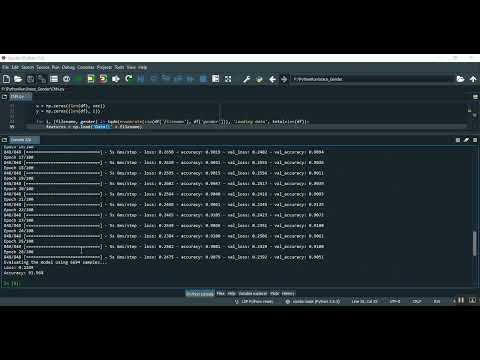
Voice Gender CNN Train Analyses in Python Projects
र 1000
Voice Gender CNN Train Analyses in Python Projects
Technical Details
Domain : Python
Database : Sqlite
Tools : Anaconda
Run Tools: VS Code
Database : Sqlite
Tools : Anaconda
Run Tools: VS Code
Secure Payment
Instant Download
GST Invoice
24/7 Support
About This Product
Voice Gender CNN Train Analyses in Python Projects
Abstract
Voice signals contain distinctive features that can be used to determine a speaker’s gender. This project focuses on Voice Gender Classification using Convolutional Neural Networks (CNN) in Python, which automatically classifies audio recordings as male or female. The system collects voice samples, preprocesses them to remove noise, and converts audio signals into spectrograms or MFCC (Mel Frequency Cepstral Coefficient) representations suitable for CNN input. A CNN model is trained on these features to learn complex patterns distinguishing male and female voices. Python libraries such as TensorFlow/Keras, Librosa, NumPy, and Matplotlib are used for audio processing, model training, and visualization. The project aims to provide an accurate, automated, and scalable solution for gender detection based on voice.
Existing System
Existing gender detection systems rely mainly on manual analysis or traditional machine learning approaches using hand-crafted features such as pitch, energy, and formants. While these methods can achieve moderate accuracy, they often fail to capture complex temporal and spectral patterns present in voice signals. Traditional classifiers like SVM, Random Forest, or K-Nearest Neighbors require extensive feature engineering and may not generalize well to diverse voice datasets. Many existing systems also lack deep learning-based modeling, which limits their performance on large-scale datasets and prevents real-time or highly accurate predictions.
Proposed System
The proposed system implements a CNN-based framework for voice gender classification. Voice recordings are first preprocessed to remove noise, normalized, and converted into spectrograms or MFCC feature maps. These feature maps are fed into a Convolutional Neural Network consisting of convolutional, pooling, and fully connected layers to automatically learn distinguishing patterns between male and female voices. The trained CNN model can then classify new audio samples with high accuracy. Python libraries like TensorFlow/Keras and Librosa are used for audio feature extraction, model training, and evaluation. This deep learning approach eliminates the need for extensive manual feature engineering and provides an automated, accurate, and scalable solution for voice-based gender detection.
Abstract
Voice signals contain distinctive features that can be used to determine a speaker’s gender. This project focuses on Voice Gender Classification using Convolutional Neural Networks (CNN) in Python, which automatically classifies audio recordings as male or female. The system collects voice samples, preprocesses them to remove noise, and converts audio signals into spectrograms or MFCC (Mel Frequency Cepstral Coefficient) representations suitable for CNN input. A CNN model is trained on these features to learn complex patterns distinguishing male and female voices. Python libraries such as TensorFlow/Keras, Librosa, NumPy, and Matplotlib are used for audio processing, model training, and visualization. The project aims to provide an accurate, automated, and scalable solution for gender detection based on voice.
Existing System
Existing gender detection systems rely mainly on manual analysis or traditional machine learning approaches using hand-crafted features such as pitch, energy, and formants. While these methods can achieve moderate accuracy, they often fail to capture complex temporal and spectral patterns present in voice signals. Traditional classifiers like SVM, Random Forest, or K-Nearest Neighbors require extensive feature engineering and may not generalize well to diverse voice datasets. Many existing systems also lack deep learning-based modeling, which limits their performance on large-scale datasets and prevents real-time or highly accurate predictions.
Proposed System
The proposed system implements a CNN-based framework for voice gender classification. Voice recordings are first preprocessed to remove noise, normalized, and converted into spectrograms or MFCC feature maps. These feature maps are fed into a Convolutional Neural Network consisting of convolutional, pooling, and fully connected layers to automatically learn distinguishing patterns between male and female voices. The trained CNN model can then classify new audio samples with high accuracy. Python libraries like TensorFlow/Keras and Librosa are used for audio feature extraction, model training, and evaluation. This deep learning approach eliminates the need for extensive manual feature engineering and provides an automated, accurate, and scalable solution for voice-based gender detection.
Customer Reviews (0)
No reviews yet. Be the first!
Related Products
⭐ Featured

AI & ML Models
Zomato Restaurant Reviews Sentimental Analyzer in Python Projects
Zomato Restaurant Reviews Sentimental Analyzer in Python Projects
र 1000
⭐ Featured
⭐ Featured

AI & ML Models
Voice Disorder Prediction using Audio Dataset in Python Projects
Voice Disorder Prediction using Audio Dataset in Python Projects
र 1000

AI & ML Models
Vitamin Deficiency Detection Using Image Processing in Python Projects
Vitamin Deficiency Detection Using Image Processing in Python Projects
र 1000