Stock Price Prediction using Genetic Algorithm in Python Projects
र 1000
Stock Price Prediction using Genetic Algorithm in Python Projects
Technical Details
Domain : Python
Database : Sqlite
Tools : Anaconda
Run Tools: VS Code
Database : Sqlite
Tools : Anaconda
Run Tools: VS Code
Secure Payment
Instant Download
GST Invoice
24/7 Support
About This Product
Stock Price Prediction using Genetic Algorithm in Python Projects
Abstract
Predicting stock prices is a critical task for investors and financial analysts aiming to make profitable decisions and manage investment risks. Traditional statistical and machine learning models often struggle with the complex, non-linear, and dynamic nature of financial markets. This project focuses on stock price prediction using Genetic Algorithm (GA) in Python, an optimization-based approach inspired by natural selection and evolution. The system applies GA to optimize predictive model parameters, enhancing the accuracy of stock price forecasts. Historical stock data, technical indicators, and market trends are collected, preprocessed, and utilized for model training. Python libraries such as Pandas, NumPy, Matplotlib, and DEAP (Distributed Evolutionary Algorithms in Python) are used for data handling, visualization, and implementation. The project provides an efficient, adaptive, and robust method for forecasting stock prices, supporting informed trading strategies and investment planning.
Existing System
Existing stock price prediction systems primarily use statistical models such as ARIMA, Moving Averages, and regression-based approaches, or machine learning models like Support Vector Machines, Random Forests, and LSTM networks. While these models can capture historical trends and patterns, they often require manual parameter tuning, extensive feature engineering, and may fail to adapt to sudden market fluctuations. Optimization of model parameters is crucial for improving prediction accuracy, but conventional approaches often rely on trial-and-error or grid search methods, which are time-consuming and computationally intensive. As a result, existing systems may provide suboptimal forecasts and cannot fully capture the non-linear behavior of stock markets.
Proposed System
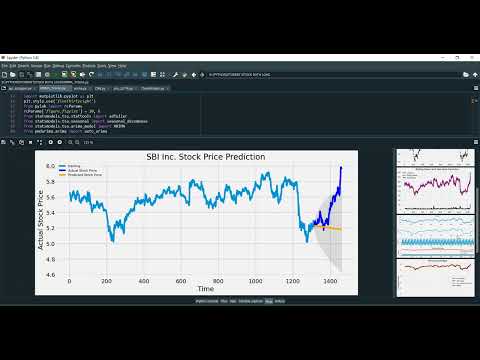
The proposed system employs a Genetic Algorithm (GA) to optimize predictive models for stock price forecasting. Historical stock price data is preprocessed to handle missing values, normalize features, and generate relevant input variables such as moving averages, technical indicators, or market sentiment scores. The GA iteratively evolves candidate solutions, optimizing parameters of prediction models such as linear regression, neural networks, or other machine learning models, using fitness functions based on prediction error metrics like RMSE or MAE. The system evaluates the model performance and selects the best set of parameters for accurate forecasting. Visualizations using Matplotlib or Seaborn display predicted versus actual stock prices, trends, and error analysis. By integrating GA for parameter optimization, the system improves forecast accuracy, adapts to dynamic market conditions, and provides actionable insights for investors and traders. The approach is scalable and can be extended to multiple stocks, indices, or multivariate datasets for comprehensive financial forecasting.
Abstract
Predicting stock prices is a critical task for investors and financial analysts aiming to make profitable decisions and manage investment risks. Traditional statistical and machine learning models often struggle with the complex, non-linear, and dynamic nature of financial markets. This project focuses on stock price prediction using Genetic Algorithm (GA) in Python, an optimization-based approach inspired by natural selection and evolution. The system applies GA to optimize predictive model parameters, enhancing the accuracy of stock price forecasts. Historical stock data, technical indicators, and market trends are collected, preprocessed, and utilized for model training. Python libraries such as Pandas, NumPy, Matplotlib, and DEAP (Distributed Evolutionary Algorithms in Python) are used for data handling, visualization, and implementation. The project provides an efficient, adaptive, and robust method for forecasting stock prices, supporting informed trading strategies and investment planning.
Existing System
Existing stock price prediction systems primarily use statistical models such as ARIMA, Moving Averages, and regression-based approaches, or machine learning models like Support Vector Machines, Random Forests, and LSTM networks. While these models can capture historical trends and patterns, they often require manual parameter tuning, extensive feature engineering, and may fail to adapt to sudden market fluctuations. Optimization of model parameters is crucial for improving prediction accuracy, but conventional approaches often rely on trial-and-error or grid search methods, which are time-consuming and computationally intensive. As a result, existing systems may provide suboptimal forecasts and cannot fully capture the non-linear behavior of stock markets.
Proposed System
The proposed system employs a Genetic Algorithm (GA) to optimize predictive models for stock price forecasting. Historical stock price data is preprocessed to handle missing values, normalize features, and generate relevant input variables such as moving averages, technical indicators, or market sentiment scores. The GA iteratively evolves candidate solutions, optimizing parameters of prediction models such as linear regression, neural networks, or other machine learning models, using fitness functions based on prediction error metrics like RMSE or MAE. The system evaluates the model performance and selects the best set of parameters for accurate forecasting. Visualizations using Matplotlib or Seaborn display predicted versus actual stock prices, trends, and error analysis. By integrating GA for parameter optimization, the system improves forecast accuracy, adapts to dynamic market conditions, and provides actionable insights for investors and traders. The approach is scalable and can be extended to multiple stocks, indices, or multivariate datasets for comprehensive financial forecasting.
Customer Reviews (0)
No reviews yet. Be the first!