
AI & ML Models
0.0 (0 reviews) • 0 downloads
Stock Forecasting CNN LSTM in Python Projects
र 1000
Stock Forecasting CNN LSTM in Python Projects
Technical Details
Domain : Python
Database : Sqlite
Tools : Anaconda
Run Tools: VS Code
Database : Sqlite
Tools : Anaconda
Run Tools: VS Code
Secure Payment
Instant Download
GST Invoice
24/7 Support
About This Product
Stock Forecasting CNN LSTM in Python Projects
Abstract
Stock market forecasting is a critical tool for investors and financial analysts to make informed decisions and optimize returns. Traditional forecasting methods often struggle with the complex, non-linear, and volatile nature of stock prices. This project implements a hybrid CNN-LSTM model in Python for stock price prediction, combining Convolutional Neural Networks (CNN) for feature extraction with Long Short-Term Memory (LSTM) networks for temporal sequence modeling. Historical stock price data, along with market indicators, is used to train the model. Python libraries such as Pandas, NumPy, Matplotlib, TensorFlow/Keras, and Scikit-learn are utilized for data preprocessing, model building, training, and visualization. The project aims to provide accurate and reliable stock price forecasts, assisting traders and financial institutions in strategic decision-making.
Existing System
Existing stock forecasting systems primarily rely on statistical methods like Moving Averages, ARIMA, and linear regression models to predict future prices. While these models are simple and interpretable, they often fail to capture the complex non-linear relationships, temporal dependencies, and sudden fluctuations in stock markets. Some machine learning approaches, such as Support Vector Regression or Random Forests, improve prediction accuracy but struggle with sequential dependencies inherent in time-series data. Moreover, conventional models often require extensive feature engineering and cannot effectively process large datasets with multiple indicators. As a result, existing systems provide limited forecasting performance and are less reliable for high-stakes investment decisions.
Proposed System
The proposed system implements a CNN-LSTM hybrid architecture to forecast stock prices more accurately. Historical stock data is first preprocessed to handle missing values, normalize features, and generate sequences for time-series modeling. The CNN layers extract important features and patterns from sequential data, such as trend fluctuations and market movements, while LSTM layers capture long-term temporal dependencies and sequential correlations. The model is trained using backpropagation with suitable loss functions and evaluated using metrics like Mean Absolute Error (MAE), Root Mean Squared Error (RMSE), and R-squared. Visualization of predicted versus actual stock prices is provided using Matplotlib or Seaborn. By integrating feature extraction and sequence modeling in a single pipeline, the system improves forecasting accuracy, reduces overfitting, and provides traders with actionable insights. The framework is scalable and can be extended to incorporate additional market indicators or multiple stocks for portfolio-level forecasting.
Abstract
Stock market forecasting is a critical tool for investors and financial analysts to make informed decisions and optimize returns. Traditional forecasting methods often struggle with the complex, non-linear, and volatile nature of stock prices. This project implements a hybrid CNN-LSTM model in Python for stock price prediction, combining Convolutional Neural Networks (CNN) for feature extraction with Long Short-Term Memory (LSTM) networks for temporal sequence modeling. Historical stock price data, along with market indicators, is used to train the model. Python libraries such as Pandas, NumPy, Matplotlib, TensorFlow/Keras, and Scikit-learn are utilized for data preprocessing, model building, training, and visualization. The project aims to provide accurate and reliable stock price forecasts, assisting traders and financial institutions in strategic decision-making.
Existing System
Existing stock forecasting systems primarily rely on statistical methods like Moving Averages, ARIMA, and linear regression models to predict future prices. While these models are simple and interpretable, they often fail to capture the complex non-linear relationships, temporal dependencies, and sudden fluctuations in stock markets. Some machine learning approaches, such as Support Vector Regression or Random Forests, improve prediction accuracy but struggle with sequential dependencies inherent in time-series data. Moreover, conventional models often require extensive feature engineering and cannot effectively process large datasets with multiple indicators. As a result, existing systems provide limited forecasting performance and are less reliable for high-stakes investment decisions.
Proposed System
The proposed system implements a CNN-LSTM hybrid architecture to forecast stock prices more accurately. Historical stock data is first preprocessed to handle missing values, normalize features, and generate sequences for time-series modeling. The CNN layers extract important features and patterns from sequential data, such as trend fluctuations and market movements, while LSTM layers capture long-term temporal dependencies and sequential correlations. The model is trained using backpropagation with suitable loss functions and evaluated using metrics like Mean Absolute Error (MAE), Root Mean Squared Error (RMSE), and R-squared. Visualization of predicted versus actual stock prices is provided using Matplotlib or Seaborn. By integrating feature extraction and sequence modeling in a single pipeline, the system improves forecasting accuracy, reduces overfitting, and provides traders with actionable insights. The framework is scalable and can be extended to incorporate additional market indicators or multiple stocks for portfolio-level forecasting.
Customer Reviews (0)
No reviews yet. Be the first!
Related Products
⭐ Featured
AI & ML Models
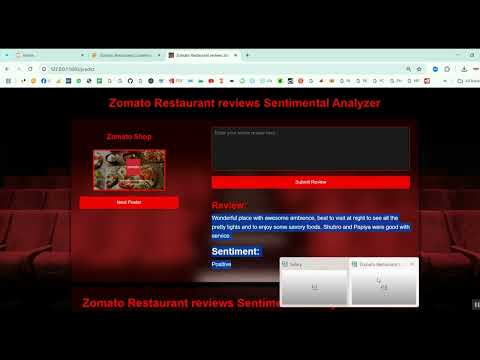
Zomato Restaurant Reviews Sentimental Analyzer in Python Projects
Zomato Restaurant Reviews Sentimental Analyzer in Python Projects
र 1000
⭐ Featured
⭐ Featured
AI & ML Models
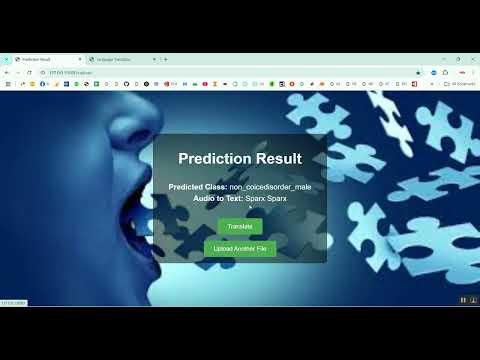
Voice Disorder Prediction using Audio Dataset in Python Projects
Voice Disorder Prediction using Audio Dataset in Python Projects
र 1000

AI & ML Models
Vitamin Deficiency Detection Using Image Processing in Python Projects
Vitamin Deficiency Detection Using Image Processing in Python Projects
र 1000