AI & ML Models
0.0 (0 reviews) • 0 downloads
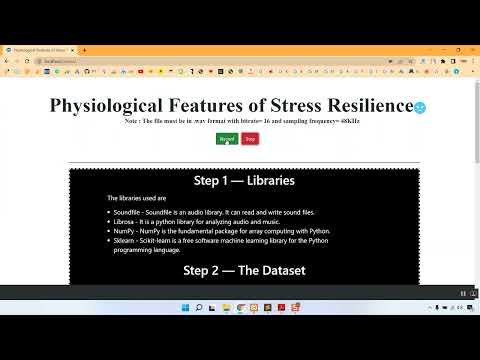
Physiological Features of Stress Resilience in Python Projects
र 1000
Physiological Features of Stress Resilience in Python Projects
Technical Details
Domain : Python
Database : Sqlite
Tools : Anaconda
Run Tools: VS Code
Database : Sqlite
Tools : Anaconda
Run Tools: VS Code
Secure Payment
Instant Download
GST Invoice
24/7 Support
About This Product
Physiological Features of Stress Resilience in Python Projects
Abstract
The Physiological Features of Stress Resilience Project is a Python-based system designed to analyze physiological data to assess and predict an individual’s resilience to stress. Stress resilience refers to the ability to maintain psychological and physical well-being under challenging conditions. This project leverages physiological signals such as heart rate variability (HRV), galvanic skin response (GSR), blood pressure, and EEG patterns to extract meaningful features associated with stress response. Using Python libraries like NumPy, Pandas, SciPy, Scikit-learn, and Matplotlib, the system preprocesses raw physiological data, extracts statistical and spectral features, and trains machine learning models like Support Vector Machines (SVM), Random Forest, or Artificial Neural Networks (ANN) to classify individuals into resilience categories. The system can support mental health monitoring, stress management interventions, and personalized wellness programs.
Existing System
Existing methods for assessing stress resilience largely rely on self-reported questionnaires, surveys, or psychological evaluations, which are subjective, time-consuming, and prone to bias. Some wearable devices collect physiological data, but most systems focus only on single parameters like heart rate or lack comprehensive machine learning analysis. Traditional statistical methods provide limited predictive capability and often fail to capture complex non-linear interactions between multiple physiological signals, reducing the accuracy and applicability of stress resilience assessment in real-world scenarios.
Proposed System
The proposed system integrates multi-modal physiological data to create an intelligent framework for stress resilience prediction. Data preprocessing includes noise removal, normalization, and signal segmentation to ensure reliable feature extraction. Features such as HRV metrics, GSR peaks, EEG band power, and blood pressure variability are extracted to capture individual physiological responses to stress. Machine learning models like SVM, Random Forest, or ANN are trained on labeled datasets to classify subjects into categories such as high resilience, moderate resilience, or low resilience. Python libraries such as Scikit-learn handle model training and validation, Pandas/NumPy manage data manipulation, and Matplotlib/Seaborn visualize patterns and results. This system provides a non-invasive, data-driven approach to monitoring stress resilience, enabling mental health professionals and researchers to identify at-risk individuals, personalize interventions, and improve overall wellness outcomes.
Abstract
The Physiological Features of Stress Resilience Project is a Python-based system designed to analyze physiological data to assess and predict an individual’s resilience to stress. Stress resilience refers to the ability to maintain psychological and physical well-being under challenging conditions. This project leverages physiological signals such as heart rate variability (HRV), galvanic skin response (GSR), blood pressure, and EEG patterns to extract meaningful features associated with stress response. Using Python libraries like NumPy, Pandas, SciPy, Scikit-learn, and Matplotlib, the system preprocesses raw physiological data, extracts statistical and spectral features, and trains machine learning models like Support Vector Machines (SVM), Random Forest, or Artificial Neural Networks (ANN) to classify individuals into resilience categories. The system can support mental health monitoring, stress management interventions, and personalized wellness programs.
Existing System
Existing methods for assessing stress resilience largely rely on self-reported questionnaires, surveys, or psychological evaluations, which are subjective, time-consuming, and prone to bias. Some wearable devices collect physiological data, but most systems focus only on single parameters like heart rate or lack comprehensive machine learning analysis. Traditional statistical methods provide limited predictive capability and often fail to capture complex non-linear interactions between multiple physiological signals, reducing the accuracy and applicability of stress resilience assessment in real-world scenarios.
Proposed System
The proposed system integrates multi-modal physiological data to create an intelligent framework for stress resilience prediction. Data preprocessing includes noise removal, normalization, and signal segmentation to ensure reliable feature extraction. Features such as HRV metrics, GSR peaks, EEG band power, and blood pressure variability are extracted to capture individual physiological responses to stress. Machine learning models like SVM, Random Forest, or ANN are trained on labeled datasets to classify subjects into categories such as high resilience, moderate resilience, or low resilience. Python libraries such as Scikit-learn handle model training and validation, Pandas/NumPy manage data manipulation, and Matplotlib/Seaborn visualize patterns and results. This system provides a non-invasive, data-driven approach to monitoring stress resilience, enabling mental health professionals and researchers to identify at-risk individuals, personalize interventions, and improve overall wellness outcomes.
Customer Reviews (0)
No reviews yet. Be the first!
Related Products
⭐ Featured
AI & ML Models
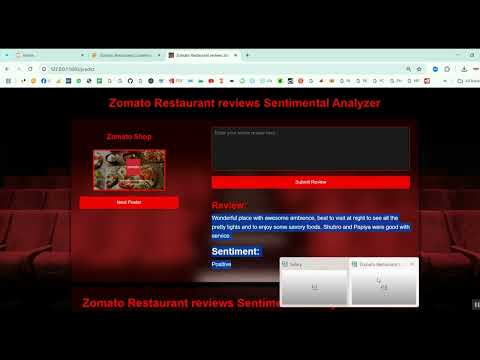
Zomato Restaurant Reviews Sentimental Analyzer in Python Projects
Zomato Restaurant Reviews Sentimental Analyzer in Python Projects
र 1000
⭐ Featured
⭐ Featured

AI & ML Models
Voice Disorder Prediction using Audio Dataset in Python Projects
Voice Disorder Prediction using Audio Dataset in Python Projects
र 1000
AI & ML Models
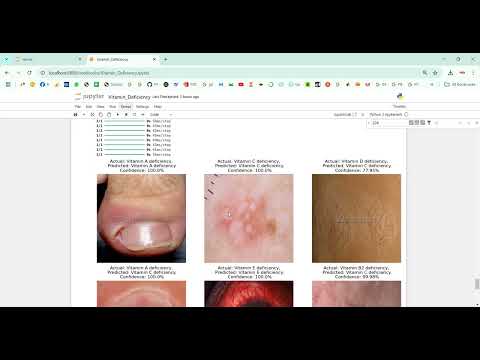
Vitamin Deficiency Detection Using Image Processing in Python Projects
Vitamin Deficiency Detection Using Image Processing in Python Projects
र 1000