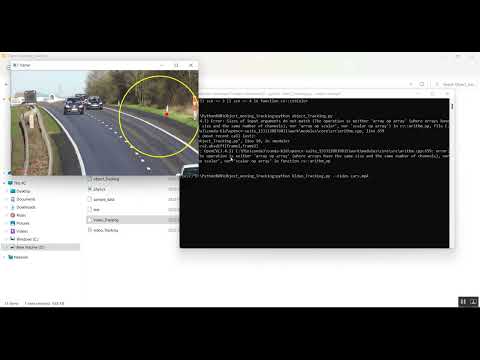
Object Moving Tracking Video Dataset in Python Projects
र 1000
Object Moving Tracking Video Dataset in Python Projects
Technical Details
Domain : Python
Database : Sqlite
Tools : Anaconda
Run Tools: VS Code
Database : Sqlite
Tools : Anaconda
Run Tools: VS Code
Secure Payment
Instant Download
GST Invoice
24/7 Support
About This Product
Object Moving Tracking Video Dataset in Python Projects
Abstract
The Object Moving Tracking Video Dataset Project is a Python-based system designed to detect, track, and analyze the movement of objects in video sequences using computer vision and machine learning. The project leverages motion detection algorithms and object tracking frameworks such as CSRT, KCF, MOSSE, or Deep SORT to monitor moving objects across frames in a video dataset. It enables precise tracking of object trajectories, speed estimation, and pattern recognition. Implemented with OpenCV, NumPy, and optionally TensorFlow for advanced tracking, the system is capable of handling static and dynamic scenes efficiently. This project finds applications in areas like traffic analysis, surveillance, sports analytics, and autonomous systems, where understanding motion and behavior is critical.
Existing System
Traditional object tracking systems mainly rely on manual annotation or simple background subtraction techniques, which struggle with complex environments, occlusion, and lighting variations. Many existing methods cannot maintain continuous tracking when multiple objects appear or when objects overlap. These older approaches often lack integration with pre-trained models or robust motion prediction mechanisms, leading to inaccuracies and unstable performance. As a result, they are less effective in real-world scenarios requiring real-time and multi-object tracking accuracy.
Proposed System
The proposed system introduces a robust tracking mechanism that automatically detects and tracks moving objects from video datasets using a combination of frame differencing, deep learning, and multi-object tracking algorithms. The video frames are processed sequentially, and moving regions are extracted using background subtraction or optical flow methods. These detected regions are then tracked using algorithms such as CSRT, KCF, or Deep SORT, which assign unique IDs to each object and maintain tracking consistency even under partial occlusion. The system calculates trajectory, direction, and speed, providing valuable insights into object motion. Implemented in Python with OpenCV and NumPy, it allows real-time visualization and storage of tracking results for further analysis. This intelligent approach enhances accuracy, speed, and robustness, making it suitable for intelligent video surveillance, transportation systems, and motion behavior analysis.
Abstract
The Object Moving Tracking Video Dataset Project is a Python-based system designed to detect, track, and analyze the movement of objects in video sequences using computer vision and machine learning. The project leverages motion detection algorithms and object tracking frameworks such as CSRT, KCF, MOSSE, or Deep SORT to monitor moving objects across frames in a video dataset. It enables precise tracking of object trajectories, speed estimation, and pattern recognition. Implemented with OpenCV, NumPy, and optionally TensorFlow for advanced tracking, the system is capable of handling static and dynamic scenes efficiently. This project finds applications in areas like traffic analysis, surveillance, sports analytics, and autonomous systems, where understanding motion and behavior is critical.
Existing System
Traditional object tracking systems mainly rely on manual annotation or simple background subtraction techniques, which struggle with complex environments, occlusion, and lighting variations. Many existing methods cannot maintain continuous tracking when multiple objects appear or when objects overlap. These older approaches often lack integration with pre-trained models or robust motion prediction mechanisms, leading to inaccuracies and unstable performance. As a result, they are less effective in real-world scenarios requiring real-time and multi-object tracking accuracy.
Proposed System
The proposed system introduces a robust tracking mechanism that automatically detects and tracks moving objects from video datasets using a combination of frame differencing, deep learning, and multi-object tracking algorithms. The video frames are processed sequentially, and moving regions are extracted using background subtraction or optical flow methods. These detected regions are then tracked using algorithms such as CSRT, KCF, or Deep SORT, which assign unique IDs to each object and maintain tracking consistency even under partial occlusion. The system calculates trajectory, direction, and speed, providing valuable insights into object motion. Implemented in Python with OpenCV and NumPy, it allows real-time visualization and storage of tracking results for further analysis. This intelligent approach enhances accuracy, speed, and robustness, making it suitable for intelligent video surveillance, transportation systems, and motion behavior analysis.
Customer Reviews (0)
No reviews yet. Be the first!