AI & ML Models
0.0 (0 reviews) • 0 downloads
Night Time Vehicle Detection Count Flask in Python Projects
र 1000
Night Time Vehicle Detection Count Flask in Python Projects
Technical Details
Domain : Python
Database : Sqlite
Tools : Anaconda
Run Tools: VS Code
Database : Sqlite
Tools : Anaconda
Run Tools: VS Code
Secure Payment
Instant Download
GST Invoice
24/7 Support
About This Product
Night Time Vehicle Detection Count Flask in Python Projects
Abstract
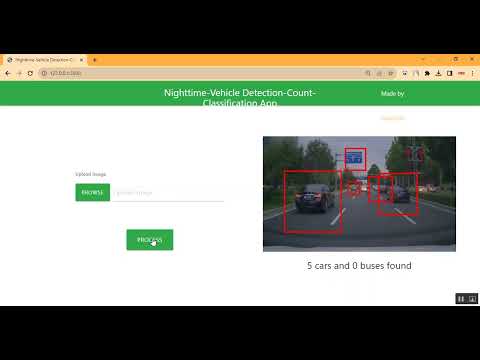
The Night Time Vehicle Detection Count Project is a Python-based system designed to detect and count vehicles in low-light or nighttime conditions using computer vision and deep learning techniques. The system leverages Convolutional Neural Networks (CNNs) or YOLO (You Only Look Once) object detection models to accurately identify vehicles in video streams or images captured at night. Implemented with Python and deployed via the Flask web framework, the system provides a user-friendly interface to upload videos or connect live camera feeds and receive real-time vehicle counts. Libraries such as OpenCV, TensorFlow/Keras, NumPy, and Pandas are used for image preprocessing, model training, detection, and data management. This project is highly applicable in traffic monitoring, smart city management, and road safety analytics, providing automated insights into vehicle flow during nighttime.
Existing System
Existing vehicle detection systems typically focus on daytime conditions with sufficient lighting and often fail in low-light or nighttime scenarios. Traditional methods rely on background subtraction, optical flow, or manual inspection, which are less effective under poor illumination and can result in inaccurate counts. Many conventional systems also lack real-time processing capabilities, limiting their practical use in traffic management or urban surveillance during nighttime. These limitations reduce detection accuracy, especially in scenarios with multiple vehicles, shadows, or headlight glare.
Proposed System
The proposed Night Time Vehicle Detection Count system integrates advanced computer vision techniques and deep learning to achieve accurate vehicle detection under low-light conditions. Video frames are first preprocessed using histogram equalization, noise reduction, and contrast enhancement to improve visibility. The frames are then passed through a trained CNN or YOLO model to detect vehicles in real-time, and a counting algorithm tracks the number of vehicles across frames. The system also filters duplicate detections to avoid overcounting. Implemented with Python, OpenCV handles video and image processing, TensorFlow/Keras manages deep learning model training, and Flask provides an interactive web interface for video upload and visualization of vehicle counts. By combining low-light preprocessing with deep learning detection and web deployment, this system delivers accurate, automated, and real-time vehicle monitoring suitable for smart city applications, traffic analysis, and road safety management.
Abstract
The Night Time Vehicle Detection Count Project is a Python-based system designed to detect and count vehicles in low-light or nighttime conditions using computer vision and deep learning techniques. The system leverages Convolutional Neural Networks (CNNs) or YOLO (You Only Look Once) object detection models to accurately identify vehicles in video streams or images captured at night. Implemented with Python and deployed via the Flask web framework, the system provides a user-friendly interface to upload videos or connect live camera feeds and receive real-time vehicle counts. Libraries such as OpenCV, TensorFlow/Keras, NumPy, and Pandas are used for image preprocessing, model training, detection, and data management. This project is highly applicable in traffic monitoring, smart city management, and road safety analytics, providing automated insights into vehicle flow during nighttime.
Existing System
Existing vehicle detection systems typically focus on daytime conditions with sufficient lighting and often fail in low-light or nighttime scenarios. Traditional methods rely on background subtraction, optical flow, or manual inspection, which are less effective under poor illumination and can result in inaccurate counts. Many conventional systems also lack real-time processing capabilities, limiting their practical use in traffic management or urban surveillance during nighttime. These limitations reduce detection accuracy, especially in scenarios with multiple vehicles, shadows, or headlight glare.
Proposed System
The proposed Night Time Vehicle Detection Count system integrates advanced computer vision techniques and deep learning to achieve accurate vehicle detection under low-light conditions. Video frames are first preprocessed using histogram equalization, noise reduction, and contrast enhancement to improve visibility. The frames are then passed through a trained CNN or YOLO model to detect vehicles in real-time, and a counting algorithm tracks the number of vehicles across frames. The system also filters duplicate detections to avoid overcounting. Implemented with Python, OpenCV handles video and image processing, TensorFlow/Keras manages deep learning model training, and Flask provides an interactive web interface for video upload and visualization of vehicle counts. By combining low-light preprocessing with deep learning detection and web deployment, this system delivers accurate, automated, and real-time vehicle monitoring suitable for smart city applications, traffic analysis, and road safety management.
Customer Reviews (0)
No reviews yet. Be the first!
Related Products
⭐ Featured

AI & ML Models
Zomato Restaurant Reviews Sentimental Analyzer in Python Projects
Zomato Restaurant Reviews Sentimental Analyzer in Python Projects
र 1000
⭐ Featured
⭐ Featured

AI & ML Models
Voice Disorder Prediction using Audio Dataset in Python Projects
Voice Disorder Prediction using Audio Dataset in Python Projects
र 1000

AI & ML Models
Vitamin Deficiency Detection Using Image Processing in Python Projects
Vitamin Deficiency Detection Using Image Processing in Python Projects
र 1000