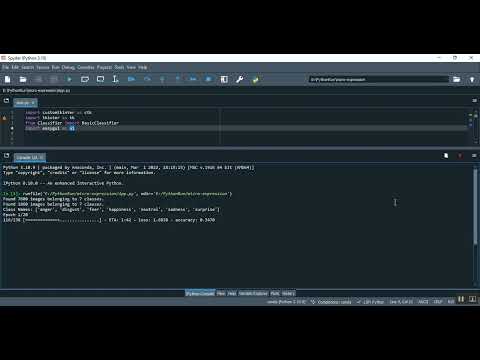
AI & ML Models
0.0 (0 reviews) • 0 downloads
Micro Expression Detection in Python Projects
र 1000
Micro Expression Detection in Python Projects
Technical Details
Domain : Python
Database : Sqlite
Tools : Anaconda
Run Tools: VS Code
Database : Sqlite
Tools : Anaconda
Run Tools: VS Code
Secure Payment
Instant Download
GST Invoice
24/7 Support
About This Product
Micro Expression Detection in Python Projects
Abstract
The Micro Expression Detection Project is a computer vision and machine learning-based system developed in Python to automatically detect subtle and brief facial expressions that reveal genuine human emotions. Micro-expressions are involuntary and often last only a fraction of a second, making them difficult to identify manually. This project leverages Convolutional Neural Networks (CNN) or other deep learning architectures to analyze facial features, capture temporal variations, and classify micro-expressions into categories such as happiness, sadness, anger, fear, surprise, or disgust. Implemented using Python libraries such as OpenCV, TensorFlow, Keras, and NumPy, the system provides accurate detection of micro-expressions from video or image datasets. It has applications in psychology, security, human-computer interaction, and behavioral analysis, providing a tool to understand subtle emotional cues efficiently.
Existing System
Existing facial expression recognition systems mainly focus on macro-expressions, which are larger, obvious, and voluntary facial movements. Traditional methods using basic image processing, feature extraction, or statistical analysis often fail to detect the subtle and rapid changes in micro-expressions. Manual detection of micro-expressions is time-consuming, requires expert knowledge, and is prone to human error. Additionally, most conventional systems do not integrate temporal analysis, which is crucial for capturing expressions that last only milliseconds, resulting in limited accuracy and applicability in real-world scenarios.
Proposed System
The proposed Micro Expression Detection system utilizes a combination of image preprocessing, feature extraction, and deep learning for automatic detection. Video frames or images are first preprocessed using techniques like grayscale conversion, normalization, and facial landmark detection to focus on key facial regions. A CNN or hybrid CNN-LSTM architecture is then employed to extract spatial and temporal features, enabling the model to capture subtle muscular movements associated with micro-expressions. The system classifies each micro-expression into predefined categories and can display results in real time. Python libraries such as OpenCV handle video and image processing, TensorFlow/Keras manage model training and inference, and NumPy/Pandas assist in numerical operations. This approach provides a high-accuracy, automated, and scalable solution for micro-expression analysis, useful in research, security surveillance, and human behavior studies.
Abstract
The Micro Expression Detection Project is a computer vision and machine learning-based system developed in Python to automatically detect subtle and brief facial expressions that reveal genuine human emotions. Micro-expressions are involuntary and often last only a fraction of a second, making them difficult to identify manually. This project leverages Convolutional Neural Networks (CNN) or other deep learning architectures to analyze facial features, capture temporal variations, and classify micro-expressions into categories such as happiness, sadness, anger, fear, surprise, or disgust. Implemented using Python libraries such as OpenCV, TensorFlow, Keras, and NumPy, the system provides accurate detection of micro-expressions from video or image datasets. It has applications in psychology, security, human-computer interaction, and behavioral analysis, providing a tool to understand subtle emotional cues efficiently.
Existing System
Existing facial expression recognition systems mainly focus on macro-expressions, which are larger, obvious, and voluntary facial movements. Traditional methods using basic image processing, feature extraction, or statistical analysis often fail to detect the subtle and rapid changes in micro-expressions. Manual detection of micro-expressions is time-consuming, requires expert knowledge, and is prone to human error. Additionally, most conventional systems do not integrate temporal analysis, which is crucial for capturing expressions that last only milliseconds, resulting in limited accuracy and applicability in real-world scenarios.
Proposed System
The proposed Micro Expression Detection system utilizes a combination of image preprocessing, feature extraction, and deep learning for automatic detection. Video frames or images are first preprocessed using techniques like grayscale conversion, normalization, and facial landmark detection to focus on key facial regions. A CNN or hybrid CNN-LSTM architecture is then employed to extract spatial and temporal features, enabling the model to capture subtle muscular movements associated with micro-expressions. The system classifies each micro-expression into predefined categories and can display results in real time. Python libraries such as OpenCV handle video and image processing, TensorFlow/Keras manage model training and inference, and NumPy/Pandas assist in numerical operations. This approach provides a high-accuracy, automated, and scalable solution for micro-expression analysis, useful in research, security surveillance, and human behavior studies.
Customer Reviews (0)
No reviews yet. Be the first!
Related Products
⭐ Featured

AI & ML Models
Zomato Restaurant Reviews Sentimental Analyzer in Python Projects
Zomato Restaurant Reviews Sentimental Analyzer in Python Projects
र 1000
⭐ Featured
⭐ Featured

AI & ML Models
Voice Disorder Prediction using Audio Dataset in Python Projects
Voice Disorder Prediction using Audio Dataset in Python Projects
र 1000

AI & ML Models
Vitamin Deficiency Detection Using Image Processing in Python Projects
Vitamin Deficiency Detection Using Image Processing in Python Projects
र 1000