AI & ML Models
0.0 (0 reviews) • 0 downloads
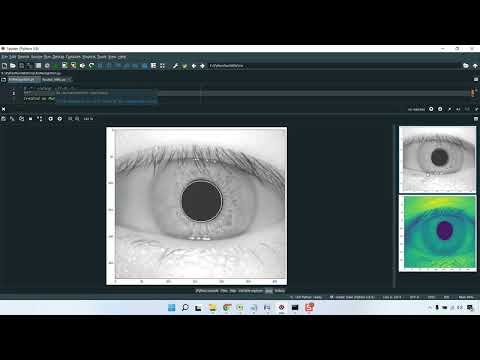
IRIS Recognition Training Image RetNet MMU in Python Projects
र 1000
IRIS Recognition Training Image RetNet MMU in Python Projects
Technical Details
Domain : Python
Database : Sqlite
Tools : Anaconda
Run Tools: VS Code
Database : Sqlite
Tools : Anaconda
Run Tools: VS Code
Secure Payment
Instant Download
GST Invoice
24/7 Support
About This Product
IRIS Recognition Training Image RetNet MMU in Python Projects
Abstract
Iris recognition is a powerful and reliable biometric authentication technique that leverages unique texture patterns within the human iris for identity verification. The project titled “Iris Recognition Training Image RetNet MMU in Python” focuses on implementing a robust deep learning model using the RetNet (Residual Network) architecture trained on the MMU (Multimedia University) iris image dataset. This system automates the process of feature extraction, classification, and recognition of iris patterns with high accuracy. By utilizing convolutional residual blocks, the RetNet model effectively mitigates the vanishing gradient problem and enhances feature learning. The entire pipeline, built in Python using frameworks such as TensorFlow, Keras, and OpenCV, integrates preprocessing (segmentation, normalization, noise reduction) with deep feature learning. The outcome is a highly accurate, efficient, and scalable iris recognition system suitable for secure biometric authentication and identity verification applications.
Existing System
Traditional iris recognition systems rely on classical machine learning and image processing techniques like Gabor filters, Daugman’s rubber sheet model, and SVM-based classifiers. Although effective in controlled environments, these methods struggle with illumination variations, occlusions, and rotation in real-world conditions. Moreover, handcrafted feature extraction limits adaptability and generalization to large, diverse datasets like MMU. Existing CNN models often suffer from overfitting or reduced gradient flow, leading to suboptimal convergence and reduced recognition accuracy. Hence, there is a need for a deep residual-based learning framework that can capture complex iris patterns with enhanced precision.
Proposed System
The proposed system employs RetNet (Residual Network) architecture to perform end-to-end iris recognition on the MMU iris dataset. The process begins with image preprocessing, including grayscale conversion, circular Hough transform for iris localization, and Daugman’s normalization for unwrapping the iris into a rectangular form. Then, the RetNet model extracts deep hierarchical features by stacking residual learning blocks, which help retain spatial information and reduce the risk of vanishing gradients. The extracted features are trained and validated using the MMU dataset to classify iris patterns corresponding to individual identities. The system is implemented in Python using libraries such as TensorFlow, Keras, NumPy, and OpenCV. This model delivers enhanced recognition accuracy, faster convergence, and higher resilience to noise, illumination, and scale variations. The resulting framework can be integrated into secure applications like biometric attendance systems, access control, and national identity verification platforms.
Abstract
Iris recognition is a powerful and reliable biometric authentication technique that leverages unique texture patterns within the human iris for identity verification. The project titled “Iris Recognition Training Image RetNet MMU in Python” focuses on implementing a robust deep learning model using the RetNet (Residual Network) architecture trained on the MMU (Multimedia University) iris image dataset. This system automates the process of feature extraction, classification, and recognition of iris patterns with high accuracy. By utilizing convolutional residual blocks, the RetNet model effectively mitigates the vanishing gradient problem and enhances feature learning. The entire pipeline, built in Python using frameworks such as TensorFlow, Keras, and OpenCV, integrates preprocessing (segmentation, normalization, noise reduction) with deep feature learning. The outcome is a highly accurate, efficient, and scalable iris recognition system suitable for secure biometric authentication and identity verification applications.
Existing System
Traditional iris recognition systems rely on classical machine learning and image processing techniques like Gabor filters, Daugman’s rubber sheet model, and SVM-based classifiers. Although effective in controlled environments, these methods struggle with illumination variations, occlusions, and rotation in real-world conditions. Moreover, handcrafted feature extraction limits adaptability and generalization to large, diverse datasets like MMU. Existing CNN models often suffer from overfitting or reduced gradient flow, leading to suboptimal convergence and reduced recognition accuracy. Hence, there is a need for a deep residual-based learning framework that can capture complex iris patterns with enhanced precision.
Proposed System
The proposed system employs RetNet (Residual Network) architecture to perform end-to-end iris recognition on the MMU iris dataset. The process begins with image preprocessing, including grayscale conversion, circular Hough transform for iris localization, and Daugman’s normalization for unwrapping the iris into a rectangular form. Then, the RetNet model extracts deep hierarchical features by stacking residual learning blocks, which help retain spatial information and reduce the risk of vanishing gradients. The extracted features are trained and validated using the MMU dataset to classify iris patterns corresponding to individual identities. The system is implemented in Python using libraries such as TensorFlow, Keras, NumPy, and OpenCV. This model delivers enhanced recognition accuracy, faster convergence, and higher resilience to noise, illumination, and scale variations. The resulting framework can be integrated into secure applications like biometric attendance systems, access control, and national identity verification platforms.
Customer Reviews (0)
No reviews yet. Be the first!
Related Products
⭐ Featured

AI & ML Models
Zomato Restaurant Reviews Sentimental Analyzer in Python Projects
Zomato Restaurant Reviews Sentimental Analyzer in Python Projects
र 1000
⭐ Featured
⭐ Featured

AI & ML Models
Voice Disorder Prediction using Audio Dataset in Python Projects
Voice Disorder Prediction using Audio Dataset in Python Projects
र 1000

AI & ML Models
Vitamin Deficiency Detection Using Image Processing in Python Projects
Vitamin Deficiency Detection Using Image Processing in Python Projects
र 1000