AI & ML Models
0.0 (0 reviews) • 0 downloads
IRIS Motion Blur Normalization in Python Projects
र 1000
IRIS Motion Blur Normalization in Python Projects
Technical Details
Domain : Python
Database : Sqlite
Tools : Anaconda
Run Tools: VS Code
Database : Sqlite
Tools : Anaconda
Run Tools: VS Code
Secure Payment
Instant Download
GST Invoice
24/7 Support
About This Product
IRIS Motion Blur Normalization in Python Projects
Abstract
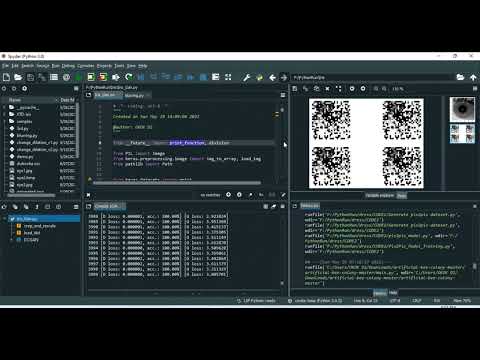
Biometric identification systems rely heavily on the quality of captured images, and iris recognition is one of the most reliable methods for secure identity verification. However, motion blur caused by user movement or camera instability significantly reduces recognition accuracy. This project presents a Python-based Iris Motion Blur Normalization System that enhances iris image quality by detecting and correcting motion blur before feature extraction. The system uses image processing and deep learning techniques to estimate the blur kernel, restore image sharpness, and normalize intensity variations. Implemented with Python libraries such as OpenCV, NumPy, TensorFlow/Keras, and Scikit-image, the proposed approach improves iris image clarity, leading to higher recognition accuracy and robustness in real-time biometric authentication applications.
Existing System
Traditional iris recognition systems depend on high-quality, static images and perform poorly when images are captured in motion or under suboptimal lighting conditions. Existing systems often fail to handle motion-induced distortions, resulting in degraded segmentation and feature extraction accuracy. Many conventional image restoration methods use simple deblurring filters that do not adapt to dynamic motion, and they are computationally intensive for real-time applications. Consequently, the accuracy of iris-based authentication systems drops significantly in real-world environments where image blur is common.
Proposed System
The proposed system introduces a motion blur normalization framework that enhances iris images through advanced image restoration and normalization techniques. The input iris image is first preprocessed to detect the presence and direction of motion blur using edge gradient analysis and blur kernel estimation. A deep learning–based deblurring model or Wiener filtering technique is then applied to reconstruct a sharp version of the image. The normalized image undergoes contrast enhancement, illumination correction, and noise reduction to prepare it for segmentation and feature extraction. Python libraries such as OpenCV and Scikit-image handle image processing and transformation, while TensorFlow/Keras can be used for training deblurring neural networks on blurred and sharp image pairs. The system significantly improves image quality, enabling accurate iris recognition even in motion-prone or low-quality capture conditions. This approach enhances both the reliability and adaptability of biometric systems in real-time security applications such as surveillance, access control, and identity verification.
Abstract
Biometric identification systems rely heavily on the quality of captured images, and iris recognition is one of the most reliable methods for secure identity verification. However, motion blur caused by user movement or camera instability significantly reduces recognition accuracy. This project presents a Python-based Iris Motion Blur Normalization System that enhances iris image quality by detecting and correcting motion blur before feature extraction. The system uses image processing and deep learning techniques to estimate the blur kernel, restore image sharpness, and normalize intensity variations. Implemented with Python libraries such as OpenCV, NumPy, TensorFlow/Keras, and Scikit-image, the proposed approach improves iris image clarity, leading to higher recognition accuracy and robustness in real-time biometric authentication applications.
Existing System
Traditional iris recognition systems depend on high-quality, static images and perform poorly when images are captured in motion or under suboptimal lighting conditions. Existing systems often fail to handle motion-induced distortions, resulting in degraded segmentation and feature extraction accuracy. Many conventional image restoration methods use simple deblurring filters that do not adapt to dynamic motion, and they are computationally intensive for real-time applications. Consequently, the accuracy of iris-based authentication systems drops significantly in real-world environments where image blur is common.
Proposed System
The proposed system introduces a motion blur normalization framework that enhances iris images through advanced image restoration and normalization techniques. The input iris image is first preprocessed to detect the presence and direction of motion blur using edge gradient analysis and blur kernel estimation. A deep learning–based deblurring model or Wiener filtering technique is then applied to reconstruct a sharp version of the image. The normalized image undergoes contrast enhancement, illumination correction, and noise reduction to prepare it for segmentation and feature extraction. Python libraries such as OpenCV and Scikit-image handle image processing and transformation, while TensorFlow/Keras can be used for training deblurring neural networks on blurred and sharp image pairs. The system significantly improves image quality, enabling accurate iris recognition even in motion-prone or low-quality capture conditions. This approach enhances both the reliability and adaptability of biometric systems in real-time security applications such as surveillance, access control, and identity verification.
Customer Reviews (0)
No reviews yet. Be the first!
Related Products
⭐ Featured

AI & ML Models
Zomato Restaurant Reviews Sentimental Analyzer in Python Projects
Zomato Restaurant Reviews Sentimental Analyzer in Python Projects
र 1000
⭐ Featured
⭐ Featured

AI & ML Models
Voice Disorder Prediction using Audio Dataset in Python Projects
Voice Disorder Prediction using Audio Dataset in Python Projects
र 1000

AI & ML Models
Vitamin Deficiency Detection Using Image Processing in Python Projects
Vitamin Deficiency Detection Using Image Processing in Python Projects
र 1000