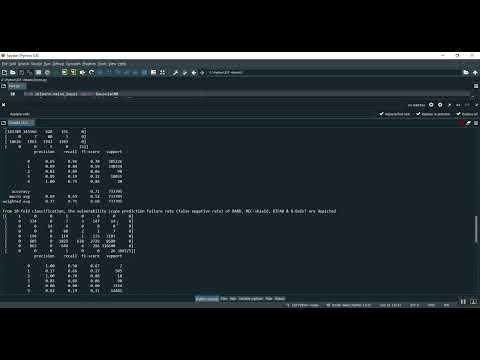
AI & ML Models
0.0 (0 reviews) • 0 downloads
IOT Attack Dos Prediction in Python Projects
र 1000
IOT Attack Dos Prediction in Python Projects
Technical Details
Domain : Python
Database : Sqlite
Tools : Anaconda
Run Tools: VS Code
Database : Sqlite
Tools : Anaconda
Run Tools: VS Code
Secure Payment
Instant Download
GST Invoice
24/7 Support
About This Product
IOT Attack Dos Prediction in Python Projects
Abstract
The rapid growth of Internet of Things (IoT) deployments has introduced a wide attack surface for cyber threats, with Denial-of-Service (DoS) attacks posing a major risk to device availability and service continuity. This project focuses on developing a Python-based IoT DoS Attack Prediction system that leverages machine learning to predict and detect DoS attacks against IoT networks. By collecting network telemetry, device logs, and flow-level features from IoT gateways and sensors, the system trains predictive models that identify abnormal traffic patterns and early indicators of volumetric or application-layer DoS activity. Implemented using Python libraries such as Pandas, NumPy, Scikit-learn, and TensorFlow/Keras, the solution aims to provide fast, automated detection and prediction to help operators mitigate attacks before they cause widespread disruption.
Existing System
Current protections for IoT devices often depend on static firewalls, simple threshold-based alarms, or signature-based intrusion detection systems that are effective only against known attack patterns. Many existing approaches struggle with the high variability of IoT traffic, device heterogeneity, and constrained device resources, resulting in delayed detection, high false-positive rates, and poor adaptation to novel DoS strategies such as low-and-slow or distributed amplification attacks. Additionally, centralized processing of raw telemetry is frequently impractical due to bandwidth and privacy constraints, and legacy systems lack mechanisms for early prediction or automated response tailored to IoT ecosystems.
Proposed System
The proposed system implements a Python-based pipeline for IoT DoS prediction that combines robust feature engineering, temporal modeling, and deployable inference for edge or gateway-level monitoring. Telemetry (packet/flow statistics, connection rates, protocol usage, and resource metrics) is preprocessed with normalization, aggregation into time windows, and handling of missing or noisy values. Feature selection and imbalance remedies (SMOTE/class-weighting) improve model learning, while models such as Random Forests, Gradient Boosting, and sequence models (LSTM/CNN-LSTM) capture both instantaneous and temporal attack signatures. The trained model is exposed via a lightweight inference service (edge daemon or REST endpoint) to generate early-warning scores and trigger automated mitigation (rate-limiting, blacklisting, or alerting). Evaluation uses precision/recall/F1, ROC/AUC, and time-to-detection metrics to tune thresholds for operational trade-offs. Implemented with Pandas, Scikit-learn, Imbalanced-learn, and TensorFlow/Keras, and optionally containerized for gateway deployment, the system delivers an adaptive, scalable, and practical solution to predict and mitigate DoS attacks in IoT environments.
Abstract
The rapid growth of Internet of Things (IoT) deployments has introduced a wide attack surface for cyber threats, with Denial-of-Service (DoS) attacks posing a major risk to device availability and service continuity. This project focuses on developing a Python-based IoT DoS Attack Prediction system that leverages machine learning to predict and detect DoS attacks against IoT networks. By collecting network telemetry, device logs, and flow-level features from IoT gateways and sensors, the system trains predictive models that identify abnormal traffic patterns and early indicators of volumetric or application-layer DoS activity. Implemented using Python libraries such as Pandas, NumPy, Scikit-learn, and TensorFlow/Keras, the solution aims to provide fast, automated detection and prediction to help operators mitigate attacks before they cause widespread disruption.
Existing System
Current protections for IoT devices often depend on static firewalls, simple threshold-based alarms, or signature-based intrusion detection systems that are effective only against known attack patterns. Many existing approaches struggle with the high variability of IoT traffic, device heterogeneity, and constrained device resources, resulting in delayed detection, high false-positive rates, and poor adaptation to novel DoS strategies such as low-and-slow or distributed amplification attacks. Additionally, centralized processing of raw telemetry is frequently impractical due to bandwidth and privacy constraints, and legacy systems lack mechanisms for early prediction or automated response tailored to IoT ecosystems.
Proposed System
The proposed system implements a Python-based pipeline for IoT DoS prediction that combines robust feature engineering, temporal modeling, and deployable inference for edge or gateway-level monitoring. Telemetry (packet/flow statistics, connection rates, protocol usage, and resource metrics) is preprocessed with normalization, aggregation into time windows, and handling of missing or noisy values. Feature selection and imbalance remedies (SMOTE/class-weighting) improve model learning, while models such as Random Forests, Gradient Boosting, and sequence models (LSTM/CNN-LSTM) capture both instantaneous and temporal attack signatures. The trained model is exposed via a lightweight inference service (edge daemon or REST endpoint) to generate early-warning scores and trigger automated mitigation (rate-limiting, blacklisting, or alerting). Evaluation uses precision/recall/F1, ROC/AUC, and time-to-detection metrics to tune thresholds for operational trade-offs. Implemented with Pandas, Scikit-learn, Imbalanced-learn, and TensorFlow/Keras, and optionally containerized for gateway deployment, the system delivers an adaptive, scalable, and practical solution to predict and mitigate DoS attacks in IoT environments.
Customer Reviews (0)
No reviews yet. Be the first!
Related Products
⭐ Featured
AI & ML Models
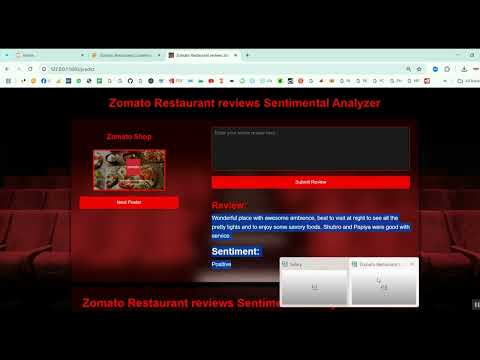
Zomato Restaurant Reviews Sentimental Analyzer in Python Projects
Zomato Restaurant Reviews Sentimental Analyzer in Python Projects
र 1000
⭐ Featured
⭐ Featured

AI & ML Models
Voice Disorder Prediction using Audio Dataset in Python Projects
Voice Disorder Prediction using Audio Dataset in Python Projects
र 1000

AI & ML Models
Vitamin Deficiency Detection Using Image Processing in Python Projects
Vitamin Deficiency Detection Using Image Processing in Python Projects
र 1000