AI & ML Models
0.0 (0 reviews) • 0 downloads
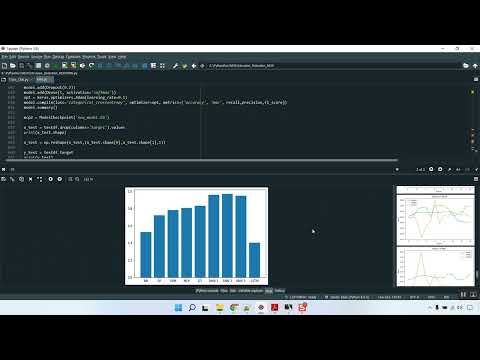
Intrusion Detection Train CNN in Python Projects
र 1000
Intrusion Detection Train CNN in Python Projects
Technical Details
Domain : Python
Database : Sqlite
Tools : Anaconda
Run Tools: VS Code
Database : Sqlite
Tools : Anaconda
Run Tools: VS Code
Secure Payment
Instant Download
GST Invoice
24/7 Support
About This Product
Intrusion Detection Train CNN in Python Projects
Abstract
Intrusion detection plays a vital role in safeguarding computer networks from malicious activities and unauthorized access. This project presents a Python-based Intrusion Detection System (IDS) using Convolutional Neural Networks (CNN) to classify and detect network intrusions efficiently. The system processes network traffic data to identify abnormal patterns representing potential threats, such as Denial of Service (DoS), probe, and user-to-root attacks. Implemented with Python libraries such as TensorFlow, Keras, NumPy, and Pandas, the CNN model learns intricate patterns in network data and performs multi-class classification with high precision. The system provides an intelligent and automated solution that enhances the accuracy and speed of detecting cyberattacks in real-time environments.
Existing System
The existing intrusion detection systems largely rely on signature-based or rule-based approaches, which are limited to recognizing previously known attack patterns. These systems often struggle to identify zero-day or evolving cyber threats. Even traditional machine learning models require manual feature extraction and may not efficiently capture complex, non-linear relationships within network data. As a result, current systems experience reduced accuracy, slow processing, and high false alarm rates, making them less effective in dynamic and large-scale network infrastructures.
Proposed System
The proposed system introduces a deep learning–based IDS that leverages Convolutional Neural Networks (CNN) for automated feature extraction and classification of network intrusions. Network datasets such as NSL-KDD, CICIDS2017, or UNSW-NB15 are used for training and testing. The data undergoes preprocessing steps including normalization, encoding of categorical variables, and reshaping into CNN-compatible formats. The CNN model consists of convolutional layers, pooling layers, and fully connected layers designed to capture both local and global data dependencies. Libraries such as TensorFlow and Keras are used to build and train the model, while Pandas and NumPy manage data operations. The trained model predicts whether incoming traffic is normal or malicious with high accuracy and low false-positive rates. The system can be extended for real-time detection and integrated into security management platforms to provide automated monitoring and alerts. This CNN-based IDS offers scalability, adaptability, and improved security performance compared to traditional intrusion detection techniques.
Abstract
Intrusion detection plays a vital role in safeguarding computer networks from malicious activities and unauthorized access. This project presents a Python-based Intrusion Detection System (IDS) using Convolutional Neural Networks (CNN) to classify and detect network intrusions efficiently. The system processes network traffic data to identify abnormal patterns representing potential threats, such as Denial of Service (DoS), probe, and user-to-root attacks. Implemented with Python libraries such as TensorFlow, Keras, NumPy, and Pandas, the CNN model learns intricate patterns in network data and performs multi-class classification with high precision. The system provides an intelligent and automated solution that enhances the accuracy and speed of detecting cyberattacks in real-time environments.
Existing System
The existing intrusion detection systems largely rely on signature-based or rule-based approaches, which are limited to recognizing previously known attack patterns. These systems often struggle to identify zero-day or evolving cyber threats. Even traditional machine learning models require manual feature extraction and may not efficiently capture complex, non-linear relationships within network data. As a result, current systems experience reduced accuracy, slow processing, and high false alarm rates, making them less effective in dynamic and large-scale network infrastructures.
Proposed System
The proposed system introduces a deep learning–based IDS that leverages Convolutional Neural Networks (CNN) for automated feature extraction and classification of network intrusions. Network datasets such as NSL-KDD, CICIDS2017, or UNSW-NB15 are used for training and testing. The data undergoes preprocessing steps including normalization, encoding of categorical variables, and reshaping into CNN-compatible formats. The CNN model consists of convolutional layers, pooling layers, and fully connected layers designed to capture both local and global data dependencies. Libraries such as TensorFlow and Keras are used to build and train the model, while Pandas and NumPy manage data operations. The trained model predicts whether incoming traffic is normal or malicious with high accuracy and low false-positive rates. The system can be extended for real-time detection and integrated into security management platforms to provide automated monitoring and alerts. This CNN-based IDS offers scalability, adaptability, and improved security performance compared to traditional intrusion detection techniques.
Customer Reviews (0)
No reviews yet. Be the first!
Related Products
⭐ Featured

AI & ML Models
Zomato Restaurant Reviews Sentimental Analyzer in Python Projects
Zomato Restaurant Reviews Sentimental Analyzer in Python Projects
र 1000
⭐ Featured

⭐ Featured

AI & ML Models
Voice Disorder Prediction using Audio Dataset in Python Projects
Voice Disorder Prediction using Audio Dataset in Python Projects
र 1000

AI & ML Models
Vitamin Deficiency Detection Using Image Processing in Python Projects
Vitamin Deficiency Detection Using Image Processing in Python Projects
र 1000