AI & ML Models
0.0 (0 reviews) • 0 downloads
Intrusion Detection Train ACO in Python Projects
र 1000
Intrusion Detection Train ACO in Python Projects
Technical Details
Domain : Python
Database : Sqlite
Tools : Anaconda
Run Tools: VS Code
Database : Sqlite
Tools : Anaconda
Run Tools: VS Code
Secure Payment
Instant Download
GST Invoice
24/7 Support
About This Product
Intrusion Detection Train ACO in Python Projects
Abstract
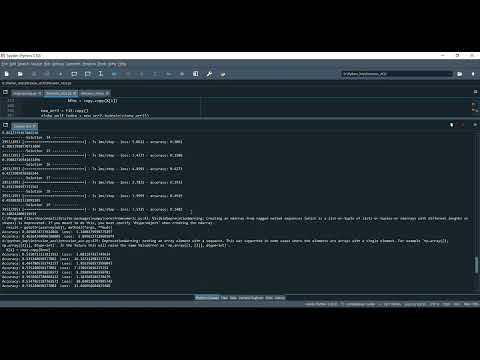
Network security is a critical concern for organizations, as intrusions can lead to data breaches, service disruptions, and financial losses. This project focuses on developing a Python-based Intrusion Detection System (IDS) that leverages Ant Colony Optimization (ACO) for feature selection and model training to enhance detection accuracy. The system analyzes network traffic and system logs to identify malicious activities, including denial-of-service attacks, unauthorized access, and other anomalies. Implemented with Python libraries such as Pandas, NumPy, Scikit-learn, and TensorFlow/Keras, the ACO algorithm optimizes feature subsets for efficient and accurate intrusion detection, improving model performance while reducing computational overhead.
Existing System
Traditional intrusion detection approaches rely on signature-based or rule-based methods, which are effective only against known attacks and are prone to high false-positive rates. Machine learning–based IDS solutions improve detection but often face challenges with high-dimensional network data, redundant or irrelevant features, and computational inefficiency. Existing systems may not adequately handle large-scale datasets or adapt dynamically to evolving attack patterns, limiting their effectiveness in real-world scenarios.
Proposed System
The proposed system introduces a hybrid IDS framework that combines feature selection via Ant Colony Optimization (ACO) with machine learning classifiers for accurate intrusion detection. Network traffic data is preprocessed to remove noise, normalize values, and handle missing entries. ACO is employed to identify the most relevant features that contribute to distinguishing normal and anomalous behavior. Selected features are then used to train machine learning models such as Random Forest, Support Vector Machine (SVM), Gradient Boosting, or Neural Networks. Python libraries such as Pandas and NumPy handle data preprocessing, Scikit-learn implements model training and evaluation, and TensorFlow/Keras can be used for deep learning classifiers. The system evaluates performance using metrics such as accuracy, precision, recall, F1-score, and ROC-AUC, ensuring robust detection. By integrating ACO for feature optimization, the system provides an efficient, scalable, and high-accuracy solution for detecting intrusions in complex network environments.
Abstract
Network security is a critical concern for organizations, as intrusions can lead to data breaches, service disruptions, and financial losses. This project focuses on developing a Python-based Intrusion Detection System (IDS) that leverages Ant Colony Optimization (ACO) for feature selection and model training to enhance detection accuracy. The system analyzes network traffic and system logs to identify malicious activities, including denial-of-service attacks, unauthorized access, and other anomalies. Implemented with Python libraries such as Pandas, NumPy, Scikit-learn, and TensorFlow/Keras, the ACO algorithm optimizes feature subsets for efficient and accurate intrusion detection, improving model performance while reducing computational overhead.
Existing System
Traditional intrusion detection approaches rely on signature-based or rule-based methods, which are effective only against known attacks and are prone to high false-positive rates. Machine learning–based IDS solutions improve detection but often face challenges with high-dimensional network data, redundant or irrelevant features, and computational inefficiency. Existing systems may not adequately handle large-scale datasets or adapt dynamically to evolving attack patterns, limiting their effectiveness in real-world scenarios.
Proposed System
The proposed system introduces a hybrid IDS framework that combines feature selection via Ant Colony Optimization (ACO) with machine learning classifiers for accurate intrusion detection. Network traffic data is preprocessed to remove noise, normalize values, and handle missing entries. ACO is employed to identify the most relevant features that contribute to distinguishing normal and anomalous behavior. Selected features are then used to train machine learning models such as Random Forest, Support Vector Machine (SVM), Gradient Boosting, or Neural Networks. Python libraries such as Pandas and NumPy handle data preprocessing, Scikit-learn implements model training and evaluation, and TensorFlow/Keras can be used for deep learning classifiers. The system evaluates performance using metrics such as accuracy, precision, recall, F1-score, and ROC-AUC, ensuring robust detection. By integrating ACO for feature optimization, the system provides an efficient, scalable, and high-accuracy solution for detecting intrusions in complex network environments.
Customer Reviews (0)
No reviews yet. Be the first!
Related Products
⭐ Featured

AI & ML Models
Zomato Restaurant Reviews Sentimental Analyzer in Python Projects
Zomato Restaurant Reviews Sentimental Analyzer in Python Projects
र 1000
⭐ Featured

⭐ Featured

AI & ML Models
Voice Disorder Prediction using Audio Dataset in Python Projects
Voice Disorder Prediction using Audio Dataset in Python Projects
र 1000

AI & ML Models
Vitamin Deficiency Detection Using Image Processing in Python Projects
Vitamin Deficiency Detection Using Image Processing in Python Projects
र 1000