AI & ML Models
0.0 (0 reviews) • 0 downloads
Heart Disease ML Classification in Python Projects
र 1000
Heart Disease ML Classification in Python Projects
Technical Details
Domain : Python
Database : Sqlite
Tools : Anaconda
Run Tools: VS Code
Database : Sqlite
Tools : Anaconda
Run Tools: VS Code
Secure Payment
Instant Download
GST Invoice
24/7 Support
About This Product
Heart Disease ML Classification in Python Projects
Abstract
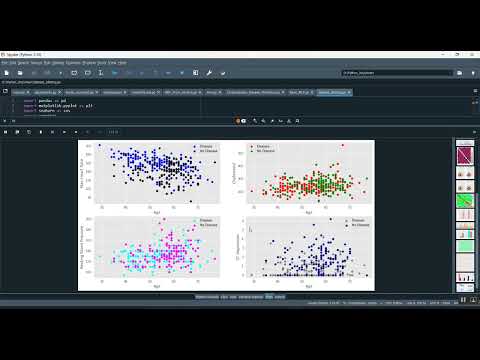
Heart disease is one of the leading causes of death globally, making early prediction and diagnosis essential for preventive care. This project focuses on developing a Python-based Heart Disease Classification system using machine learning (ML) algorithms. The system analyzes patient data, including age, gender, blood pressure, cholesterol levels, ECG results, and other relevant clinical features, to predict the presence or absence of heart disease. Implemented using Python libraries such as Pandas, NumPy, Scikit-learn, and Matplotlib, the model trains on labeled datasets to provide accurate and reliable predictions. The system aims to assist healthcare professionals in making informed decisions, improving patient outcomes, and reducing risks associated with late detection.
Existing System
Traditional diagnosis of heart disease relies heavily on manual clinical evaluation, laboratory tests, and physician expertise. While effective, this approach is time-consuming, subjective, and may not efficiently handle large datasets or complex patterns in patient data. Some existing digital solutions use basic statistical methods or single ML algorithms, which often fail to achieve high prediction accuracy. Moreover, most conventional systems lack interactive tools for visualization and real-time prediction, limiting their accessibility for healthcare providers and patients alike.
Proposed System
The proposed system introduces a Python-based ML framework for heart disease classification. Patient datasets are preprocessed by handling missing values, normalizing numerical features, and encoding categorical variables to improve model performance. Multiple supervised learning algorithms, including Logistic Regression, Decision Tree, Random Forest, Support Vector Machine (SVM), and Gradient Boosting, are trained and compared to identify the best-performing model. Performance evaluation is carried out using metrics such as accuracy, precision, recall, F1-score, and confusion matrices to ensure robustness and reliability. Python libraries such as Pandas and NumPy handle data preprocessing, Scikit-learn supports model training and evaluation, and Matplotlib or Seaborn is used for visualizing data trends and model performance. By integrating multiple ML algorithms with comprehensive data preprocessing and evaluation, the system provides an efficient, scalable, and accurate solution for heart disease prediction, aiding early diagnosis and preventive healthcare management.
Abstract
Heart disease is one of the leading causes of death globally, making early prediction and diagnosis essential for preventive care. This project focuses on developing a Python-based Heart Disease Classification system using machine learning (ML) algorithms. The system analyzes patient data, including age, gender, blood pressure, cholesterol levels, ECG results, and other relevant clinical features, to predict the presence or absence of heart disease. Implemented using Python libraries such as Pandas, NumPy, Scikit-learn, and Matplotlib, the model trains on labeled datasets to provide accurate and reliable predictions. The system aims to assist healthcare professionals in making informed decisions, improving patient outcomes, and reducing risks associated with late detection.
Existing System
Traditional diagnosis of heart disease relies heavily on manual clinical evaluation, laboratory tests, and physician expertise. While effective, this approach is time-consuming, subjective, and may not efficiently handle large datasets or complex patterns in patient data. Some existing digital solutions use basic statistical methods or single ML algorithms, which often fail to achieve high prediction accuracy. Moreover, most conventional systems lack interactive tools for visualization and real-time prediction, limiting their accessibility for healthcare providers and patients alike.
Proposed System
The proposed system introduces a Python-based ML framework for heart disease classification. Patient datasets are preprocessed by handling missing values, normalizing numerical features, and encoding categorical variables to improve model performance. Multiple supervised learning algorithms, including Logistic Regression, Decision Tree, Random Forest, Support Vector Machine (SVM), and Gradient Boosting, are trained and compared to identify the best-performing model. Performance evaluation is carried out using metrics such as accuracy, precision, recall, F1-score, and confusion matrices to ensure robustness and reliability. Python libraries such as Pandas and NumPy handle data preprocessing, Scikit-learn supports model training and evaluation, and Matplotlib or Seaborn is used for visualizing data trends and model performance. By integrating multiple ML algorithms with comprehensive data preprocessing and evaluation, the system provides an efficient, scalable, and accurate solution for heart disease prediction, aiding early diagnosis and preventive healthcare management.
Customer Reviews (0)
No reviews yet. Be the first!
Related Products
⭐ Featured

AI & ML Models
Zomato Restaurant Reviews Sentimental Analyzer in Python Projects
Zomato Restaurant Reviews Sentimental Analyzer in Python Projects
र 1000
⭐ Featured
⭐ Featured
AI & ML Models
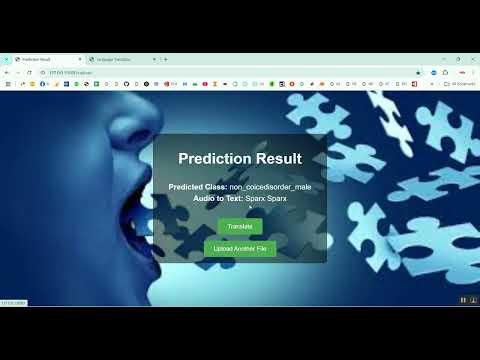
Voice Disorder Prediction using Audio Dataset in Python Projects
Voice Disorder Prediction using Audio Dataset in Python Projects
र 1000

AI & ML Models
Vitamin Deficiency Detection Using Image Processing in Python Projects
Vitamin Deficiency Detection Using Image Processing in Python Projects
र 1000