
AI & ML Models
0.0 (0 reviews) • 0 downloads
Fake Review Prediction ML Classification in Python Projects
र 1000
Fake Review Prediction ML Classification in Python Projects
Technical Details
Domain : Python
Database : Sqlite
Tools : Anaconda
Run Tools: VS Code
Database : Sqlite
Tools : Anaconda
Run Tools: VS Code
Secure Payment
Instant Download
GST Invoice
24/7 Support
About This Product
Fake Review Prediction ML Classification in Python Projects
Abstract
The prevalence of fake reviews on e-commerce and service platforms can mislead consumers and negatively impact business reputation. This project focuses on developing a Python-based system for Fake Review Prediction using machine learning classification techniques. By analyzing textual content, sentiment, and reviewer behavior, the system identifies patterns indicative of deceptive reviews. Features such as review length, word frequency, sentiment polarity, and reviewer metadata are extracted and used to train supervised machine learning models capable of classifying reviews as genuine or fake. Implemented with Python libraries like NLTK, Scikit-learn, Pandas, and TensorFlow/Keras, the system provides a scalable, automated, and efficient solution for detecting fake reviews and improving consumer trust.
Existing System
Existing fake review detection systems often rely on manual moderation, keyword-based filters, or simple sentiment analysis. Manual verification is slow, inconsistent, and cannot scale with the high volume of online reviews. Keyword or lexicon-based methods fail to capture nuanced deception or sophisticated manipulative patterns. Some ML-based systems focus only on textual content and ignore important metadata such as posting frequency, account age, and rating behavior, which are critical for improving detection accuracy. These limitations reduce the effectiveness of current solutions in real-world online platforms.
Proposed System
The proposed system employs a Python-based machine learning framework that integrates text preprocessing, feature extraction, and classification for fake review prediction. Text preprocessing includes tokenization, stopword removal, stemming/lemmatization, and vectorization using TF-IDF or word embeddings such as Word2Vec or GloVe. Behavioral and metadata features—such as reviewer credibility, posting patterns, rating deviations, and review timing—are combined with textual features to enhance predictive accuracy. Extracted features are used to train classifiers such as Logistic Regression, Naïve Bayes, Random Forest, or deep learning models like LSTM for sequence-based analysis. The system outputs predictions indicating whether a review is fake or genuine, along with confidence scores. Using Python libraries like NLTK, Scikit-learn, Pandas, and TensorFlow/Keras, this solution provides an automated, scalable, and accurate method for maintaining the integrity of online reviews.
Abstract
The prevalence of fake reviews on e-commerce and service platforms can mislead consumers and negatively impact business reputation. This project focuses on developing a Python-based system for Fake Review Prediction using machine learning classification techniques. By analyzing textual content, sentiment, and reviewer behavior, the system identifies patterns indicative of deceptive reviews. Features such as review length, word frequency, sentiment polarity, and reviewer metadata are extracted and used to train supervised machine learning models capable of classifying reviews as genuine or fake. Implemented with Python libraries like NLTK, Scikit-learn, Pandas, and TensorFlow/Keras, the system provides a scalable, automated, and efficient solution for detecting fake reviews and improving consumer trust.
Existing System
Existing fake review detection systems often rely on manual moderation, keyword-based filters, or simple sentiment analysis. Manual verification is slow, inconsistent, and cannot scale with the high volume of online reviews. Keyword or lexicon-based methods fail to capture nuanced deception or sophisticated manipulative patterns. Some ML-based systems focus only on textual content and ignore important metadata such as posting frequency, account age, and rating behavior, which are critical for improving detection accuracy. These limitations reduce the effectiveness of current solutions in real-world online platforms.
Proposed System
The proposed system employs a Python-based machine learning framework that integrates text preprocessing, feature extraction, and classification for fake review prediction. Text preprocessing includes tokenization, stopword removal, stemming/lemmatization, and vectorization using TF-IDF or word embeddings such as Word2Vec or GloVe. Behavioral and metadata features—such as reviewer credibility, posting patterns, rating deviations, and review timing—are combined with textual features to enhance predictive accuracy. Extracted features are used to train classifiers such as Logistic Regression, Naïve Bayes, Random Forest, or deep learning models like LSTM for sequence-based analysis. The system outputs predictions indicating whether a review is fake or genuine, along with confidence scores. Using Python libraries like NLTK, Scikit-learn, Pandas, and TensorFlow/Keras, this solution provides an automated, scalable, and accurate method for maintaining the integrity of online reviews.
Customer Reviews (0)
No reviews yet. Be the first!
Related Products
⭐ Featured
AI & ML Models
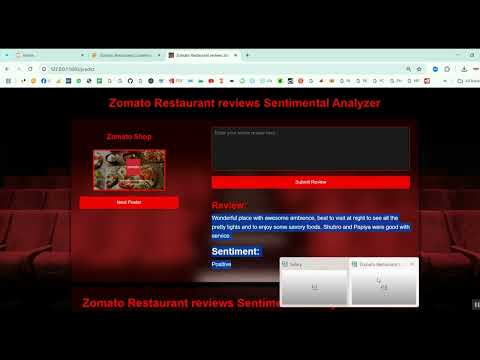
Zomato Restaurant Reviews Sentimental Analyzer in Python Projects
Zomato Restaurant Reviews Sentimental Analyzer in Python Projects
र 1000
⭐ Featured

⭐ Featured

AI & ML Models
Voice Disorder Prediction using Audio Dataset in Python Projects
Voice Disorder Prediction using Audio Dataset in Python Projects
र 1000

AI & ML Models
Vitamin Deficiency Detection Using Image Processing in Python Projects
Vitamin Deficiency Detection Using Image Processing in Python Projects
र 1000