AI & ML Models
0.0 (0 reviews) • 0 downloads
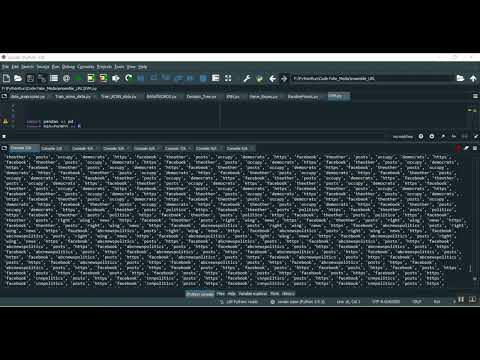
Fake News Social Media Detection in Python Projects
र 1000
Fake News Social Media Detection in Python Projects
Technical Details
Domain : Python
Database : Sqlite
Tools : Anaconda
Run Tools: VS Code
Database : Sqlite
Tools : Anaconda
Run Tools: VS Code
Secure Payment
Instant Download
GST Invoice
24/7 Support
About This Product
Fake News Social Media Detection in Python Projects
Abstract
The rapid spread of fake news on social media platforms poses a serious threat to public opinion, political stability, and social trust. This project focuses on developing a Python-based system for detecting fake news specifically on social media platforms such as Twitter, Facebook, and Instagram. The system collects posts, tweets, or status updates and analyzes their textual content, metadata, and user behavior patterns to classify news as real or fake. By leveraging natural language processing (NLP) techniques and machine learning classifiers, the system extracts features such as word frequency, sentiment analysis, hashtags, mentions, and posting patterns to improve prediction accuracy. Implemented using Python libraries like NLTK, Scikit-learn, Pandas, and TensorFlow/Keras, the application provides an automated, scalable, and efficient solution for social media misinformation detection.
Existing System
Existing social media monitoring systems primarily rely on manual fact-checking, rule-based keyword detection, or content-only NLP models. Manual verification is slow and cannot cope with the large volume of social media content generated every second. Rule-based systems detect only obvious cues and fail to capture context, sarcasm, or evolving fake news patterns. Content-only NLP models often ignore user behavior and metadata such as account credibility, post frequency, or network propagation patterns, limiting the accuracy and robustness of detection. Moreover, many current tools lack real-time capabilities or automated pipelines for continuous monitoring of social media feeds.
Proposed System
The proposed system introduces a Python-based framework for fake news detection on social media by combining textual content analysis with metadata and behavioral feature extraction. Text preprocessing includes tokenization, stopword removal, lemmatization, and vectorization using TF-IDF or word embeddings like Word2Vec or BERT. Metadata and behavioral features such as user credibility, number of followers, retweet/share count, post time patterns, and hashtag usage are also considered. Extracted features are fed into machine learning classifiers such as Logistic Regression, Random Forest, SVM, or deep learning models like LSTM for sequence-based analysis. The system outputs a prediction of whether the news is fake or real, along with a confidence score. Implemented with Python libraries such as Pandas, Scikit-learn, TensorFlow/Keras, NLTK, and Tweepy for social media data collection, the solution enables real-time or batch monitoring, providing an effective, accurate, and automated tool for detecting misinformation on social media platforms.
Abstract
The rapid spread of fake news on social media platforms poses a serious threat to public opinion, political stability, and social trust. This project focuses on developing a Python-based system for detecting fake news specifically on social media platforms such as Twitter, Facebook, and Instagram. The system collects posts, tweets, or status updates and analyzes their textual content, metadata, and user behavior patterns to classify news as real or fake. By leveraging natural language processing (NLP) techniques and machine learning classifiers, the system extracts features such as word frequency, sentiment analysis, hashtags, mentions, and posting patterns to improve prediction accuracy. Implemented using Python libraries like NLTK, Scikit-learn, Pandas, and TensorFlow/Keras, the application provides an automated, scalable, and efficient solution for social media misinformation detection.
Existing System
Existing social media monitoring systems primarily rely on manual fact-checking, rule-based keyword detection, or content-only NLP models. Manual verification is slow and cannot cope with the large volume of social media content generated every second. Rule-based systems detect only obvious cues and fail to capture context, sarcasm, or evolving fake news patterns. Content-only NLP models often ignore user behavior and metadata such as account credibility, post frequency, or network propagation patterns, limiting the accuracy and robustness of detection. Moreover, many current tools lack real-time capabilities or automated pipelines for continuous monitoring of social media feeds.
Proposed System
The proposed system introduces a Python-based framework for fake news detection on social media by combining textual content analysis with metadata and behavioral feature extraction. Text preprocessing includes tokenization, stopword removal, lemmatization, and vectorization using TF-IDF or word embeddings like Word2Vec or BERT. Metadata and behavioral features such as user credibility, number of followers, retweet/share count, post time patterns, and hashtag usage are also considered. Extracted features are fed into machine learning classifiers such as Logistic Regression, Random Forest, SVM, or deep learning models like LSTM for sequence-based analysis. The system outputs a prediction of whether the news is fake or real, along with a confidence score. Implemented with Python libraries such as Pandas, Scikit-learn, TensorFlow/Keras, NLTK, and Tweepy for social media data collection, the solution enables real-time or batch monitoring, providing an effective, accurate, and automated tool for detecting misinformation on social media platforms.
Customer Reviews (0)
No reviews yet. Be the first!
Related Products
⭐ Featured

AI & ML Models
Zomato Restaurant Reviews Sentimental Analyzer in Python Projects
Zomato Restaurant Reviews Sentimental Analyzer in Python Projects
र 1000
⭐ Featured
⭐ Featured

AI & ML Models
Voice Disorder Prediction using Audio Dataset in Python Projects
Voice Disorder Prediction using Audio Dataset in Python Projects
र 1000

AI & ML Models
Vitamin Deficiency Detection Using Image Processing in Python Projects
Vitamin Deficiency Detection Using Image Processing in Python Projects
र 1000