AI & ML Models
0.0 (0 reviews) • 0 downloads
Fake Currency Detection using Image Processing in Python Projects
र 1000
Fake Currency Detection using Image Processing in Python Projects
Technical Details
Domain : Python
Database : Sqlite
Tools : Anaconda
Run Tools: VS Code
Database : Sqlite
Tools : Anaconda
Run Tools: VS Code
Secure Payment
Instant Download
GST Invoice
24/7 Support
About This Product
Fake Currency Detection using Image Processing in Python Projects
Abstract
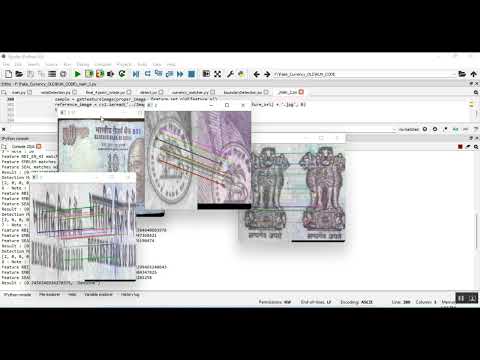
Counterfeit currency poses significant economic and security risks, demanding reliable automated detection systems to assist banks, retailers, and law enforcement. This project presents a Python-based Fake Currency Detection system using image processing and machine learning techniques to distinguish genuine banknotes from forged ones. By capturing high-resolution images of banknotes via scanner or camera, the system analyzes visual features such as texture, color distribution, edge patterns, watermark regions, and micro-printed elements. Feature extraction methods transform these visual cues into discriminative descriptors, which are then used to train classifiers that identify counterfeit notes with high accuracy. Implemented using Python libraries like OpenCV, NumPy, and Scikit-learn (with optional deep learning via TensorFlow/Keras), the solution aims to provide an efficient, scalable, and user-friendly tool for real-time or batch currency verification.
Existing System
Current counterfeit detection practices range from manual inspection by trained personnel to hardware devices that measure infrared, ultraviolet responses, or magnetic ink properties. Manual inspection is subjective and error-prone under poor lighting or high throughput conditions, while specialized hardware is accurate but costly and not always available in small businesses. Software approaches that rely solely on simple template matching or color thresholding often fail when faced with variations in note orientation, wear-and-tear, different print batches, or skillful forgeries. Moreover, many legacy image-based methods lack robustness to rotation, scale, illumination changes, and background clutter, limiting their effectiveness in real-world deployment where input quality and conditions vary widely.
Proposed System
The proposed system combines robust image-processing pipelines with supervised learning to reliably detect fake currency. Input images are preprocessed for illumination normalization, perspective correction, and noise reduction; regions of interest such as portrait, serial number area, watermark window, and security thread are localized using contour analysis and keypoint detectors. Feature extraction leverages a mix of handcrafted descriptors (e.g., local binary patterns, histogram of oriented gradients, color histograms, ORB/SIFT-like keypoints) and learned features from a CNN to capture subtle texture and pattern differences. These features feed into classifiers such as Random Forests, SVM, or a shallow CNN ensemble; the system outputs a genuineness score and highlights suspect regions for user review. Additional modules include an OCR check for serial-number format verification and a retraining pipeline to incorporate new counterfeit patterns. Deployed as a desktop or lightweight web/Streamlit app, the solution balances accuracy, speed, and cost-effectiveness to support both high-throughput and low-resource scenarios
Abstract
Counterfeit currency poses significant economic and security risks, demanding reliable automated detection systems to assist banks, retailers, and law enforcement. This project presents a Python-based Fake Currency Detection system using image processing and machine learning techniques to distinguish genuine banknotes from forged ones. By capturing high-resolution images of banknotes via scanner or camera, the system analyzes visual features such as texture, color distribution, edge patterns, watermark regions, and micro-printed elements. Feature extraction methods transform these visual cues into discriminative descriptors, which are then used to train classifiers that identify counterfeit notes with high accuracy. Implemented using Python libraries like OpenCV, NumPy, and Scikit-learn (with optional deep learning via TensorFlow/Keras), the solution aims to provide an efficient, scalable, and user-friendly tool for real-time or batch currency verification.
Existing System
Current counterfeit detection practices range from manual inspection by trained personnel to hardware devices that measure infrared, ultraviolet responses, or magnetic ink properties. Manual inspection is subjective and error-prone under poor lighting or high throughput conditions, while specialized hardware is accurate but costly and not always available in small businesses. Software approaches that rely solely on simple template matching or color thresholding often fail when faced with variations in note orientation, wear-and-tear, different print batches, or skillful forgeries. Moreover, many legacy image-based methods lack robustness to rotation, scale, illumination changes, and background clutter, limiting their effectiveness in real-world deployment where input quality and conditions vary widely.
Proposed System
The proposed system combines robust image-processing pipelines with supervised learning to reliably detect fake currency. Input images are preprocessed for illumination normalization, perspective correction, and noise reduction; regions of interest such as portrait, serial number area, watermark window, and security thread are localized using contour analysis and keypoint detectors. Feature extraction leverages a mix of handcrafted descriptors (e.g., local binary patterns, histogram of oriented gradients, color histograms, ORB/SIFT-like keypoints) and learned features from a CNN to capture subtle texture and pattern differences. These features feed into classifiers such as Random Forests, SVM, or a shallow CNN ensemble; the system outputs a genuineness score and highlights suspect regions for user review. Additional modules include an OCR check for serial-number format verification and a retraining pipeline to incorporate new counterfeit patterns. Deployed as a desktop or lightweight web/Streamlit app, the solution balances accuracy, speed, and cost-effectiveness to support both high-throughput and low-resource scenarios
Customer Reviews (0)
No reviews yet. Be the first!
Related Products
⭐ Featured

AI & ML Models
Zomato Restaurant Reviews Sentimental Analyzer in Python Projects
Zomato Restaurant Reviews Sentimental Analyzer in Python Projects
र 1000
⭐ Featured
⭐ Featured

AI & ML Models
Voice Disorder Prediction using Audio Dataset in Python Projects
Voice Disorder Prediction using Audio Dataset in Python Projects
र 1000

AI & ML Models
Vitamin Deficiency Detection Using Image Processing in Python Projects
Vitamin Deficiency Detection Using Image Processing in Python Projects
र 1000