AI & ML Models
0.0 (0 reviews) • 0 downloads
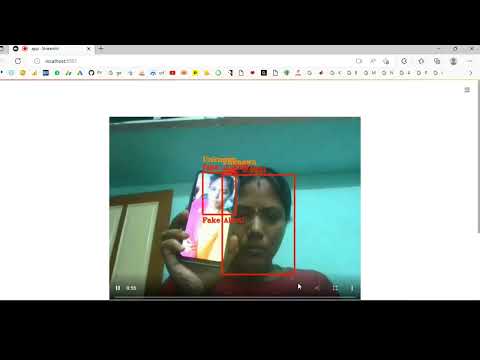
Fake and Fraud Face Detection Deep Reinforcement Learning in Python Projects
र 1000
Fake and Fraud Face Detection Deep Reinforcement Learning in Python Projects
Technical Details
Domain : Python
Database : Sqlite
Tools : Anaconda
Run Tools: VS Code
Database : Sqlite
Tools : Anaconda
Run Tools: VS Code
Secure Payment
Instant Download
GST Invoice
24/7 Support
About This Product
Fake and Fraud Face Detection Deep Reinforcement Learning in Python Projects
Abstract
With the rapid advancement of digital imaging and social media platforms, detecting fake and fraudulent faces has become a critical challenge in security, authentication, and identity verification systems. This project focuses on developing a Python-based system for detecting fake or manipulated facial images using Deep Reinforcement Learning (DRL). Unlike traditional supervised learning approaches, DRL allows the model to learn optimal strategies for distinguishing real faces from fraudulent or synthetically generated ones by interacting with the environment and receiving feedback. The system leverages feature extraction, image analysis, and policy-based reinforcement learning to identify anomalies and manipulations such as deepfakes, morphing, or spoofing attacks. This approach provides a scalable, adaptive, and highly accurate solution for real-time fake face detection.
Existing System
Existing face authentication and verification systems mainly rely on supervised machine learning techniques, facial recognition, or image forensic methods. While these methods can detect some fraudulent faces, they often fail against sophisticated attacks like deepfakes or AI-generated images, which mimic realistic facial patterns. Traditional image forensics approaches require manual feature engineering and are limited in adaptability to new attack methods. Furthermore, current systems often lack real-time detection capabilities and struggle to maintain high accuracy when encountering unseen fraud patterns. These limitations make conventional systems insufficient for modern identity verification and security requirements.
Proposed System
The proposed system introduces a Python-based deep reinforcement learning framework for detecting fake and fraudulent faces. Initially, facial images are preprocessed through normalization, resizing, and augmentation, followed by feature extraction using convolutional neural networks (CNNs) to capture facial patterns. The DRL agent interacts with the feature space, making decisions about whether a face is real or fraudulent and receiving rewards based on correct classification. Over time, the agent learns optimal policies to maximize detection accuracy, even against novel fraud types. Python libraries such as TensorFlow/Keras, OpenCV, and NumPy are used for model development, image processing, and deployment. The system can operate in real time, providing immediate feedback on suspicious images. By combining DRL with deep feature extraction, the proposed solution offers a robust, adaptive, and scalable approach for protecting digital identity and preventing fraud in security-critical applications.
Abstract
With the rapid advancement of digital imaging and social media platforms, detecting fake and fraudulent faces has become a critical challenge in security, authentication, and identity verification systems. This project focuses on developing a Python-based system for detecting fake or manipulated facial images using Deep Reinforcement Learning (DRL). Unlike traditional supervised learning approaches, DRL allows the model to learn optimal strategies for distinguishing real faces from fraudulent or synthetically generated ones by interacting with the environment and receiving feedback. The system leverages feature extraction, image analysis, and policy-based reinforcement learning to identify anomalies and manipulations such as deepfakes, morphing, or spoofing attacks. This approach provides a scalable, adaptive, and highly accurate solution for real-time fake face detection.
Existing System
Existing face authentication and verification systems mainly rely on supervised machine learning techniques, facial recognition, or image forensic methods. While these methods can detect some fraudulent faces, they often fail against sophisticated attacks like deepfakes or AI-generated images, which mimic realistic facial patterns. Traditional image forensics approaches require manual feature engineering and are limited in adaptability to new attack methods. Furthermore, current systems often lack real-time detection capabilities and struggle to maintain high accuracy when encountering unseen fraud patterns. These limitations make conventional systems insufficient for modern identity verification and security requirements.
Proposed System
The proposed system introduces a Python-based deep reinforcement learning framework for detecting fake and fraudulent faces. Initially, facial images are preprocessed through normalization, resizing, and augmentation, followed by feature extraction using convolutional neural networks (CNNs) to capture facial patterns. The DRL agent interacts with the feature space, making decisions about whether a face is real or fraudulent and receiving rewards based on correct classification. Over time, the agent learns optimal policies to maximize detection accuracy, even against novel fraud types. Python libraries such as TensorFlow/Keras, OpenCV, and NumPy are used for model development, image processing, and deployment. The system can operate in real time, providing immediate feedback on suspicious images. By combining DRL with deep feature extraction, the proposed solution offers a robust, adaptive, and scalable approach for protecting digital identity and preventing fraud in security-critical applications.
Customer Reviews (0)
No reviews yet. Be the first!
Related Products
⭐ Featured

AI & ML Models
Zomato Restaurant Reviews Sentimental Analyzer in Python Projects
Zomato Restaurant Reviews Sentimental Analyzer in Python Projects
र 1000
⭐ Featured
⭐ Featured

AI & ML Models
Voice Disorder Prediction using Audio Dataset in Python Projects
Voice Disorder Prediction using Audio Dataset in Python Projects
र 1000

AI & ML Models
Vitamin Deficiency Detection Using Image Processing in Python Projects
Vitamin Deficiency Detection Using Image Processing in Python Projects
र 1000