AI & ML Models
0.0 (0 reviews) • 0 downloads
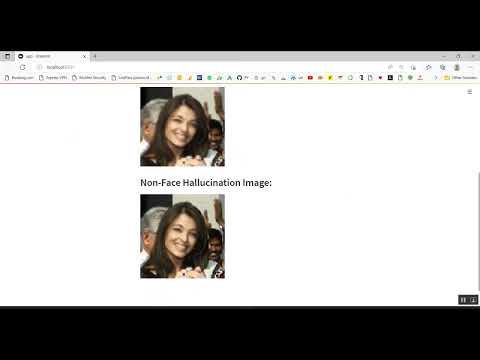
Face Hallucination Streamlite App in Python Projects
र 1000
Face Hallucination Streamlite App in Python Projects
Technical Details
Domain : Python
Database : Sqlite
Tools : Anaconda
Run Tools: VS Code
Database : Sqlite
Tools : Anaconda
Run Tools: VS Code
Secure Payment
Instant Download
GST Invoice
24/7 Support
About This Product
Face Hallucination Streamlite App in Python Projects
Abstract
Face hallucination, also known as facial super-resolution, is the process of generating high-resolution facial images from low-resolution inputs. This technique is critical in applications such as facial recognition, video surveillance, digital entertainment, and historical image restoration. This project focuses on developing a Python-based Streamlit application that performs face hallucination using deep learning techniques. By leveraging Convolutional Neural Networks (CNNs) and Generative Adversarial Networks (GANs), the system enhances the clarity and details of low-resolution facial images while preserving essential facial features. The integration with Streamlit provides an interactive platform for users to upload images, apply face hallucination models, and visualize high-resolution outputs in real time. This approach demonstrates how AI-powered solutions can improve facial image quality efficiently and effectively.
Existing System
Existing face super-resolution methods often rely on traditional image processing techniques such as interpolation, smoothing, or filtering. While these methods can improve resolution to some extent, they fail to reconstruct fine facial details and often produce blurred or unrealistic results. Some deep learning-based solutions exist, but they are typically implemented in research environments without a user-friendly interface. Furthermore, many current systems do not provide real-time results or interactive access, making it difficult for users to easily apply face hallucination to personal or practical use cases. As a result, current solutions are limited in usability, accuracy, and accessibility.
Proposed System
The proposed system introduces a Python-based Streamlit application that integrates face hallucination models for practical and interactive usage. Low-resolution facial images uploaded by users are preprocessed and passed through deep learning models such as CNNs or GANs trained for super-resolution tasks. The models reconstruct high-resolution facial features while maintaining natural appearance and identity characteristics. Streamlit provides an easy-to-use web interface where users can visualize results in real time, adjust model parameters if necessary, and save enhanced images. Python libraries such as OpenCV, TensorFlow/Keras, PIL, and NumPy are used for image processing, model implementation, and application deployment. This integrated approach offers a scalable, accurate, and user-friendly solution for improving facial image resolution, making it suitable for applications in security, media, and digital restoration.
Abstract
Face hallucination, also known as facial super-resolution, is the process of generating high-resolution facial images from low-resolution inputs. This technique is critical in applications such as facial recognition, video surveillance, digital entertainment, and historical image restoration. This project focuses on developing a Python-based Streamlit application that performs face hallucination using deep learning techniques. By leveraging Convolutional Neural Networks (CNNs) and Generative Adversarial Networks (GANs), the system enhances the clarity and details of low-resolution facial images while preserving essential facial features. The integration with Streamlit provides an interactive platform for users to upload images, apply face hallucination models, and visualize high-resolution outputs in real time. This approach demonstrates how AI-powered solutions can improve facial image quality efficiently and effectively.
Existing System
Existing face super-resolution methods often rely on traditional image processing techniques such as interpolation, smoothing, or filtering. While these methods can improve resolution to some extent, they fail to reconstruct fine facial details and often produce blurred or unrealistic results. Some deep learning-based solutions exist, but they are typically implemented in research environments without a user-friendly interface. Furthermore, many current systems do not provide real-time results or interactive access, making it difficult for users to easily apply face hallucination to personal or practical use cases. As a result, current solutions are limited in usability, accuracy, and accessibility.
Proposed System
The proposed system introduces a Python-based Streamlit application that integrates face hallucination models for practical and interactive usage. Low-resolution facial images uploaded by users are preprocessed and passed through deep learning models such as CNNs or GANs trained for super-resolution tasks. The models reconstruct high-resolution facial features while maintaining natural appearance and identity characteristics. Streamlit provides an easy-to-use web interface where users can visualize results in real time, adjust model parameters if necessary, and save enhanced images. Python libraries such as OpenCV, TensorFlow/Keras, PIL, and NumPy are used for image processing, model implementation, and application deployment. This integrated approach offers a scalable, accurate, and user-friendly solution for improving facial image resolution, making it suitable for applications in security, media, and digital restoration.
Customer Reviews (0)
No reviews yet. Be the first!
Related Products
⭐ Featured

AI & ML Models
Zomato Restaurant Reviews Sentimental Analyzer in Python Projects
Zomato Restaurant Reviews Sentimental Analyzer in Python Projects
र 1000
⭐ Featured
⭐ Featured

AI & ML Models
Voice Disorder Prediction using Audio Dataset in Python Projects
Voice Disorder Prediction using Audio Dataset in Python Projects
र 1000

AI & ML Models
Vitamin Deficiency Detection Using Image Processing in Python Projects
Vitamin Deficiency Detection Using Image Processing in Python Projects
र 1000