AI & ML Models
0.0 (0 reviews) • 0 downloads
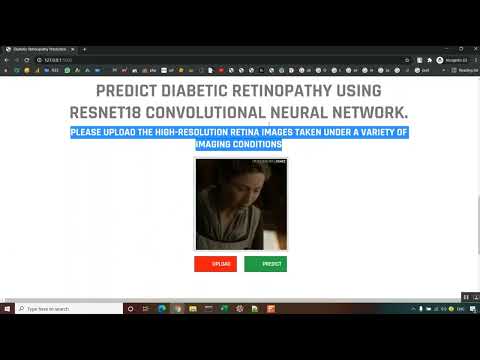
Diabetic Retinopathy Inception in Python Projects
र 1000
Diabetic Retinopathy Inception in Python Projects
Technical Details
Domain : Python
Database : Sqlite
Tools : Anaconda
Run Tools: VS Code
Database : Sqlite
Tools : Anaconda
Run Tools: VS Code
Secure Payment
Instant Download
GST Invoice
24/7 Support
About This Product
Diabetic Retinopathy Inception in Python Projects
Abstract
Diabetic Retinopathy (DR) is a diabetes-related complication that affects the retina and can lead to permanent vision loss if undetected. Early diagnosis is critical for effective treatment and prevention of severe outcomes. The project “Diabetic Retinopathy Inception in Python” leverages deep learning, specifically the Inception Convolutional Neural Network (CNN) architecture, to automatically detect and classify diabetic retinopathy from retinal fundus images. Using Python libraries such as TensorFlow/Keras, OpenCV, NumPy, and Matplotlib, the system preprocesses fundus images, trains the Inception model on labeled datasets, and predicts the stage of retinopathy (e.g., mild, moderate, severe, or no DR). This project demonstrates the application of deep learning in ophthalmology to provide accurate, scalable, and automated solutions for DR detection.
Existing System
Traditional diabetic retinopathy detection relies on manual examination of retinal images by ophthalmologists, which is labor-intensive, time-consuming, and prone to inter-observer variability. Some existing automated systems use basic CNN models or handcrafted feature extraction methods, but they often suffer from limited accuracy and poor generalization across diverse datasets. Additionally, these systems may struggle with preprocessing challenges such as varying illumination, image noise, and differences in retinal image acquisition. The absence of robust and efficient architectures limits real-time deployment and widespread clinical adoption.
Proposed System
The proposed system utilizes the Inception CNN architecture to build a deep learning pipeline for DR detection. Preprocessing steps include resizing images, normalization, augmentation (rotation, flipping, and scaling), and contrast enhancement to improve model performance. The Inception model, known for its ability to capture multi-scale features through parallel convolutional filters, is trained on labeled retinal datasets to classify images into DR severity levels. Python’s TensorFlow/Keras framework handles model training, evaluation, and prediction, while OpenCV is used for image preprocessing. The system outputs a classification label along with prediction confidence, which can be visualized for medical interpretation. For deployment, the model can be integrated with a Flask or Streamlit web application to allow ophthalmologists and patients to upload retinal images and receive automated diagnosis, improving accessibility, efficiency, and early intervention in diabetic retinopathy care.
Abstract
Diabetic Retinopathy (DR) is a diabetes-related complication that affects the retina and can lead to permanent vision loss if undetected. Early diagnosis is critical for effective treatment and prevention of severe outcomes. The project “Diabetic Retinopathy Inception in Python” leverages deep learning, specifically the Inception Convolutional Neural Network (CNN) architecture, to automatically detect and classify diabetic retinopathy from retinal fundus images. Using Python libraries such as TensorFlow/Keras, OpenCV, NumPy, and Matplotlib, the system preprocesses fundus images, trains the Inception model on labeled datasets, and predicts the stage of retinopathy (e.g., mild, moderate, severe, or no DR). This project demonstrates the application of deep learning in ophthalmology to provide accurate, scalable, and automated solutions for DR detection.
Existing System
Traditional diabetic retinopathy detection relies on manual examination of retinal images by ophthalmologists, which is labor-intensive, time-consuming, and prone to inter-observer variability. Some existing automated systems use basic CNN models or handcrafted feature extraction methods, but they often suffer from limited accuracy and poor generalization across diverse datasets. Additionally, these systems may struggle with preprocessing challenges such as varying illumination, image noise, and differences in retinal image acquisition. The absence of robust and efficient architectures limits real-time deployment and widespread clinical adoption.
Proposed System
The proposed system utilizes the Inception CNN architecture to build a deep learning pipeline for DR detection. Preprocessing steps include resizing images, normalization, augmentation (rotation, flipping, and scaling), and contrast enhancement to improve model performance. The Inception model, known for its ability to capture multi-scale features through parallel convolutional filters, is trained on labeled retinal datasets to classify images into DR severity levels. Python’s TensorFlow/Keras framework handles model training, evaluation, and prediction, while OpenCV is used for image preprocessing. The system outputs a classification label along with prediction confidence, which can be visualized for medical interpretation. For deployment, the model can be integrated with a Flask or Streamlit web application to allow ophthalmologists and patients to upload retinal images and receive automated diagnosis, improving accessibility, efficiency, and early intervention in diabetic retinopathy care.
Customer Reviews (0)
No reviews yet. Be the first!
Related Products
⭐ Featured

AI & ML Models
Zomato Restaurant Reviews Sentimental Analyzer in Python Projects
Zomato Restaurant Reviews Sentimental Analyzer in Python Projects
र 1000
⭐ Featured
⭐ Featured

AI & ML Models
Voice Disorder Prediction using Audio Dataset in Python Projects
Voice Disorder Prediction using Audio Dataset in Python Projects
र 1000
AI & ML Models
Vitamin Deficiency Detection Using Image Processing in Python Projects
Vitamin Deficiency Detection Using Image Processing in Python Projects
र 1000