AI & ML Models
0.0 (0 reviews) • 0 downloads
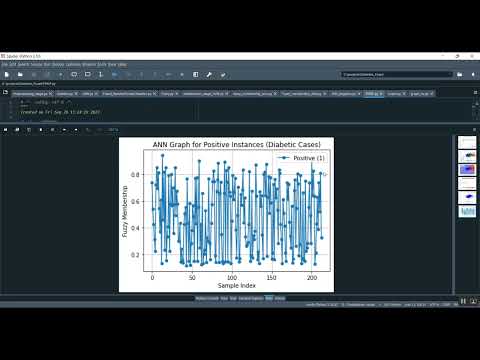
Diabetes Detection using Fused ML Algorithm in Python Projects
र 1000
Diabetes Detection using Fused ML Algorithm in Python Projects
Technical Details
Domain : Python
Database : Sqlite
Tools : Anaconda
Run Tools: VS Code
Database : Sqlite
Tools : Anaconda
Run Tools: VS Code
Secure Payment
Instant Download
GST Invoice
24/7 Support
About This Product
Diabetes Detection using Fused ML Algorithm in Python Projects
Abstract
Diabetes is a chronic health condition that requires early detection and timely management to prevent severe complications. Conventional diagnostic methods are often invasive, time-consuming, and dependent on extensive laboratory testing. The project “Diabetes Detection using Fused ML Algorithm in Python” aims to develop an intelligent system that leverages multiple machine learning algorithms in a fused framework for accurate prediction of diabetes risk. The system utilizes medical datasets (such as patient records including glucose level, BMI, blood pressure, insulin, and age) to train models like Logistic Regression, Random Forest, Support Vector Machine (SVM), and Gradient Boosting. By fusing these algorithms through ensemble techniques (stacking, bagging, or boosting), the system enhances prediction accuracy and robustness. Python libraries such as Scikit-learn, Pandas, NumPy, and Matplotlib are used for model development, analysis, and visualization.
Existing System
Traditional diabetes detection approaches rely on clinical laboratory tests and rule-based diagnostic systems that depend heavily on physician expertise. While some existing machine learning models have been applied, most rely on a single classifier such as Logistic Regression or Decision Trees, which may not generalize well across diverse datasets. These models often suffer from limitations like overfitting, reduced accuracy, and poor handling of imbalanced data. Moreover, many current systems lack user-friendly interfaces and are not designed for real-time prediction, restricting their usability in remote healthcare or personal monitoring scenarios.
Proposed System
The proposed system introduces a fused machine learning framework for diabetes prediction, combining the strengths of multiple classifiers to deliver improved accuracy and stability. Data preprocessing includes handling missing values, normalization, and feature selection to enhance model performance. Individual classifiers are trained, and their predictions are integrated using ensemble fusion methods such as majority voting, weighted averaging, or stacking with a meta-classifier. This fusion reduces variance, bias, and classification errors compared to single models. The system provides risk predictions (diabetic or non-diabetic) along with confidence scores, enabling users to better understand their health status. The final solution is designed as a Python-based predictive tool with visualization support, making it accessible to both healthcare providers and individuals for early diabetes risk assessment.
Abstract
Diabetes is a chronic health condition that requires early detection and timely management to prevent severe complications. Conventional diagnostic methods are often invasive, time-consuming, and dependent on extensive laboratory testing. The project “Diabetes Detection using Fused ML Algorithm in Python” aims to develop an intelligent system that leverages multiple machine learning algorithms in a fused framework for accurate prediction of diabetes risk. The system utilizes medical datasets (such as patient records including glucose level, BMI, blood pressure, insulin, and age) to train models like Logistic Regression, Random Forest, Support Vector Machine (SVM), and Gradient Boosting. By fusing these algorithms through ensemble techniques (stacking, bagging, or boosting), the system enhances prediction accuracy and robustness. Python libraries such as Scikit-learn, Pandas, NumPy, and Matplotlib are used for model development, analysis, and visualization.
Existing System
Traditional diabetes detection approaches rely on clinical laboratory tests and rule-based diagnostic systems that depend heavily on physician expertise. While some existing machine learning models have been applied, most rely on a single classifier such as Logistic Regression or Decision Trees, which may not generalize well across diverse datasets. These models often suffer from limitations like overfitting, reduced accuracy, and poor handling of imbalanced data. Moreover, many current systems lack user-friendly interfaces and are not designed for real-time prediction, restricting their usability in remote healthcare or personal monitoring scenarios.
Proposed System
The proposed system introduces a fused machine learning framework for diabetes prediction, combining the strengths of multiple classifiers to deliver improved accuracy and stability. Data preprocessing includes handling missing values, normalization, and feature selection to enhance model performance. Individual classifiers are trained, and their predictions are integrated using ensemble fusion methods such as majority voting, weighted averaging, or stacking with a meta-classifier. This fusion reduces variance, bias, and classification errors compared to single models. The system provides risk predictions (diabetic or non-diabetic) along with confidence scores, enabling users to better understand their health status. The final solution is designed as a Python-based predictive tool with visualization support, making it accessible to both healthcare providers and individuals for early diabetes risk assessment.
Customer Reviews (0)
No reviews yet. Be the first!
Related Products
⭐ Featured

AI & ML Models
Zomato Restaurant Reviews Sentimental Analyzer in Python Projects
Zomato Restaurant Reviews Sentimental Analyzer in Python Projects
र 1000
⭐ Featured
⭐ Featured
AI & ML Models
Voice Disorder Prediction using Audio Dataset in Python Projects
Voice Disorder Prediction using Audio Dataset in Python Projects
र 1000
AI & ML Models
Vitamin Deficiency Detection Using Image Processing in Python Projects
Vitamin Deficiency Detection Using Image Processing in Python Projects
र 1000