AI & ML Models
0.0 (0 reviews) • 0 downloads
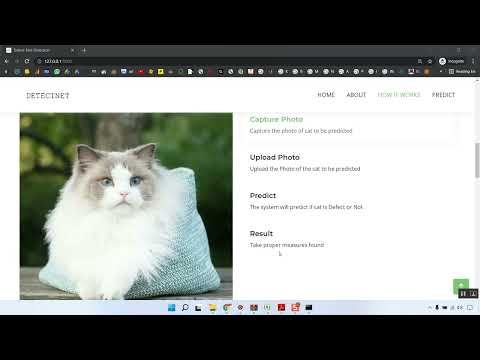
DefectNet Detection Classification CNN Flask App in Python Projects
र 1000
DefectNet Detection Classification CNN Flask App in Python Projects
Technical Details
Domain : Python
Database : Sqlite
Tools : Anaconda
Run Tools: VS Code
Database : Sqlite
Tools : Anaconda
Run Tools: VS Code
Secure Payment
Instant Download
GST Invoice
24/7 Support
About This Product
DefectNet Detection Classification CNN Flask App in Python Projects
Abstract
Defect detection in manufacturing and industrial systems is a crucial step in ensuring product quality and operational efficiency. Traditional manual inspection methods are time-consuming, error-prone, and unable to scale for modern production demands. The project “DefectNet Detection Classification CNN Flask App in Python” proposes a computer vision–based approach using deep learning to automatically detect and classify defects in products. Leveraging Convolutional Neural Networks (CNNs), the system processes input images, identifies defect regions, and classifies them into categories such as scratches, cracks, or surface anomalies. Python libraries like TensorFlow/Keras, OpenCV, NumPy, and Matplotlib are employed for model training and visualization. To make the system interactive and accessible, a Flask web application is developed where users can upload product images and receive real-time defect classification results. This project demonstrates the integration of AI-driven defect detection with a practical deployment platform for industrial applications.
Existing System
In existing manufacturing systems, defect detection is often carried out through manual inspections or rule-based computer vision techniques (e.g., edge detection, thresholding, and template matching). These methods are limited in adaptability and fail when defects are subtle, irregular, or occur in complex patterns. Traditional approaches also lack scalability for high-speed production lines and are prone to high false positive or false negative rates. While some companies employ automated vision systems, they are often expensive, proprietary, and not easily customizable for different industrial use cases. This creates a gap for lightweight, open-source, and accurate defect detection tools.
Proposed System
The proposed system introduces DefectNet, a Python-based defect detection and classification pipeline built using CNNs and deployed through Flask. The system preprocesses images by resizing, normalizing, and applying augmentation techniques to improve generalization. The CNN architecture is trained on labeled defect datasets, learning to extract spatial patterns and classify defect categories accurately. The output layer generates classification probabilities and highlights whether an image is defect-free or defective. For deployment, Flask provides a user-friendly web app where users can upload an image, run detection, and view classification results along with confidence scores. Additional features such as defect heatmaps (via Grad-CAM) can be integrated to enhance interpretability. This approach ensures scalability, low cost, and real-time usability, making it suitable for small and medium-scale industries.
Abstract
Defect detection in manufacturing and industrial systems is a crucial step in ensuring product quality and operational efficiency. Traditional manual inspection methods are time-consuming, error-prone, and unable to scale for modern production demands. The project “DefectNet Detection Classification CNN Flask App in Python” proposes a computer vision–based approach using deep learning to automatically detect and classify defects in products. Leveraging Convolutional Neural Networks (CNNs), the system processes input images, identifies defect regions, and classifies them into categories such as scratches, cracks, or surface anomalies. Python libraries like TensorFlow/Keras, OpenCV, NumPy, and Matplotlib are employed for model training and visualization. To make the system interactive and accessible, a Flask web application is developed where users can upload product images and receive real-time defect classification results. This project demonstrates the integration of AI-driven defect detection with a practical deployment platform for industrial applications.
Existing System
In existing manufacturing systems, defect detection is often carried out through manual inspections or rule-based computer vision techniques (e.g., edge detection, thresholding, and template matching). These methods are limited in adaptability and fail when defects are subtle, irregular, or occur in complex patterns. Traditional approaches also lack scalability for high-speed production lines and are prone to high false positive or false negative rates. While some companies employ automated vision systems, they are often expensive, proprietary, and not easily customizable for different industrial use cases. This creates a gap for lightweight, open-source, and accurate defect detection tools.
Proposed System
The proposed system introduces DefectNet, a Python-based defect detection and classification pipeline built using CNNs and deployed through Flask. The system preprocesses images by resizing, normalizing, and applying augmentation techniques to improve generalization. The CNN architecture is trained on labeled defect datasets, learning to extract spatial patterns and classify defect categories accurately. The output layer generates classification probabilities and highlights whether an image is defect-free or defective. For deployment, Flask provides a user-friendly web app where users can upload an image, run detection, and view classification results along with confidence scores. Additional features such as defect heatmaps (via Grad-CAM) can be integrated to enhance interpretability. This approach ensures scalability, low cost, and real-time usability, making it suitable for small and medium-scale industries.
Customer Reviews (0)
No reviews yet. Be the first!
Related Products
⭐ Featured

AI & ML Models
Zomato Restaurant Reviews Sentimental Analyzer in Python Projects
Zomato Restaurant Reviews Sentimental Analyzer in Python Projects
र 1000
⭐ Featured
⭐ Featured

AI & ML Models
Voice Disorder Prediction using Audio Dataset in Python Projects
Voice Disorder Prediction using Audio Dataset in Python Projects
र 1000
AI & ML Models
Vitamin Deficiency Detection Using Image Processing in Python Projects
Vitamin Deficiency Detection Using Image Processing in Python Projects
र 1000