AI & ML Models
0.0 (0 reviews) • 0 downloads
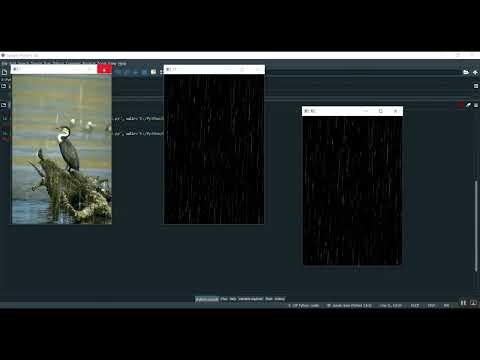
De-Rain Rain Drop Removal in Python Projects
र 1000
De-Rain Rain Drop Removal in Python Projects
Technical Details
Domain : Python
Database : Sqlite
Tools : Anaconda
Run Tools: VS Code
Database : Sqlite
Tools : Anaconda
Run Tools: VS Code
Secure Payment
Instant Download
GST Invoice
24/7 Support
About This Product
De-Rain Rain Drop Removal in Python Projects
Abstract
Rain streaks and raindrops significantly degrade the visibility and quality of outdoor images, affecting applications such as surveillance, autonomous driving, and photography. The project “De-Rain Rain Drop Removal in Python” focuses on developing a deep learning–based solution to restore clear images by removing raindrop artifacts. The system leverages Convolutional Neural Networks (CNNs) and advanced image processing techniques to separate rain streak patterns from background content and reconstruct high-quality images. Python libraries such as TensorFlow/Keras, OpenCV, NumPy, and Matplotlib are utilized for model training, testing, and evaluation. This project demonstrates how computer vision combined with deep learning can improve visual clarity and enable reliable image restoration under adverse weather conditions.
Existing System
Traditional deraining methods typically rely on filtering techniques (Gaussian, median, bilateral filters) or model-based approaches that assume rain streaks follow predefined patterns. While effective for simple cases, these methods often fail when raindrops are complex, irregular, or partially occlude background objects. Many existing algorithms also struggle with preserving fine image details, resulting in blurred or distorted outputs. Moreover, conventional approaches lack adaptability to different environments and weather intensities, making them unsuitable for real-world, dynamic applications like self-driving cars or real-time surveillance.
Proposed System
The proposed system introduces a deep learning–based rain removal model that learns to distinguish rain streaks and droplets from background features. Preprocessing involves preparing paired datasets of rainy and clean images, applying normalization, and augmentations. A CNN or encoder–decoder architecture (such as U-Net, ResNet, or GAN-based models) is trained to map rainy inputs to clean outputs by minimizing pixel-level reconstruction loss and perceptual similarity loss. Python’s OpenCV library is used for image handling, while deep learning frameworks handle training and inference. The final system takes rainy images as input and generates high-quality, de-rained images with preserved details. This approach ensures robustness, adaptability, and scalability across different weather conditions, offering a practical solution for computer vision applications in outdoor environments.
Abstract
Rain streaks and raindrops significantly degrade the visibility and quality of outdoor images, affecting applications such as surveillance, autonomous driving, and photography. The project “De-Rain Rain Drop Removal in Python” focuses on developing a deep learning–based solution to restore clear images by removing raindrop artifacts. The system leverages Convolutional Neural Networks (CNNs) and advanced image processing techniques to separate rain streak patterns from background content and reconstruct high-quality images. Python libraries such as TensorFlow/Keras, OpenCV, NumPy, and Matplotlib are utilized for model training, testing, and evaluation. This project demonstrates how computer vision combined with deep learning can improve visual clarity and enable reliable image restoration under adverse weather conditions.
Existing System
Traditional deraining methods typically rely on filtering techniques (Gaussian, median, bilateral filters) or model-based approaches that assume rain streaks follow predefined patterns. While effective for simple cases, these methods often fail when raindrops are complex, irregular, or partially occlude background objects. Many existing algorithms also struggle with preserving fine image details, resulting in blurred or distorted outputs. Moreover, conventional approaches lack adaptability to different environments and weather intensities, making them unsuitable for real-world, dynamic applications like self-driving cars or real-time surveillance.
Proposed System
The proposed system introduces a deep learning–based rain removal model that learns to distinguish rain streaks and droplets from background features. Preprocessing involves preparing paired datasets of rainy and clean images, applying normalization, and augmentations. A CNN or encoder–decoder architecture (such as U-Net, ResNet, or GAN-based models) is trained to map rainy inputs to clean outputs by minimizing pixel-level reconstruction loss and perceptual similarity loss. Python’s OpenCV library is used for image handling, while deep learning frameworks handle training and inference. The final system takes rainy images as input and generates high-quality, de-rained images with preserved details. This approach ensures robustness, adaptability, and scalability across different weather conditions, offering a practical solution for computer vision applications in outdoor environments.
Customer Reviews (0)
No reviews yet. Be the first!
Related Products
⭐ Featured

AI & ML Models
Zomato Restaurant Reviews Sentimental Analyzer in Python Projects
Zomato Restaurant Reviews Sentimental Analyzer in Python Projects
र 1000
⭐ Featured
⭐ Featured

AI & ML Models
Voice Disorder Prediction using Audio Dataset in Python Projects
Voice Disorder Prediction using Audio Dataset in Python Projects
र 1000
AI & ML Models
Vitamin Deficiency Detection Using Image Processing in Python Projects
Vitamin Deficiency Detection Using Image Processing in Python Projects
र 1000