AI & ML Models
0.0 (0 reviews) • 0 downloads
DDos Attack Detection in Python Projects
र 1000
DDos Attack Detection in Python Projects
Technical Details
Domain : Python
Database : Sqlite
Tools : Anaconda
Run Tools: VS Code
Database : Sqlite
Tools : Anaconda
Run Tools: VS Code
Secure Payment
Instant Download
GST Invoice
24/7 Support
About This Product
DDos Attack Detection in Python Projects
Abstract
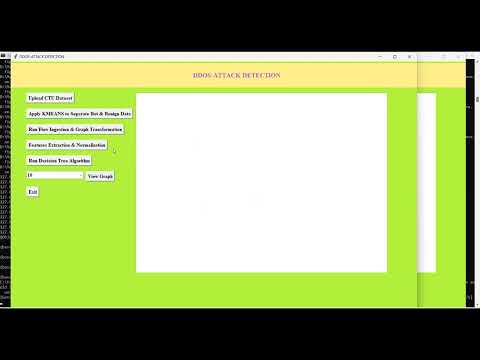
Distributed Denial of Service (DDoS) attacks remain one of the most disruptive cyber threats, overwhelming networked services by flooding them with high-volume traffic or exploiting protocol vulnerabilities to exhaust resources. The project DDoS Attack Detection in Python Projects aims to design and implement an intelligent detection system that identifies and classifies DDoS attacks in real time using a combination of statistical analysis, machine learning, and deep learning. Python is selected as the development platform for its strong networking, data-processing, and ML libraries such as Scapy, Pandas, NumPy, Scikit-learn, TensorFlow, and PyTorch. The system collects network flow and packet-level features, performs feature engineering and dimensionality reduction, and applies supervised and unsupervised models (e.g., Random Forest, XGBoost, Isolation Forest, LSTM) to detect volumetric, protocol, and application-layer attacks. Real-time alerting, visualization dashboards, and integration hooks for automated mitigation complete the pipeline, enabling faster incident response and improved service availability.
Existing System
Existing DDoS defenses commonly rely on static thresholding, signature-based detection, and perimeter devices such as basic firewalls or rate-limiters that trigger on unusually high traffic volumes or known malicious patterns. While effective for clear, high-volume floods, these techniques struggle with low-and-slow attacks, multi-vector campaigns, or attacks that mimic legitimate traffic. Many operational systems also lack adaptive learning capabilities and produce high false-positive rates during flash crowds or legitimate traffic spikes. Traditional methods frequently require manual tuning and do not scale well for high-speed networks, making them less effective in cloud and distributed environments. Moreover, some networks lack centralized telemetry aggregation, reducing visibility and delaying detection and mitigation of coordinated attacks.
Proposed System
The proposed system presents a Python-based, hybrid DDoS detection framework that integrates flow-based analytics, behavioral modeling, and machine/deep learning to improve accuracy and responsiveness. Network telemetry (NetFlow/IPFIX, packet captures) is ingested and aggregated into features such as packet rates, byte rates, unique source counts, entropy measures, protocol distributions, and temporal statistics. Feature selection and dimensionality reduction (PCA, feature importance) prepare inputs for classifiers; supervised models detect known attack patterns while unsupervised/anomaly detectors (Isolation Forest, Autoencoders) surface novel or stealthy attacks. For temporal and application-layer detection, sequence models like LSTM or CNN-LSTM analyze time-windowed feature sequences to spot subtle behavioral changes. The system includes online learning or periodic retraining to adapt to evolving traffic patterns, a scoring and confidence mechanism to prioritize alerts, and explainability outputs (feature contributions, SHAP values) to assist operators. Integration with mitigation modules—traffic shaping, dynamic ACL updates, or cloud-provider scrubbing APIs—enables automated or operator-approved responses. Dashboards visualize traffic trends and incidents for rapid forensic analysis. Overall, this hybrid approach increases detection robustness, reduces false alarms, and enables scalable, real-time DDoS defense suitable for enterprise and cloud deployments.
Abstract
Distributed Denial of Service (DDoS) attacks remain one of the most disruptive cyber threats, overwhelming networked services by flooding them with high-volume traffic or exploiting protocol vulnerabilities to exhaust resources. The project DDoS Attack Detection in Python Projects aims to design and implement an intelligent detection system that identifies and classifies DDoS attacks in real time using a combination of statistical analysis, machine learning, and deep learning. Python is selected as the development platform for its strong networking, data-processing, and ML libraries such as Scapy, Pandas, NumPy, Scikit-learn, TensorFlow, and PyTorch. The system collects network flow and packet-level features, performs feature engineering and dimensionality reduction, and applies supervised and unsupervised models (e.g., Random Forest, XGBoost, Isolation Forest, LSTM) to detect volumetric, protocol, and application-layer attacks. Real-time alerting, visualization dashboards, and integration hooks for automated mitigation complete the pipeline, enabling faster incident response and improved service availability.
Existing System
Existing DDoS defenses commonly rely on static thresholding, signature-based detection, and perimeter devices such as basic firewalls or rate-limiters that trigger on unusually high traffic volumes or known malicious patterns. While effective for clear, high-volume floods, these techniques struggle with low-and-slow attacks, multi-vector campaigns, or attacks that mimic legitimate traffic. Many operational systems also lack adaptive learning capabilities and produce high false-positive rates during flash crowds or legitimate traffic spikes. Traditional methods frequently require manual tuning and do not scale well for high-speed networks, making them less effective in cloud and distributed environments. Moreover, some networks lack centralized telemetry aggregation, reducing visibility and delaying detection and mitigation of coordinated attacks.
Proposed System
The proposed system presents a Python-based, hybrid DDoS detection framework that integrates flow-based analytics, behavioral modeling, and machine/deep learning to improve accuracy and responsiveness. Network telemetry (NetFlow/IPFIX, packet captures) is ingested and aggregated into features such as packet rates, byte rates, unique source counts, entropy measures, protocol distributions, and temporal statistics. Feature selection and dimensionality reduction (PCA, feature importance) prepare inputs for classifiers; supervised models detect known attack patterns while unsupervised/anomaly detectors (Isolation Forest, Autoencoders) surface novel or stealthy attacks. For temporal and application-layer detection, sequence models like LSTM or CNN-LSTM analyze time-windowed feature sequences to spot subtle behavioral changes. The system includes online learning or periodic retraining to adapt to evolving traffic patterns, a scoring and confidence mechanism to prioritize alerts, and explainability outputs (feature contributions, SHAP values) to assist operators. Integration with mitigation modules—traffic shaping, dynamic ACL updates, or cloud-provider scrubbing APIs—enables automated or operator-approved responses. Dashboards visualize traffic trends and incidents for rapid forensic analysis. Overall, this hybrid approach increases detection robustness, reduces false alarms, and enables scalable, real-time DDoS defense suitable for enterprise and cloud deployments.
Customer Reviews (0)
No reviews yet. Be the first!
Related Products
⭐ Featured

AI & ML Models
Zomato Restaurant Reviews Sentimental Analyzer in Python Projects
Zomato Restaurant Reviews Sentimental Analyzer in Python Projects
र 1000
⭐ Featured
⭐ Featured

AI & ML Models
Voice Disorder Prediction using Audio Dataset in Python Projects
Voice Disorder Prediction using Audio Dataset in Python Projects
र 1000

AI & ML Models
Vitamin Deficiency Detection Using Image Processing in Python Projects
Vitamin Deficiency Detection Using Image Processing in Python Projects
र 1000