AI & ML Models
0.0 (0 reviews) • 0 downloads
DDos Attack Decision Tree LSTM in Python Projects
र 1000
DDos Attack Decision Tree LSTM in Python Projects
Technical Details
Domain : Python
Database : Sqlite
Tools : Anaconda
Run Tools: VS Code
Database : Sqlite
Tools : Anaconda
Run Tools: VS Code
Secure Payment
Instant Download
GST Invoice
24/7 Support
About This Product
DDos Attack Decision Tree LSTM in Python Projects
Abstract
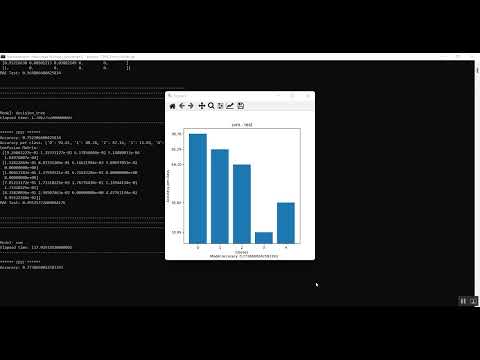
Distributed Denial of Service (DDoS) attacks disrupt services by overwhelming targeted servers or networks with illegitimate traffic. Detecting such attacks quickly and accurately is essential for maintaining network availability and reliability. The project “DDoS Attack Decision Tree LSTM in Python” combines traditional Decision Tree classifiers with advanced Long Short-Term Memory (LSTM) neural networks to improve the detection and classification of DDoS attacks. Decision Trees are employed to identify static patterns from network features, while LSTMs capture temporal patterns in traffic flows. Python’s rich ecosystem (NumPy, Pandas, Scikit-learn, TensorFlow/Keras, Matplotlib) is used for preprocessing, model training, and evaluation. This hybrid approach leverages both rule-based interpretability and deep learning’s sequence modeling power to enhance DDoS detection accuracy.
Existing System
Most existing DDoS detection mechanisms rely either on signature-based intrusion detection systems or on single machine-learning models trained on static snapshots of traffic. These systems often fail to capture time-dependent behaviors and struggle to adapt to evolving attack vectors. Traditional classifiers such as Decision Trees or SVMs may detect simple attacks but miss complex, multi-stage DDoS traffic. On the other hand, deep learning methods like LSTM models are often deployed without complementary interpretable models, which limits their transparency. Additionally, many existing tools lack integrated Python pipelines that combine preprocessing, hybrid modeling, and real-time dashboards.
Proposed System
The proposed system integrates Decision Tree classifiers and LSTM networks in a unified Python pipeline to detect and classify DDoS attacks more effectively. Network traffic is collected or imported from benchmark datasets, then preprocessed (feature scaling, encoding, and windowing of sequential data). The Decision Tree model first analyzes non-temporal features to identify potential anomalies, while the LSTM model processes time-series traffic data to detect sequential attack patterns. The outputs are combined (through ensemble or stacked models) to improve overall prediction accuracy and reduce false positives. A Flask-based web interface can be added for uploading traffic logs, monitoring live predictions, and visualizing model performance. This hybrid approach yields a more robust, interpretable, and adaptive solution to DDoS attack detection and classification.
Abstract
Distributed Denial of Service (DDoS) attacks disrupt services by overwhelming targeted servers or networks with illegitimate traffic. Detecting such attacks quickly and accurately is essential for maintaining network availability and reliability. The project “DDoS Attack Decision Tree LSTM in Python” combines traditional Decision Tree classifiers with advanced Long Short-Term Memory (LSTM) neural networks to improve the detection and classification of DDoS attacks. Decision Trees are employed to identify static patterns from network features, while LSTMs capture temporal patterns in traffic flows. Python’s rich ecosystem (NumPy, Pandas, Scikit-learn, TensorFlow/Keras, Matplotlib) is used for preprocessing, model training, and evaluation. This hybrid approach leverages both rule-based interpretability and deep learning’s sequence modeling power to enhance DDoS detection accuracy.
Existing System
Most existing DDoS detection mechanisms rely either on signature-based intrusion detection systems or on single machine-learning models trained on static snapshots of traffic. These systems often fail to capture time-dependent behaviors and struggle to adapt to evolving attack vectors. Traditional classifiers such as Decision Trees or SVMs may detect simple attacks but miss complex, multi-stage DDoS traffic. On the other hand, deep learning methods like LSTM models are often deployed without complementary interpretable models, which limits their transparency. Additionally, many existing tools lack integrated Python pipelines that combine preprocessing, hybrid modeling, and real-time dashboards.
Proposed System
The proposed system integrates Decision Tree classifiers and LSTM networks in a unified Python pipeline to detect and classify DDoS attacks more effectively. Network traffic is collected or imported from benchmark datasets, then preprocessed (feature scaling, encoding, and windowing of sequential data). The Decision Tree model first analyzes non-temporal features to identify potential anomalies, while the LSTM model processes time-series traffic data to detect sequential attack patterns. The outputs are combined (through ensemble or stacked models) to improve overall prediction accuracy and reduce false positives. A Flask-based web interface can be added for uploading traffic logs, monitoring live predictions, and visualizing model performance. This hybrid approach yields a more robust, interpretable, and adaptive solution to DDoS attack detection and classification.
Customer Reviews (0)
No reviews yet. Be the first!
Related Products
⭐ Featured

AI & ML Models
Zomato Restaurant Reviews Sentimental Analyzer in Python Projects
Zomato Restaurant Reviews Sentimental Analyzer in Python Projects
र 1000
⭐ Featured
⭐ Featured

AI & ML Models
Voice Disorder Prediction using Audio Dataset in Python Projects
Voice Disorder Prediction using Audio Dataset in Python Projects
र 1000

AI & ML Models
Vitamin Deficiency Detection Using Image Processing in Python Projects
Vitamin Deficiency Detection Using Image Processing in Python Projects
र 1000