AI & ML Models
0.0 (0 reviews) • 0 downloads
Dark Web Classification Based on TextCNN in Python Projects
Dark Web Classification Based on TextCNN in Python Projects
Technical Details
Domain : Python
Database : Sqlite
Tools : Anaconda
Run Tools: VS Code
Database : Sqlite
Tools : Anaconda
Run Tools: VS Code
Secure Payment
Instant Download
GST Invoice
24/7 Support
About This Product
Dark Web Classification Based on TextCNN in Python Projects
Abstract
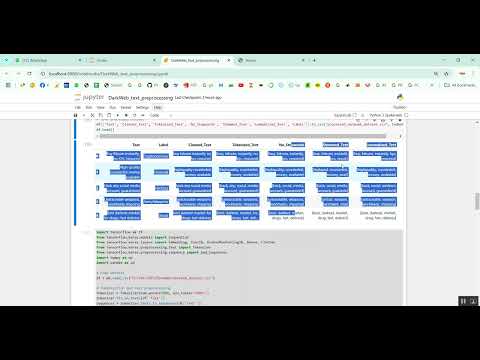
The Dark Web has become a hub for illegal transactions involving drugs, weapons, cybercrime services, financial fraud, and extremist content. Automatic classification of Dark Web content is essential for law enforcement, cybersecurity analysts, and intelligence agencies to monitor illegal activities and identify potential threats. The project Dark Web Classification Based on TextCNN in Python presents a deep learning-based text classification framework that uses Text Convolutional Neural Networks (TextCNN) to classify Dark Web forum posts, marketplace descriptions, and hidden service content into meaningful categories. Python is used to preprocess textual data, remove noise such as Tor-specific URLs, encryption keys, obfuscation patterns, and slang expressions, and convert text into vectorized representations using Word2Vec or FastText embeddings. The TextCNN model captures semantic and syntactic patterns from short and long text to perform accurate classification with high precision and recall. The proposed system supports cyber threat intelligence by enabling automated monitoring and detection of malicious hidden services.
Existing System
Existing Dark Web monitoring methods rely heavily on manual analysis, keyword filtering, and basic machine learning classifiers such as Naïve Bayes, Logistic Regression, and Support Vector Machines. These systems are limited in identifying concealed or evolving vocabularies used by criminal actors, leading to poor classification accuracy. Traditional bag-of-words and TF-IDF-based models fail to capture contextual meanings, phrase-level semantics, and linguistic patterns common in Dark Web communication. Furthermore, existing systems lack scalability, struggle with multilingual data, and cannot adapt to dynamic domain-specific vocabulary updates. Manual Dark Web investigations are slow, resource-intensive, and expose analysts to harmful and illegal content. As a result, current approaches are insufficient for real-time automated threat intelligence in hidden networks.
Proposed System
The proposed system leverages a deep learning architecture based on TextCNN to classify Dark Web content more accurately and efficiently. TextCNN utilizes multiple convolutional filters of varying kernel sizes to capture n-gram features and semantic patterns across textual data. The system preprocesses Dark Web crawled datasets by removing special characters, Tor onion links, stop words, and encoded patterns, and then transforms the cleaned text into dense embeddings using pretrained Word2Vec, FastText, or GloVe models. A convolution layer extracts local textual features, followed by max-pooling layers to retain key features, and fully connected layers for classification into categories such as drugs, fraud, hacking services, illegal pornography, and weapons. Python libraries like TensorFlow/Keras and PyTorch are used to build and train the model, while scikit-learn aids in evaluation metrics. The system is scalable, capable of handling large volumes of hidden content, and adaptable through retraining. This project enhances automated Dark Web surveillance and provides a reliable framework for cybercrime detection and intelligence analytics.
Abstract
The Dark Web has become a hub for illegal transactions involving drugs, weapons, cybercrime services, financial fraud, and extremist content. Automatic classification of Dark Web content is essential for law enforcement, cybersecurity analysts, and intelligence agencies to monitor illegal activities and identify potential threats. The project Dark Web Classification Based on TextCNN in Python presents a deep learning-based text classification framework that uses Text Convolutional Neural Networks (TextCNN) to classify Dark Web forum posts, marketplace descriptions, and hidden service content into meaningful categories. Python is used to preprocess textual data, remove noise such as Tor-specific URLs, encryption keys, obfuscation patterns, and slang expressions, and convert text into vectorized representations using Word2Vec or FastText embeddings. The TextCNN model captures semantic and syntactic patterns from short and long text to perform accurate classification with high precision and recall. The proposed system supports cyber threat intelligence by enabling automated monitoring and detection of malicious hidden services.
Existing System
Existing Dark Web monitoring methods rely heavily on manual analysis, keyword filtering, and basic machine learning classifiers such as Naïve Bayes, Logistic Regression, and Support Vector Machines. These systems are limited in identifying concealed or evolving vocabularies used by criminal actors, leading to poor classification accuracy. Traditional bag-of-words and TF-IDF-based models fail to capture contextual meanings, phrase-level semantics, and linguistic patterns common in Dark Web communication. Furthermore, existing systems lack scalability, struggle with multilingual data, and cannot adapt to dynamic domain-specific vocabulary updates. Manual Dark Web investigations are slow, resource-intensive, and expose analysts to harmful and illegal content. As a result, current approaches are insufficient for real-time automated threat intelligence in hidden networks.
Proposed System
The proposed system leverages a deep learning architecture based on TextCNN to classify Dark Web content more accurately and efficiently. TextCNN utilizes multiple convolutional filters of varying kernel sizes to capture n-gram features and semantic patterns across textual data. The system preprocesses Dark Web crawled datasets by removing special characters, Tor onion links, stop words, and encoded patterns, and then transforms the cleaned text into dense embeddings using pretrained Word2Vec, FastText, or GloVe models. A convolution layer extracts local textual features, followed by max-pooling layers to retain key features, and fully connected layers for classification into categories such as drugs, fraud, hacking services, illegal pornography, and weapons. Python libraries like TensorFlow/Keras and PyTorch are used to build and train the model, while scikit-learn aids in evaluation metrics. The system is scalable, capable of handling large volumes of hidden content, and adaptable through retraining. This project enhances automated Dark Web surveillance and provides a reliable framework for cybercrime detection and intelligence analytics.
Customer Reviews (0)
No reviews yet. Be the first!
Related Products
⭐ Featured
AI & ML Models
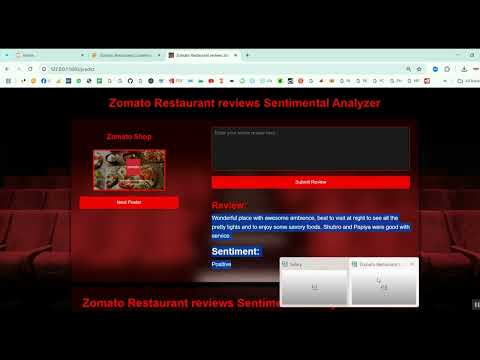
Zomato Restaurant Reviews Sentimental Analyzer in Python Projects
Zomato Restaurant Reviews Sentimental Analyzer in Python Projects
र 1000
⭐ Featured
⭐ Featured

AI & ML Models
Voice Disorder Prediction using Audio Dataset in Python Projects
Voice Disorder Prediction using Audio Dataset in Python Projects
र 1000

AI & ML Models
Vitamin Deficiency Detection Using Image Processing in Python Projects
Vitamin Deficiency Detection Using Image Processing in Python Projects
र 1000