AI & ML Models
0.0 (0 reviews) • 0 downloads
Cyber Thread UNSW AWID in Python Projects
र 1000
Cyber Thread UNSW AWID in Python Projects
Technical Details
Domain : Python
Database : Sqlite
Tools : Anaconda
Run Tools: VS Code
Database : Sqlite
Tools : Anaconda
Run Tools: VS Code
Secure Payment
Instant Download
GST Invoice
24/7 Support
About This Product
Cyber Thread UNSW AWID in Python Projects
Abstract
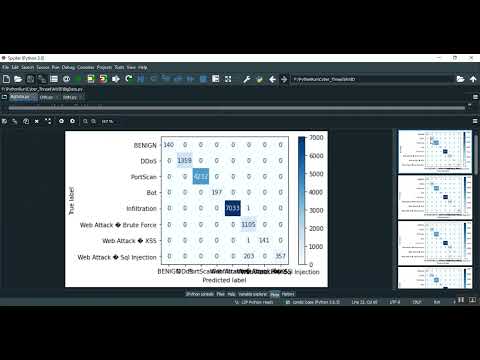
Cybersecurity threats targeting wireless and wired networks are growing in complexity, requiring automated solutions for detection and classification. Public datasets such as UNSW-NB15 and AWID provide large-scale, labeled network traffic that can be used to train machine learning models for intrusion detection. The project “Cyber Threat UNSW AWID in Python” focuses on building a Python-based application that ingests these datasets, applies advanced preprocessing, and develops machine learning models to detect and classify cyber threats. Using Python libraries such as Pandas, Scikit-learn, and TensorFlow/PyTorch, the system evaluates different algorithms (Random Forest, Gradient Boosting, SVM, and Deep Neural Networks) and applies feature selection to identify the most influential predictors. The project demonstrates how open datasets can be used to build scalable and accurate intrusion detection tools.
Existing System
Most existing intrusion detection systems rely on outdated datasets (like KDDCup99) or rule-based mechanisms that cannot handle modern, high-volume network traffic. Traditional IDS solutions also focus on signature-based detection, which fails against zero-day or novel attacks. The lack of benchmark-driven evaluation in many tools leads to poor generalization and high false positive rates. Furthermore, few existing systems provide user-friendly, Python-based frameworks for experimenting with both UNSW-NB15 and AWID datasets simultaneously, limiting opportunities for research and educational purposes.
Proposed System
The proposed system introduces a Python application for cyber threat detection using UNSW-NB15 and AWID datasets, offering an end-to-end pipeline from data ingestion to classification. The pipeline includes preprocessing steps such as feature encoding, normalization, and handling class imbalance (via SMOTE or undersampling). It then trains multiple classifiers — including Random Forest, Gradient Boosting, and Deep Neural Networks — and evaluates them using cross-validation to ensure robustness. Feature importance metrics highlight the top predictors for attack detection, giving interpretability to the model’s decisions. The system can also integrate with Flask to provide a web dashboard for uploading datasets, viewing metrics, and visualizing detected threats. This approach creates a practical, research-friendly, and extensible framework for intrusion detection based on modern cybersecurity datasets.
Abstract
Cybersecurity threats targeting wireless and wired networks are growing in complexity, requiring automated solutions for detection and classification. Public datasets such as UNSW-NB15 and AWID provide large-scale, labeled network traffic that can be used to train machine learning models for intrusion detection. The project “Cyber Threat UNSW AWID in Python” focuses on building a Python-based application that ingests these datasets, applies advanced preprocessing, and develops machine learning models to detect and classify cyber threats. Using Python libraries such as Pandas, Scikit-learn, and TensorFlow/PyTorch, the system evaluates different algorithms (Random Forest, Gradient Boosting, SVM, and Deep Neural Networks) and applies feature selection to identify the most influential predictors. The project demonstrates how open datasets can be used to build scalable and accurate intrusion detection tools.
Existing System
Most existing intrusion detection systems rely on outdated datasets (like KDDCup99) or rule-based mechanisms that cannot handle modern, high-volume network traffic. Traditional IDS solutions also focus on signature-based detection, which fails against zero-day or novel attacks. The lack of benchmark-driven evaluation in many tools leads to poor generalization and high false positive rates. Furthermore, few existing systems provide user-friendly, Python-based frameworks for experimenting with both UNSW-NB15 and AWID datasets simultaneously, limiting opportunities for research and educational purposes.
Proposed System
The proposed system introduces a Python application for cyber threat detection using UNSW-NB15 and AWID datasets, offering an end-to-end pipeline from data ingestion to classification. The pipeline includes preprocessing steps such as feature encoding, normalization, and handling class imbalance (via SMOTE or undersampling). It then trains multiple classifiers — including Random Forest, Gradient Boosting, and Deep Neural Networks — and evaluates them using cross-validation to ensure robustness. Feature importance metrics highlight the top predictors for attack detection, giving interpretability to the model’s decisions. The system can also integrate with Flask to provide a web dashboard for uploading datasets, viewing metrics, and visualizing detected threats. This approach creates a practical, research-friendly, and extensible framework for intrusion detection based on modern cybersecurity datasets.
Customer Reviews (0)
No reviews yet. Be the first!
Related Products
⭐ Featured

AI & ML Models
Zomato Restaurant Reviews Sentimental Analyzer in Python Projects
Zomato Restaurant Reviews Sentimental Analyzer in Python Projects
र 1000
⭐ Featured
⭐ Featured

AI & ML Models
Voice Disorder Prediction using Audio Dataset in Python Projects
Voice Disorder Prediction using Audio Dataset in Python Projects
र 1000

AI & ML Models
Vitamin Deficiency Detection Using Image Processing in Python Projects
Vitamin Deficiency Detection Using Image Processing in Python Projects
र 1000