Django Projects
0.0 (0 reviews) • 0 downloads
Crop Yield Ml Classification in Python Projects
र 1000
Crop Yield Ml Classification in Python Projects
Technical Details
Domain : Python
Database : Sqlite
Tools : Anaconda
Run Tools: VS Code
Database : Sqlite
Tools : Anaconda
Run Tools: VS Code
Secure Payment
Instant Download
GST Invoice
24/7 Support
About This Product
Crop Yield Ml Classification in Python Projects
Abstract
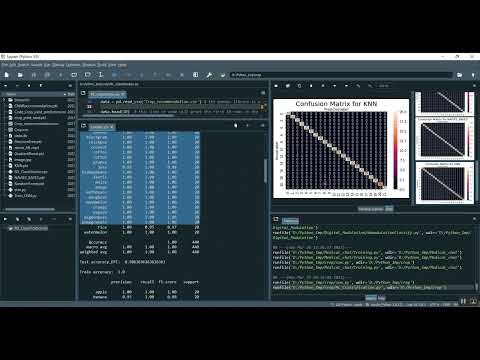
Accurate crop yield prediction is a vital aspect of modern agriculture, enabling farmers, policymakers, and agronomists to make informed decisions on resource allocation, crop selection, and market planning. This project, Crop Yield Prediction Using ML Classification in Python, applies machine learning algorithms to classify expected crop yields (e.g., high, medium, or low) based on soil parameters, climatic conditions, and crop features. The dataset includes attributes such as rainfall, temperature, humidity, soil fertility, and past crop performance. Using Python libraries such as Pandas, NumPy, Scikit-learn, and Matplotlib, the data is preprocessed, classified using ML models (e.g., Decision Tree, Random Forest, KNN, and SVM), and evaluated through accuracy, precision, recall, and F1-score. The system supports sustainable agriculture and minimizes farmer risks by providing data-driven yield predictions.
Existing System
Existing yield estimation methods rely heavily on historical yield averages, farmer experience, and agricultural surveys, which are often generalized, manual, and error-prone. Statistical regression-based approaches are also used but fail to capture nonlinear relationships and multiple variable dependencies. These systems often lack real-time adaptability, making them less effective in changing climatic and soil conditions. Moreover, most available solutions are not accessible to small-scale farmers due to lack of simple interfaces or personalized prediction.
Proposed System
The proposed system introduces a machine learning classification approach for crop yield prediction. The workflow includes data preprocessing (handling missing values, encoding categorical variables, and feature scaling), followed by training ML classifiers such as Decision Tree, Random Forest, KNN, and SVM. The models classify yield into different categories (high, medium, or low), providing actionable insights for farmers. The system is evaluated using metrics like confusion matrix and ROC curve to ensure robustness. Compared to existing systems, this ML-based approach delivers higher accuracy, adaptability to diverse datasets, and the ability to process multiple features simultaneously, making it a reliable decision-support tool for precision agriculture.
Abstract
Accurate crop yield prediction is a vital aspect of modern agriculture, enabling farmers, policymakers, and agronomists to make informed decisions on resource allocation, crop selection, and market planning. This project, Crop Yield Prediction Using ML Classification in Python, applies machine learning algorithms to classify expected crop yields (e.g., high, medium, or low) based on soil parameters, climatic conditions, and crop features. The dataset includes attributes such as rainfall, temperature, humidity, soil fertility, and past crop performance. Using Python libraries such as Pandas, NumPy, Scikit-learn, and Matplotlib, the data is preprocessed, classified using ML models (e.g., Decision Tree, Random Forest, KNN, and SVM), and evaluated through accuracy, precision, recall, and F1-score. The system supports sustainable agriculture and minimizes farmer risks by providing data-driven yield predictions.
Existing System
Existing yield estimation methods rely heavily on historical yield averages, farmer experience, and agricultural surveys, which are often generalized, manual, and error-prone. Statistical regression-based approaches are also used but fail to capture nonlinear relationships and multiple variable dependencies. These systems often lack real-time adaptability, making them less effective in changing climatic and soil conditions. Moreover, most available solutions are not accessible to small-scale farmers due to lack of simple interfaces or personalized prediction.
Proposed System
The proposed system introduces a machine learning classification approach for crop yield prediction. The workflow includes data preprocessing (handling missing values, encoding categorical variables, and feature scaling), followed by training ML classifiers such as Decision Tree, Random Forest, KNN, and SVM. The models classify yield into different categories (high, medium, or low), providing actionable insights for farmers. The system is evaluated using metrics like confusion matrix and ROC curve to ensure robustness. Compared to existing systems, this ML-based approach delivers higher accuracy, adaptability to diverse datasets, and the ability to process multiple features simultaneously, making it a reliable decision-support tool for precision agriculture.
Customer Reviews (0)
No reviews yet. Be the first!
Related Products
⭐ Featured
⭐ Featured

Django Projects
Music Event Booking App in Django Python
Music Event Booking App in Django Python
र 1000
⭐ Featured
Django Projects
Multi Server Management System in Django Python
Multi Server Management System in Django Python
र 1000
⭐ Featured

Django Projects
Multi Authority Access Control in Django Python
Multi Authority Access Control in Django Python
र 1000