AI & ML Models
0.0 (0 reviews) • 0 downloads
Credit Card PSO using DL in Python Projects
र 1000
Credit Card PSO using DL in Python Projects
Technical Details
Domain : Python
Database : Sqlite
Tools : Anaconda
Run Tools: VS Code
Database : Sqlite
Tools : Anaconda
Run Tools: VS Code
Secure Payment
Instant Download
GST Invoice
24/7 Support
About This Product
Credit Card PSO using DL in Python Projects
Abstract
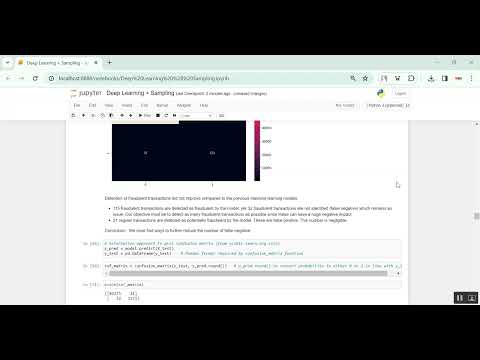
Credit card fraud poses a significant threat to financial institutions and customers, leading to substantial economic losses and reduced trust in digital transactions. Detecting fraudulent transactions efficiently and accurately is essential to mitigate risk. This project develops a Python-based system that combines Particle Swarm Optimization (PSO) and Deep Learning (DL) techniques for credit card fraud detection. PSO is employed to optimize feature selection and model parameters, while deep learning models such as Convolutional Neural Networks (CNN) or Long Short-Term Memory (LSTM) networks are used to classify transactions as legitimate or fraudulent. This hybrid approach improves detection accuracy, reduces false positives, and provides real-time monitoring, ensuring secure financial transactions and efficient fraud management.
Existing System
Traditional credit card fraud detection systems often rely on manual monitoring, rule-based checks, or basic statistical methods. These approaches are inefficient for detecting complex fraud patterns and cannot adapt to evolving fraudulent behaviors. Conventional machine learning methods, such as Decision Trees, Support Vector Machines (SVM), and Random Forests, have been applied but struggle with high-dimensional datasets and class imbalance, where fraudulent transactions are rare compared to legitimate ones. Existing systems rarely employ optimization techniques to enhance feature selection or model performance, leading to suboptimal accuracy, longer training times, and higher false positive rates. Furthermore, they often lack real-time applicability and robustness for large-scale financial systems.
Proposed System
The proposed system integrates Particle Swarm Optimization (PSO) with Deep Learning (DL) models to improve credit card fraud detection. PSO is used to select the most relevant features and optimize hyperparameters of the deep learning model, reducing dimensionality and improving computational efficiency. Deep learning models, such as LSTM networks, analyze sequential transaction data to capture temporal patterns and classify transactions as fraudulent or legitimate. Class imbalance is addressed using techniques like SMOTE (Synthetic Minority Over-sampling Technique), enhancing detection of rare fraudulent events. Python libraries such as Pandas, NumPy, PySwarms, TensorFlow, and Keras are employed for data preprocessing, PSO implementation, model training, and evaluation. By combining PSO for optimization and deep learning for classification, the system achieves high accuracy, minimizes false positives, and enables real-time fraud detection, ensuring secure and reliable financial operations.
Abstract
Credit card fraud poses a significant threat to financial institutions and customers, leading to substantial economic losses and reduced trust in digital transactions. Detecting fraudulent transactions efficiently and accurately is essential to mitigate risk. This project develops a Python-based system that combines Particle Swarm Optimization (PSO) and Deep Learning (DL) techniques for credit card fraud detection. PSO is employed to optimize feature selection and model parameters, while deep learning models such as Convolutional Neural Networks (CNN) or Long Short-Term Memory (LSTM) networks are used to classify transactions as legitimate or fraudulent. This hybrid approach improves detection accuracy, reduces false positives, and provides real-time monitoring, ensuring secure financial transactions and efficient fraud management.
Existing System
Traditional credit card fraud detection systems often rely on manual monitoring, rule-based checks, or basic statistical methods. These approaches are inefficient for detecting complex fraud patterns and cannot adapt to evolving fraudulent behaviors. Conventional machine learning methods, such as Decision Trees, Support Vector Machines (SVM), and Random Forests, have been applied but struggle with high-dimensional datasets and class imbalance, where fraudulent transactions are rare compared to legitimate ones. Existing systems rarely employ optimization techniques to enhance feature selection or model performance, leading to suboptimal accuracy, longer training times, and higher false positive rates. Furthermore, they often lack real-time applicability and robustness for large-scale financial systems.
Proposed System
The proposed system integrates Particle Swarm Optimization (PSO) with Deep Learning (DL) models to improve credit card fraud detection. PSO is used to select the most relevant features and optimize hyperparameters of the deep learning model, reducing dimensionality and improving computational efficiency. Deep learning models, such as LSTM networks, analyze sequential transaction data to capture temporal patterns and classify transactions as fraudulent or legitimate. Class imbalance is addressed using techniques like SMOTE (Synthetic Minority Over-sampling Technique), enhancing detection of rare fraudulent events. Python libraries such as Pandas, NumPy, PySwarms, TensorFlow, and Keras are employed for data preprocessing, PSO implementation, model training, and evaluation. By combining PSO for optimization and deep learning for classification, the system achieves high accuracy, minimizes false positives, and enables real-time fraud detection, ensuring secure and reliable financial operations.
Customer Reviews (0)
No reviews yet. Be the first!
Related Products
⭐ Featured

AI & ML Models
Zomato Restaurant Reviews Sentimental Analyzer in Python Projects
Zomato Restaurant Reviews Sentimental Analyzer in Python Projects
र 1000
⭐ Featured
⭐ Featured

AI & ML Models
Voice Disorder Prediction using Audio Dataset in Python Projects
Voice Disorder Prediction using Audio Dataset in Python Projects
र 1000

AI & ML Models
Vitamin Deficiency Detection Using Image Processing in Python Projects
Vitamin Deficiency Detection Using Image Processing in Python Projects
र 1000