AI & ML Models
0.0 (0 reviews) • 0 downloads
Cotton Leaf Disease Detection in Python Projects
र 1000
Cotton Leaf Disease Detection in Python Projects
Technical Details
Domain : Python
Database : Sqlite
Tools : Anaconda
Run Tools: VS Code
Database : Sqlite
Tools : Anaconda
Run Tools: VS Code
Secure Payment
Instant Download
GST Invoice
24/7 Support
About This Product
Cotton Leaf Disease Detection in Python Projects
Abstract
Cotton is a vital cash crop, but its production is severely affected by leaf diseases caused by fungi, bacteria, and environmental factors. Early and accurate detection of these diseases is essential to reduce yield loss and improve crop quality. This project develops a Python-based cotton leaf disease detection system using image processing and machine learning techniques. The system captures leaf images, preprocesses them to enhance relevant features, and classifies them into healthy or various disease categories. By automating the detection process, the system provides timely and reliable diagnosis, enabling farmers and agricultural specialists to implement effective disease management strategies and minimize economic losses.
Existing System
Traditionally, cotton leaf disease detection is performed manually by farmers or agricultural experts through visual inspection. This method is time-consuming, subjective, and prone to human error, particularly when dealing with large plantations. Some early automated systems utilized basic image processing methods, such as thresholding and color segmentation, to identify diseased regions. However, these techniques are sensitive to variations in lighting, leaf orientation, and background noise, resulting in inconsistent detection. Conventional machine learning methods, including Support Vector Machines (SVM) and K-Nearest Neighbors (KNN), rely on hand-crafted features and often fail to accurately classify multiple disease types in complex scenarios. Consequently, existing approaches lack scalability, robustness, and real-time applicability.
Proposed System
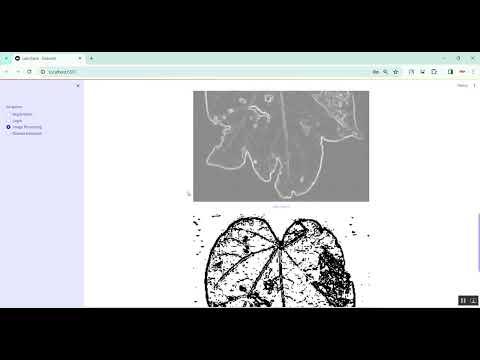
The proposed system implements a Python-based cotton leaf disease detection framework using advanced image processing and deep learning algorithms for improved accuracy and efficiency. Leaf images are preprocessed to remove noise, normalize color variations, and enhance critical features. Convolutional Neural Networks (CNNs) are then applied to extract deep features and classify the leaves into healthy or diseased categories, such as leaf spot, bacterial blight, or powdery mildew. Python libraries such as OpenCV, TensorFlow, and PyTorch are utilized to build, train, and test the model. The system also supports real-time detection, making it suitable for large-scale agricultural monitoring. By accurately detecting diseases and providing rapid feedback, the proposed approach helps farmers take timely action, optimize crop protection strategies, and improve overall cotton yield.
Abstract
Cotton is a vital cash crop, but its production is severely affected by leaf diseases caused by fungi, bacteria, and environmental factors. Early and accurate detection of these diseases is essential to reduce yield loss and improve crop quality. This project develops a Python-based cotton leaf disease detection system using image processing and machine learning techniques. The system captures leaf images, preprocesses them to enhance relevant features, and classifies them into healthy or various disease categories. By automating the detection process, the system provides timely and reliable diagnosis, enabling farmers and agricultural specialists to implement effective disease management strategies and minimize economic losses.
Existing System
Traditionally, cotton leaf disease detection is performed manually by farmers or agricultural experts through visual inspection. This method is time-consuming, subjective, and prone to human error, particularly when dealing with large plantations. Some early automated systems utilized basic image processing methods, such as thresholding and color segmentation, to identify diseased regions. However, these techniques are sensitive to variations in lighting, leaf orientation, and background noise, resulting in inconsistent detection. Conventional machine learning methods, including Support Vector Machines (SVM) and K-Nearest Neighbors (KNN), rely on hand-crafted features and often fail to accurately classify multiple disease types in complex scenarios. Consequently, existing approaches lack scalability, robustness, and real-time applicability.
Proposed System
The proposed system implements a Python-based cotton leaf disease detection framework using advanced image processing and deep learning algorithms for improved accuracy and efficiency. Leaf images are preprocessed to remove noise, normalize color variations, and enhance critical features. Convolutional Neural Networks (CNNs) are then applied to extract deep features and classify the leaves into healthy or diseased categories, such as leaf spot, bacterial blight, or powdery mildew. Python libraries such as OpenCV, TensorFlow, and PyTorch are utilized to build, train, and test the model. The system also supports real-time detection, making it suitable for large-scale agricultural monitoring. By accurately detecting diseases and providing rapid feedback, the proposed approach helps farmers take timely action, optimize crop protection strategies, and improve overall cotton yield.
Customer Reviews (0)
No reviews yet. Be the first!
Related Products
⭐ Featured

AI & ML Models
Zomato Restaurant Reviews Sentimental Analyzer in Python Projects
Zomato Restaurant Reviews Sentimental Analyzer in Python Projects
र 1000
⭐ Featured
⭐ Featured

AI & ML Models
Voice Disorder Prediction using Audio Dataset in Python Projects
Voice Disorder Prediction using Audio Dataset in Python Projects
र 1000
AI & ML Models
Vitamin Deficiency Detection Using Image Processing in Python Projects
Vitamin Deficiency Detection Using Image Processing in Python Projects
र 1000