Django Projects
0.0 (0 reviews) • 0 downloads
Climate Weather Prediction By Twitter Data in Python Projects
र 1000
Climate Weather Prediction By Twitter Data in Python Projects
Technical Details
Domain : Python
Database : Sqlite
Tools : Anaconda
Run Tools: VS Code
Database : Sqlite
Tools : Anaconda
Run Tools: VS Code
Secure Payment
Instant Download
GST Invoice
24/7 Support
About This Product
Climate Weather Prediction By Twitter Data in Python Projects
Abstract
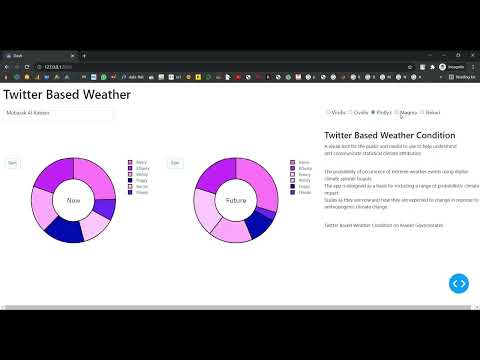
Accurate weather prediction is crucial for disaster management, agriculture, transportation, and daily life planning. Traditional weather prediction systems rely on meteorological data collected from sensors, satellites, and weather stations. This project, Climate Weather Prediction by Twitter Data in Python, explores using social media data, specifically Twitter, as an alternative data source to predict weather conditions. Tweets related to weather events are collected, preprocessed, and analyzed using Natural Language Processing (NLP) techniques and machine learning models. Python libraries such as Tweepy, Pandas, NumPy, Scikit-learn, NLTK, and TensorFlow/Keras are used to clean, tokenize, and extract sentiment and feature information from tweets. The system predicts weather patterns such as sunny, rainy, stormy, or snowy conditions, demonstrating how social media data can complement traditional meteorological models.
Existing System
Traditional weather prediction relies on numerical weather prediction (NWP) models, sensor networks, and satellite data. While accurate, these methods are resource-intensive, computationally expensive, and sometimes delayed due to processing time. Some machine learning–based systems use historical weather data for short-term forecasting, but they lack real-time human-generated information that can capture micro-level events like local rain, storms, or temperature anomalies. Social media data as a predictive tool is largely unexplored in conventional weather prediction systems.
Proposed System
The proposed system introduces a Twitter-based weather prediction framework. The workflow includes data collection (using Tweepy API to fetch tweets with weather-related keywords), data preprocessing (removing stop words, special characters, and URLs), and feature extraction (TF-IDF vectors, sentiment scores, or word embeddings). Machine learning models such as Random Forest, SVM, or LSTM networks are trained to classify tweets into weather categories. Predictions can be visualized or reported in real time to reflect ongoing weather events. Compared to existing systems, this approach leverages real-time social insights, provides localized predictions, and complements traditional meteorological models, offering an innovative and cost-effective method for climate and weather monitoring.
Abstract
Accurate weather prediction is crucial for disaster management, agriculture, transportation, and daily life planning. Traditional weather prediction systems rely on meteorological data collected from sensors, satellites, and weather stations. This project, Climate Weather Prediction by Twitter Data in Python, explores using social media data, specifically Twitter, as an alternative data source to predict weather conditions. Tweets related to weather events are collected, preprocessed, and analyzed using Natural Language Processing (NLP) techniques and machine learning models. Python libraries such as Tweepy, Pandas, NumPy, Scikit-learn, NLTK, and TensorFlow/Keras are used to clean, tokenize, and extract sentiment and feature information from tweets. The system predicts weather patterns such as sunny, rainy, stormy, or snowy conditions, demonstrating how social media data can complement traditional meteorological models.
Existing System
Traditional weather prediction relies on numerical weather prediction (NWP) models, sensor networks, and satellite data. While accurate, these methods are resource-intensive, computationally expensive, and sometimes delayed due to processing time. Some machine learning–based systems use historical weather data for short-term forecasting, but they lack real-time human-generated information that can capture micro-level events like local rain, storms, or temperature anomalies. Social media data as a predictive tool is largely unexplored in conventional weather prediction systems.
Proposed System
The proposed system introduces a Twitter-based weather prediction framework. The workflow includes data collection (using Tweepy API to fetch tweets with weather-related keywords), data preprocessing (removing stop words, special characters, and URLs), and feature extraction (TF-IDF vectors, sentiment scores, or word embeddings). Machine learning models such as Random Forest, SVM, or LSTM networks are trained to classify tweets into weather categories. Predictions can be visualized or reported in real time to reflect ongoing weather events. Compared to existing systems, this approach leverages real-time social insights, provides localized predictions, and complements traditional meteorological models, offering an innovative and cost-effective method for climate and weather monitoring.
Customer Reviews (0)
No reviews yet. Be the first!
Related Products
⭐ Featured
⭐ Featured

Django Projects
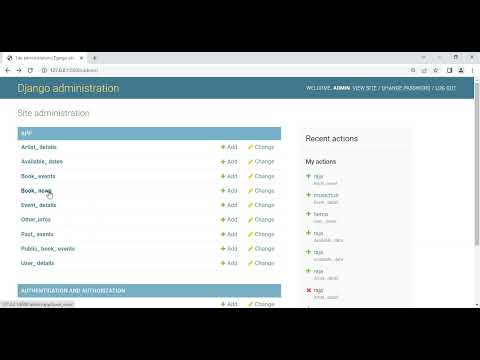
Music Event Booking App in Django Python
Music Event Booking App in Django Python
र 1000
⭐ Featured
Django Projects
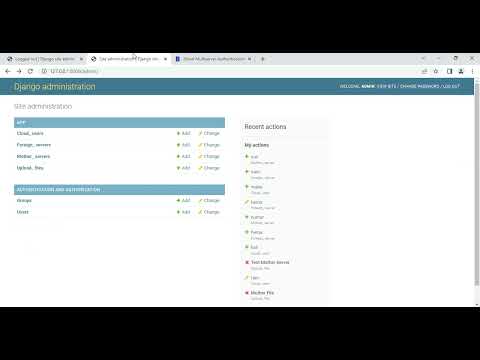
Multi Server Management System in Django Python
Multi Server Management System in Django Python
र 1000
⭐ Featured

Django Projects
Multi Authority Access Control in Django Python
Multi Authority Access Control in Django Python
र 1000