Django Projects
0.0 (0 reviews) • 0 downloads
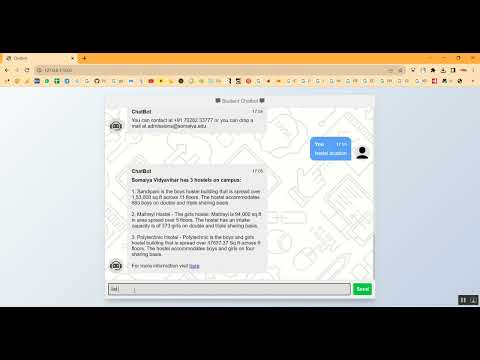
Chat bot Data Analysis in Python Projects
र 1000
Chat bot Data Analysis in Python Projects
Technical Details
Domain : Python
Database : Sqlite
Tools : Anaconda
Run Tools: VS Code
Database : Sqlite
Tools : Anaconda
Run Tools: VS Code
Secure Payment
Instant Download
GST Invoice
24/7 Support
About This Product
Chat bot Data Analysis in Python Projects
Abstract
Chatbots have become a key component in modern digital communication, providing automated customer support, information retrieval, and conversational interfaces across industries. Analyzing chatbot data is essential to improve user experience, enhance response accuracy, and optimize system performance. This project, Chatbot Data Analysis in Python, focuses on collecting, preprocessing, and analyzing conversational data generated by chatbots to identify patterns, common queries, and response effectiveness. Using Python libraries such as Pandas, NumPy, NLTK, Scikit-learn, and Matplotlib, the system performs tasks including sentiment analysis, query classification, frequency analysis, and response evaluation. Insights obtained from the analysis can guide improvements in chatbot design, training datasets, and machine learning models for natural language understanding.
Existing System
Current chatbot systems primarily rely on rule-based responses or pre-trained conversational models such as retrieval-based or generative models. While functional, these systems often lack mechanisms for analyzing chatbot interactions, leading to missed insights on user behavior, common issues, or system weaknesses. Some existing tools provide basic metrics such as the number of queries or simple success rates, but they do not offer comprehensive analysis of sentiment, topic trends, or response quality. Consequently, chatbot optimization is often performed manually and is not data-driven, limiting improvements in performance and user satisfaction.
Proposed System
The proposed system introduces a Python-based chatbot data analysis framework to automate and enhance the evaluation of chatbot interactions. The process includes data preprocessing (cleaning chat logs, tokenization, and stop-word removal), feature extraction (TF-IDF, word embeddings), and analysis using machine learning and natural language processing techniques such as clustering, sentiment analysis, and topic modeling. Visualization tools (Matplotlib, Seaborn, or Plotly) are used to display trends, common queries, and sentiment distribution. By identifying user behavior patterns, frequently asked questions, and system weaknesses, the system enables data-driven optimization of chatbot responses. Compared to existing methods, this approach provides actionable insights, automated evaluation, and improved user satisfaction, making it useful for businesses, educational platforms, and service-oriented applications.
Abstract
Chatbots have become a key component in modern digital communication, providing automated customer support, information retrieval, and conversational interfaces across industries. Analyzing chatbot data is essential to improve user experience, enhance response accuracy, and optimize system performance. This project, Chatbot Data Analysis in Python, focuses on collecting, preprocessing, and analyzing conversational data generated by chatbots to identify patterns, common queries, and response effectiveness. Using Python libraries such as Pandas, NumPy, NLTK, Scikit-learn, and Matplotlib, the system performs tasks including sentiment analysis, query classification, frequency analysis, and response evaluation. Insights obtained from the analysis can guide improvements in chatbot design, training datasets, and machine learning models for natural language understanding.
Existing System
Current chatbot systems primarily rely on rule-based responses or pre-trained conversational models such as retrieval-based or generative models. While functional, these systems often lack mechanisms for analyzing chatbot interactions, leading to missed insights on user behavior, common issues, or system weaknesses. Some existing tools provide basic metrics such as the number of queries or simple success rates, but they do not offer comprehensive analysis of sentiment, topic trends, or response quality. Consequently, chatbot optimization is often performed manually and is not data-driven, limiting improvements in performance and user satisfaction.
Proposed System
The proposed system introduces a Python-based chatbot data analysis framework to automate and enhance the evaluation of chatbot interactions. The process includes data preprocessing (cleaning chat logs, tokenization, and stop-word removal), feature extraction (TF-IDF, word embeddings), and analysis using machine learning and natural language processing techniques such as clustering, sentiment analysis, and topic modeling. Visualization tools (Matplotlib, Seaborn, or Plotly) are used to display trends, common queries, and sentiment distribution. By identifying user behavior patterns, frequently asked questions, and system weaknesses, the system enables data-driven optimization of chatbot responses. Compared to existing methods, this approach provides actionable insights, automated evaluation, and improved user satisfaction, making it useful for businesses, educational platforms, and service-oriented applications.
Customer Reviews (0)
No reviews yet. Be the first!
Related Products
⭐ Featured
⭐ Featured
Django Projects
Music Event Booking App in Django Python
Music Event Booking App in Django Python
र 1000
⭐ Featured
Django Projects
Multi Server Management System in Django Python
Multi Server Management System in Django Python
र 1000
⭐ Featured

Django Projects
Multi Authority Access Control in Django Python
Multi Authority Access Control in Django Python
र 1000