AI & ML Models
0.0 (0 reviews) • 0 downloads
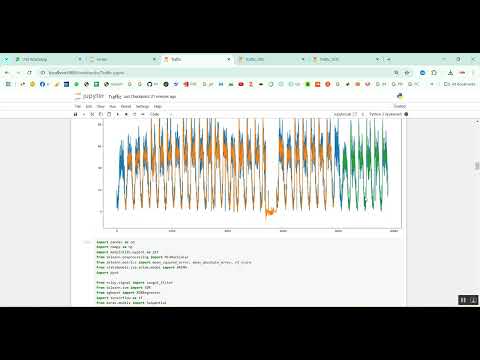
Ceemdan and Attention Mechanism Network Traffic Prediction in Python Projects
र 1000
Ceemdan and Attention Mechanism Network Traffic Prediction in Python Projects
Technical Details
Domain : Python
Database : Sqlite
Tools : Anaconda
Run Tools: VS Code
Database : Sqlite
Tools : Anaconda
Run Tools: VS Code
Secure Payment
Instant Download
GST Invoice
24/7 Support
About This Product
Ceemdan and Attention Mechanism Network Traffic Prediction in Python Projects
Abstract
Accurate network traffic prediction is critical for optimizing resource allocation, reducing congestion, and improving the performance of communication networks. The project titled CEEMDAN and Attention Mechanism Network Traffic Prediction in Python Projects focuses on developing a hybrid predictive framework that combines signal decomposition and deep learning techniques. CEEMDAN (Complete Ensemble Empirical Mode Decomposition with Adaptive Noise) is used to decompose complex network traffic signals into intrinsic mode functions, capturing multi-scale temporal patterns. An attention-based neural network is then applied to selectively focus on important temporal features and improve prediction accuracy. Python is used as the development platform due to its powerful libraries such as NumPy, Pandas, SciPy, TensorFlow, and Keras. The proposed system aims to provide accurate short-term and long-term network traffic forecasts, enabling better network management, load balancing, and proactive decision-making.
Existing System
Existing network traffic prediction systems typically rely on statistical models such as ARIMA, moving averages, or basic neural networks. While these models can capture linear patterns, they struggle with nonlinear, volatile, and highly dynamic traffic data. Conventional deep learning models such as LSTM or GRU have improved predictive performance but often treat the traffic signal as a single input sequence, ignoring multi-scale patterns inherent in network traffic. Additionally, many systems lack feature selection mechanisms to focus on the most relevant temporal information, which may reduce accuracy and increase computational overhead. Existing approaches are limited in handling high-frequency fluctuations, sudden bursts, or seasonal variations, leading to suboptimal network resource management.
Proposed System
The proposed system introduces a Python-based hybrid approach combining CEEMDAN signal decomposition with an attention-based deep learning network for network traffic prediction. Raw traffic data is first decomposed into intrinsic mode functions (IMFs) using CEEMDAN, separating low- and high-frequency components to capture multi-scale temporal patterns. Each IMF is then fed into an attention-augmented neural network, such as LSTM or GRU with attention layers, to selectively focus on important temporal features that contribute most to accurate forecasting. Python libraries such as PyEMD are used for CEEMDAN decomposition, while TensorFlow and Keras are used to implement the attention-based neural networks. The system is trained on historical network traffic datasets and evaluated using metrics such as Mean Absolute Error (MAE), Root Mean Square Error (RMSE), and Mean Absolute Percentage Error (MAPE). This hybrid approach enhances prediction accuracy, handles nonlinear and non-stationary traffic patterns, and supports intelligent network resource allocation and congestion control in real-time applications.
Abstract
Accurate network traffic prediction is critical for optimizing resource allocation, reducing congestion, and improving the performance of communication networks. The project titled CEEMDAN and Attention Mechanism Network Traffic Prediction in Python Projects focuses on developing a hybrid predictive framework that combines signal decomposition and deep learning techniques. CEEMDAN (Complete Ensemble Empirical Mode Decomposition with Adaptive Noise) is used to decompose complex network traffic signals into intrinsic mode functions, capturing multi-scale temporal patterns. An attention-based neural network is then applied to selectively focus on important temporal features and improve prediction accuracy. Python is used as the development platform due to its powerful libraries such as NumPy, Pandas, SciPy, TensorFlow, and Keras. The proposed system aims to provide accurate short-term and long-term network traffic forecasts, enabling better network management, load balancing, and proactive decision-making.
Existing System
Existing network traffic prediction systems typically rely on statistical models such as ARIMA, moving averages, or basic neural networks. While these models can capture linear patterns, they struggle with nonlinear, volatile, and highly dynamic traffic data. Conventional deep learning models such as LSTM or GRU have improved predictive performance but often treat the traffic signal as a single input sequence, ignoring multi-scale patterns inherent in network traffic. Additionally, many systems lack feature selection mechanisms to focus on the most relevant temporal information, which may reduce accuracy and increase computational overhead. Existing approaches are limited in handling high-frequency fluctuations, sudden bursts, or seasonal variations, leading to suboptimal network resource management.
Proposed System
The proposed system introduces a Python-based hybrid approach combining CEEMDAN signal decomposition with an attention-based deep learning network for network traffic prediction. Raw traffic data is first decomposed into intrinsic mode functions (IMFs) using CEEMDAN, separating low- and high-frequency components to capture multi-scale temporal patterns. Each IMF is then fed into an attention-augmented neural network, such as LSTM or GRU with attention layers, to selectively focus on important temporal features that contribute most to accurate forecasting. Python libraries such as PyEMD are used for CEEMDAN decomposition, while TensorFlow and Keras are used to implement the attention-based neural networks. The system is trained on historical network traffic datasets and evaluated using metrics such as Mean Absolute Error (MAE), Root Mean Square Error (RMSE), and Mean Absolute Percentage Error (MAPE). This hybrid approach enhances prediction accuracy, handles nonlinear and non-stationary traffic patterns, and supports intelligent network resource allocation and congestion control in real-time applications.
Customer Reviews (0)
No reviews yet. Be the first!
Related Products
⭐ Featured

AI & ML Models
Zomato Restaurant Reviews Sentimental Analyzer in Python Projects
Zomato Restaurant Reviews Sentimental Analyzer in Python Projects
र 1000
⭐ Featured
⭐ Featured

AI & ML Models
Voice Disorder Prediction using Audio Dataset in Python Projects
Voice Disorder Prediction using Audio Dataset in Python Projects
र 1000

AI & ML Models
Vitamin Deficiency Detection Using Image Processing in Python Projects
Vitamin Deficiency Detection Using Image Processing in Python Projects
र 1000