Django Projects
0.0 (0 reviews) • 0 downloads
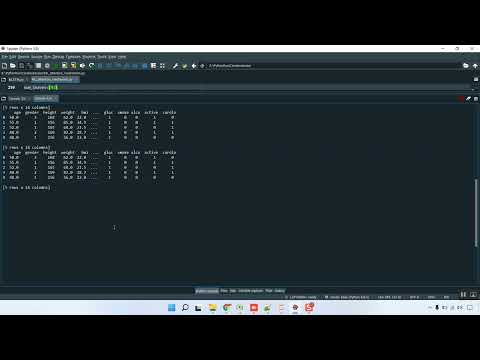
Cardiovascular Data Train MLP Analysis in Python Projects
र 1000
Cardiovascular Data Train MLP Analysis in Python Projects
Technical Details
Domain : Python
Database : Sqlite
Tools : Anaconda
Run Tools: VS Code
Database : Sqlite
Tools : Anaconda
Run Tools: VS Code
Secure Payment
Instant Download
GST Invoice
24/7 Support
About This Product
Cardiovascular Data Train MLP Analysis in Python Projects
Abstract
Cardiovascular diseases (CVDs) remain one of the leading causes of mortality worldwide, making their early detection and prediction a critical area of research. This project, Cardiovascular Data Train MLP Analysis in Python, applies Multilayer Perceptron (MLP), a type of artificial neural network, to analyze cardiovascular datasets and predict the likelihood of heart-related conditions. The system preprocesses the cardiovascular dataset, extracts relevant features (such as age, blood pressure, cholesterol, glucose level, smoking habits, and physical activity), and trains an MLP model to classify patients as at risk or not at risk. Implemented in Python using libraries like NumPy, Pandas, Scikit-learn, TensorFlow/Keras, and Matplotlib, this project provides a reliable machine learning pipeline for cardiovascular disease risk assessment and decision support in healthcare.
Existing System
Existing cardiovascular disease prediction systems primarily rely on manual diagnosis through clinical tests, patient history, and physician expertise. While effective, these methods are time-consuming, subject to human error, and not scalable for large populations. Some automated approaches use traditional machine learning classifiers like Logistic Regression, Decision Trees, and SVM, but these often require extensive feature engineering and may not capture nonlinear relationships in complex health data. Moreover, many existing systems lack proper model optimization and real-time analysis, limiting their clinical usefulness.
Proposed System
The proposed system introduces a deep learning approach using MLP to analyze cardiovascular data and predict disease risk more accurately. The workflow includes data preprocessing (handling missing values, normalization, and encoding categorical variables), MLP training with hidden layers to capture complex patterns, and evaluation using metrics like accuracy, precision, recall, F1-score, and ROC-AUC. The system can be extended to a Flask or Streamlit app for real-time predictions where users input patient health parameters and receive risk assessments instantly. Compared to existing systems, this approach provides higher accuracy, automated feature learning, and robustness to complex datasets, making it an effective solution for modern healthcare analytics and preventive medicine.
Abstract
Cardiovascular diseases (CVDs) remain one of the leading causes of mortality worldwide, making their early detection and prediction a critical area of research. This project, Cardiovascular Data Train MLP Analysis in Python, applies Multilayer Perceptron (MLP), a type of artificial neural network, to analyze cardiovascular datasets and predict the likelihood of heart-related conditions. The system preprocesses the cardiovascular dataset, extracts relevant features (such as age, blood pressure, cholesterol, glucose level, smoking habits, and physical activity), and trains an MLP model to classify patients as at risk or not at risk. Implemented in Python using libraries like NumPy, Pandas, Scikit-learn, TensorFlow/Keras, and Matplotlib, this project provides a reliable machine learning pipeline for cardiovascular disease risk assessment and decision support in healthcare.
Existing System
Existing cardiovascular disease prediction systems primarily rely on manual diagnosis through clinical tests, patient history, and physician expertise. While effective, these methods are time-consuming, subject to human error, and not scalable for large populations. Some automated approaches use traditional machine learning classifiers like Logistic Regression, Decision Trees, and SVM, but these often require extensive feature engineering and may not capture nonlinear relationships in complex health data. Moreover, many existing systems lack proper model optimization and real-time analysis, limiting their clinical usefulness.
Proposed System
The proposed system introduces a deep learning approach using MLP to analyze cardiovascular data and predict disease risk more accurately. The workflow includes data preprocessing (handling missing values, normalization, and encoding categorical variables), MLP training with hidden layers to capture complex patterns, and evaluation using metrics like accuracy, precision, recall, F1-score, and ROC-AUC. The system can be extended to a Flask or Streamlit app for real-time predictions where users input patient health parameters and receive risk assessments instantly. Compared to existing systems, this approach provides higher accuracy, automated feature learning, and robustness to complex datasets, making it an effective solution for modern healthcare analytics and preventive medicine.
Customer Reviews (0)
No reviews yet. Be the first!
Related Products
⭐ Featured
⭐ Featured

Django Projects
Music Event Booking App in Django Python
Music Event Booking App in Django Python
र 1000
⭐ Featured
Django Projects
Multi Server Management System in Django Python
Multi Server Management System in Django Python
र 1000
⭐ Featured

Django Projects
Multi Authority Access Control in Django Python
Multi Authority Access Control in Django Python
र 1000