AI & ML Models
0.0 (0 reviews) • 0 downloads
Cardiac Arrhythmia Classification in Python Projects
Cardiac Arrhythmia Classification in Python Projects
Technical Details
Domain : Python
Database : Sqlite
Tools : Anaconda
Run Tools: VS Code
Database : Sqlite
Tools : Anaconda
Run Tools: VS Code
Secure Payment
Instant Download
GST Invoice
24/7 Support
About This Product
Cardiac Arrhythmia Classification in Python Projects
Abstract
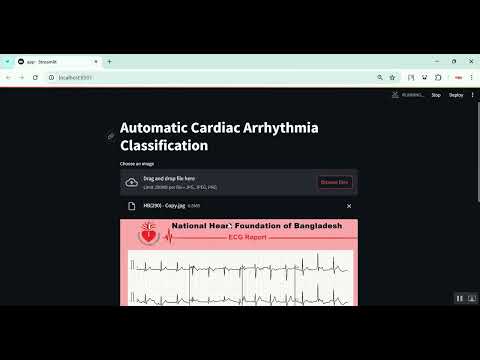
Cardiac arrhythmia refers to abnormal heart rhythms that may lead to serious cardiovascular complications if not detected early. Electrocardiogram (ECG) signals are widely used for diagnosing arrhythmias, but manual interpretation of ECG data is time-consuming and prone to human error. This project proposes an automated Cardiac Arrhythmia Classification System using Machine Learning and Deep Learning in Python. The system processes ECG signals and classifies them into categories such as normal, tachycardia, bradycardia, atrial fibrillation, and ventricular arrhythmia. It uses feature extraction techniques and learning algorithms such as Support Vector Machine (SVM), Random Forest, and Convolutional Neural Networks (CNN). Python libraries like NumPy, Pandas, SciPy, TensorFlow, and Matplotlib are used for implementation. The model improves diagnostic accuracy and assists cardiologists in decision-making by providing fast and reliable arrhythmia predictions.
Existing System
Traditional arrhythmia detection systems rely heavily on manual ECG analysis by medical experts, which is slow and subjective in nature. In existing methods, rule-based signal processing techniques are used to detect R-peaks and abnormalities, but they often struggle with noisy ECG data and cannot generalize well for different patient conditions. Some traditional clinical systems also lack real-time prediction capabilities and suffer from poor classification accuracy due to limited feature extraction strategies. Furthermore, there is no automated classification mechanism in basic ECG tools used in small clinics, resulting in delayed diagnosis and missed cases of arrhythmia.
Proposed System
The proposed system introduces an automated and intelligent cardiac arrhythmia classification model using Machine Learning and Deep Learning techniques. The system preprocesses ECG signals using bandpass filtering and wavelet transformation to remove noise and enhance key signal features. It extracts temporal and frequency-based features and trains classification models such as SVM and Random Forest, along with a CNN-based deep learning model for improved accuracy. The system uses datasets like MIT-BIH Arrhythmia Database for training and validation. A user-friendly Python interface (Flask/Streamlit) allows users to upload ECG data and view classification results instantly. The system enhances early diagnosis, supports clinical decisions, and provides a cost-effective solution for arrhythmia screening.
Abstract
Cardiac arrhythmia refers to abnormal heart rhythms that may lead to serious cardiovascular complications if not detected early. Electrocardiogram (ECG) signals are widely used for diagnosing arrhythmias, but manual interpretation of ECG data is time-consuming and prone to human error. This project proposes an automated Cardiac Arrhythmia Classification System using Machine Learning and Deep Learning in Python. The system processes ECG signals and classifies them into categories such as normal, tachycardia, bradycardia, atrial fibrillation, and ventricular arrhythmia. It uses feature extraction techniques and learning algorithms such as Support Vector Machine (SVM), Random Forest, and Convolutional Neural Networks (CNN). Python libraries like NumPy, Pandas, SciPy, TensorFlow, and Matplotlib are used for implementation. The model improves diagnostic accuracy and assists cardiologists in decision-making by providing fast and reliable arrhythmia predictions.
Existing System
Traditional arrhythmia detection systems rely heavily on manual ECG analysis by medical experts, which is slow and subjective in nature. In existing methods, rule-based signal processing techniques are used to detect R-peaks and abnormalities, but they often struggle with noisy ECG data and cannot generalize well for different patient conditions. Some traditional clinical systems also lack real-time prediction capabilities and suffer from poor classification accuracy due to limited feature extraction strategies. Furthermore, there is no automated classification mechanism in basic ECG tools used in small clinics, resulting in delayed diagnosis and missed cases of arrhythmia.
Proposed System
The proposed system introduces an automated and intelligent cardiac arrhythmia classification model using Machine Learning and Deep Learning techniques. The system preprocesses ECG signals using bandpass filtering and wavelet transformation to remove noise and enhance key signal features. It extracts temporal and frequency-based features and trains classification models such as SVM and Random Forest, along with a CNN-based deep learning model for improved accuracy. The system uses datasets like MIT-BIH Arrhythmia Database for training and validation. A user-friendly Python interface (Flask/Streamlit) allows users to upload ECG data and view classification results instantly. The system enhances early diagnosis, supports clinical decisions, and provides a cost-effective solution for arrhythmia screening.
Customer Reviews (0)
No reviews yet. Be the first!
Related Products
⭐ Featured

AI & ML Models
Zomato Restaurant Reviews Sentimental Analyzer in Python Projects
Zomato Restaurant Reviews Sentimental Analyzer in Python Projects
र 1000
⭐ Featured
⭐ Featured

AI & ML Models
Voice Disorder Prediction using Audio Dataset in Python Projects
Voice Disorder Prediction using Audio Dataset in Python Projects
र 1000

AI & ML Models
Vitamin Deficiency Detection Using Image Processing in Python Projects
Vitamin Deficiency Detection Using Image Processing in Python Projects
र 1000