Django Projects
0.0 (0 reviews) • 0 downloads
Car Parking Simple Management in Python Projects
र 1000
Car Parking Simple Management in Python Projects
Technical Details
Domain : Python
Database : Sqlite
Tools : Anaconda
Run Tools: VS Code
Database : Sqlite
Tools : Anaconda
Run Tools: VS Code
Secure Payment
Instant Download
GST Invoice
24/7 Support
About This Product
Car Parking Simple Management in Python Projects
Abstract
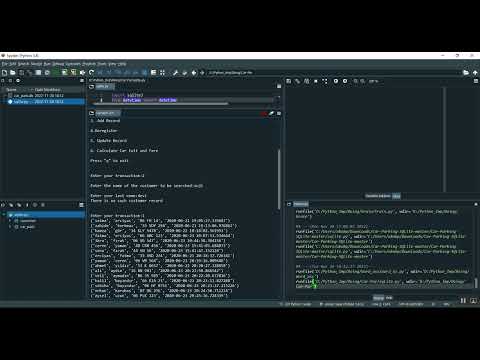
Car parking management has become an essential requirement in urban areas where the number of vehicles is rapidly increasing. Manual methods of managing parking slots are inefficient, time-consuming, and often lead to confusion, misuse of space, or disputes. This project, Car Parking Simple Management in Python, introduces a lightweight and user-friendly system to efficiently manage available parking slots, vehicle entry, and exit records. The system allows administrators or users to record vehicle details, check available slots, allocate parking space, and generate simple usage reports. Implemented using Python, it provides a console or GUI-based interface (Tkinter/Flask optional) for easy management. The system ensures transparency, reduces manual errors, and offers an effective way to utilize parking resources.
Existing System
Existing car parking systems in many places are still manual, relying on human attendants to note vehicle numbers, allocate slots, and manage availability. This process is prone to human errors, mismanagement, and delays during peak hours. In some digital approaches, parking systems are complex and require advanced hardware (RFID, IoT, sensors), making them expensive and less accessible for small-scale parking facilities. Hence, there is a gap for a simple, software-only solution that can be implemented easily in small apartments, offices, or institutions.
Proposed System
The proposed system provides a simple Python-based car parking management application that maintains records of parked vehicles and available slots. Users can input details such as vehicle number, entry time, and exit time, and the system automatically updates the slot availability. Administrators can view the current status of parking slots, track which vehicles are parked, and calculate parking duration or simple charges if required. The system can be further extended with a Tkinter GUI or Flask-based web app for user-friendly interaction. Compared to existing manual methods, this solution is low-cost, efficient, accurate, and scalable, making it suitable for small-scale deployment without the need for expensive infrastructure.
Abstract
Car parking management has become an essential requirement in urban areas where the number of vehicles is rapidly increasing. Manual methods of managing parking slots are inefficient, time-consuming, and often lead to confusion, misuse of space, or disputes. This project, Car Parking Simple Management in Python, introduces a lightweight and user-friendly system to efficiently manage available parking slots, vehicle entry, and exit records. The system allows administrators or users to record vehicle details, check available slots, allocate parking space, and generate simple usage reports. Implemented using Python, it provides a console or GUI-based interface (Tkinter/Flask optional) for easy management. The system ensures transparency, reduces manual errors, and offers an effective way to utilize parking resources.
Existing System
Existing car parking systems in many places are still manual, relying on human attendants to note vehicle numbers, allocate slots, and manage availability. This process is prone to human errors, mismanagement, and delays during peak hours. In some digital approaches, parking systems are complex and require advanced hardware (RFID, IoT, sensors), making them expensive and less accessible for small-scale parking facilities. Hence, there is a gap for a simple, software-only solution that can be implemented easily in small apartments, offices, or institutions.
Proposed System
The proposed system provides a simple Python-based car parking management application that maintains records of parked vehicles and available slots. Users can input details such as vehicle number, entry time, and exit time, and the system automatically updates the slot availability. Administrators can view the current status of parking slots, track which vehicles are parked, and calculate parking duration or simple charges if required. The system can be further extended with a Tkinter GUI or Flask-based web app for user-friendly interaction. Compared to existing manual methods, this solution is low-cost, efficient, accurate, and scalable, making it suitable for small-scale deployment without the need for expensive infrastructure.
Customer Reviews (0)
No reviews yet. Be the first!
Related Products
⭐ Featured
⭐ Featured

Django Projects
Music Event Booking App in Django Python
Music Event Booking App in Django Python
र 1000
⭐ Featured
Django Projects
Multi Server Management System in Django Python
Multi Server Management System in Django Python
र 1000
⭐ Featured

Django Projects
Multi Authority Access Control in Django Python
Multi Authority Access Control in Django Python
र 1000