AI & ML Models
0.0 (0 reviews) • 0 downloads
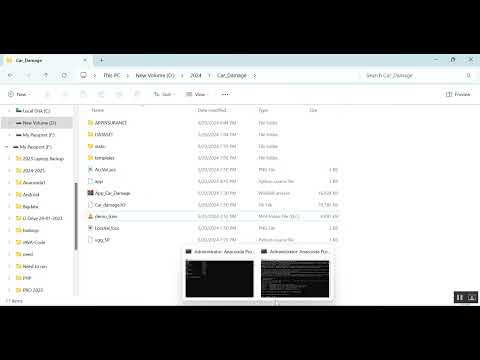
Car Damage Detection in Python Projects
र 1000
Car Damage Detection in Python Projects
Technical Details
Domain : Python
Database : Sqlite
Tools : Anaconda
Run Tools: VS Code
Database : Sqlite
Tools : Anaconda
Run Tools: VS Code
Secure Payment
Instant Download
GST Invoice
24/7 Support
About This Product
Car Damage Detection in Python Projects
Abstract
Car damage detection plays a vital role in the automobile insurance and service industries by automating the process of identifying and analyzing damage on vehicle surfaces. Traditional manual inspection is prone to human error and consumes time, especially during insurance claim verification. This project presents a Car Damage Detection System using Deep Learning in Python that automatically detects damaged car parts from images. The system uses Convolutional Neural Networks (CNN) to classify images into damaged or undamaged categories and further localizes the damage area using image processing techniques. Python libraries such as TensorFlow, Keras, OpenCV, and NumPy are utilized for model training and implementation. The system assists insurance companies, car rental services, and automobile workshops by providing fast, accurate, and cost-effective damage detection.
Existing System
In the existing manual system, car damage assessment is performed through visual inspection by human inspectors or insurance agents. This approach is highly time-consuming, subjective, and often inaccurate due to human bias or limited expertise. In many cases, minor damages like scratches, dents, or cracks are overlooked. Insurance claim fraud is also common due to a lack of automated verification systems. Existing automation systems rely only on simple image matching or basic edge detection methods, which are not efficient in handling complex car images with varying light conditions and backgrounds.
Proposed System
The proposed system introduces an automated deep learning-based car damage detection model that detects and identifies damaged regions from car images with high precision. The system uses a pre-trained CNN model such as VGG16, ResNet50, or YOLOv5 for feature extraction and fine-tuning. The model is trained on a labeled dataset containing damaged and non-damaged car images. OpenCV techniques are used to preprocess input images by resizing, denoising, and enhancing image quality. The system classifies whether the car is damaged and identifies the damage location using bounding boxes. A user interface is developed using Flask or Streamlit, allowing users to upload car images and view detection results. This automated system reduces inspection time, eliminates manual errors, and supports reliable insurance assessments
Abstract
Car damage detection plays a vital role in the automobile insurance and service industries by automating the process of identifying and analyzing damage on vehicle surfaces. Traditional manual inspection is prone to human error and consumes time, especially during insurance claim verification. This project presents a Car Damage Detection System using Deep Learning in Python that automatically detects damaged car parts from images. The system uses Convolutional Neural Networks (CNN) to classify images into damaged or undamaged categories and further localizes the damage area using image processing techniques. Python libraries such as TensorFlow, Keras, OpenCV, and NumPy are utilized for model training and implementation. The system assists insurance companies, car rental services, and automobile workshops by providing fast, accurate, and cost-effective damage detection.
Existing System
In the existing manual system, car damage assessment is performed through visual inspection by human inspectors or insurance agents. This approach is highly time-consuming, subjective, and often inaccurate due to human bias or limited expertise. In many cases, minor damages like scratches, dents, or cracks are overlooked. Insurance claim fraud is also common due to a lack of automated verification systems. Existing automation systems rely only on simple image matching or basic edge detection methods, which are not efficient in handling complex car images with varying light conditions and backgrounds.
Proposed System
The proposed system introduces an automated deep learning-based car damage detection model that detects and identifies damaged regions from car images with high precision. The system uses a pre-trained CNN model such as VGG16, ResNet50, or YOLOv5 for feature extraction and fine-tuning. The model is trained on a labeled dataset containing damaged and non-damaged car images. OpenCV techniques are used to preprocess input images by resizing, denoising, and enhancing image quality. The system classifies whether the car is damaged and identifies the damage location using bounding boxes. A user interface is developed using Flask or Streamlit, allowing users to upload car images and view detection results. This automated system reduces inspection time, eliminates manual errors, and supports reliable insurance assessments
Customer Reviews (0)
No reviews yet. Be the first!
Related Products
⭐ Featured

AI & ML Models
Zomato Restaurant Reviews Sentimental Analyzer in Python Projects
Zomato Restaurant Reviews Sentimental Analyzer in Python Projects
र 1000
⭐ Featured
⭐ Featured

AI & ML Models
Voice Disorder Prediction using Audio Dataset in Python Projects
Voice Disorder Prediction using Audio Dataset in Python Projects
र 1000
AI & ML Models
Vitamin Deficiency Detection Using Image Processing in Python Projects
Vitamin Deficiency Detection Using Image Processing in Python Projects
र 1000