AI & ML Models
0.0 (0 reviews) • 0 downloads
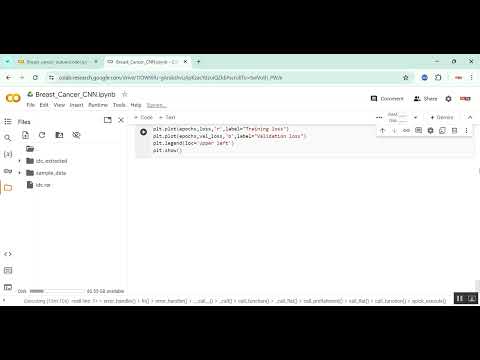
Breast Cancer Auto Encoder Classification Colab in Python Projects
र 1000
Breast Cancer Auto Encoder Classification Colab in Python Projects
Technical Details
Domain : Python
Database : Sqlite
Tools : Anaconda
Run Tools: VS Code
Database : Sqlite
Tools : Anaconda
Run Tools: VS Code
Secure Payment
Instant Download
GST Invoice
24/7 Support
About This Product
Breast Cancer Auto Encoder Classification Colab in Python Projects
Abstract
Early detection and accurate classification of breast cancer are critical for effective treatment and patient survival. This project presents a Breast Cancer Classification System using Autoencoders in Python (Google Colab), which leverages deep learning for feature extraction and classification of breast cancer data. The system uses autoencoders to learn compressed representations of input data (such as mammograms or gene expression datasets) and then classifies samples into malignant or benign categories. Python libraries such as TensorFlow/Keras, NumPy, Pandas, Matplotlib, and Seaborn are used for data preprocessing, model training, evaluation, and visualization. By using autoencoders, the system captures essential features automatically, improving classification accuracy and supporting early diagnosis.
Existing System
Existing breast cancer classification systems often rely on traditional machine learning methods like SVM, Random Forest, or Logistic Regression, which require manual feature selection and extraction. Some systems use CNNs for image-based analysis, but they often need large labeled datasets and extensive computational resources. Manual feature engineering is time-consuming and may fail to capture hidden patterns in the data. Consequently, existing methods may have limited accuracy, especially when handling high-dimensional or complex datasets such as gene expression profiles or mammogram images.
Proposed System
The proposed system introduces a Python-based autoencoder framework for breast cancer classification, implemented on Google Colab for cloud-based computation. Input data (images or structured datasets) are preprocessed using normalization, resizing (for images), and data cleaning. The autoencoder network learns a compressed representation of the input features through an encoder-decoder architecture. The encoded features are then passed to a classifier (dense layers or softmax output) to predict whether the sample is malignant or benign. Model performance is evaluated using metrics like accuracy, precision, recall, F1-score, and ROC-AUC. Visualization tools display reconstructed inputs, latent features, and classification results. Using Colab allows GPU acceleration and interactive notebooks for real-time experimentation. This approach automates feature extraction, enhances classification accuracy, and provides a scalable and efficient solution for breast cancer diagnosis.
Abstract
Early detection and accurate classification of breast cancer are critical for effective treatment and patient survival. This project presents a Breast Cancer Classification System using Autoencoders in Python (Google Colab), which leverages deep learning for feature extraction and classification of breast cancer data. The system uses autoencoders to learn compressed representations of input data (such as mammograms or gene expression datasets) and then classifies samples into malignant or benign categories. Python libraries such as TensorFlow/Keras, NumPy, Pandas, Matplotlib, and Seaborn are used for data preprocessing, model training, evaluation, and visualization. By using autoencoders, the system captures essential features automatically, improving classification accuracy and supporting early diagnosis.
Existing System
Existing breast cancer classification systems often rely on traditional machine learning methods like SVM, Random Forest, or Logistic Regression, which require manual feature selection and extraction. Some systems use CNNs for image-based analysis, but they often need large labeled datasets and extensive computational resources. Manual feature engineering is time-consuming and may fail to capture hidden patterns in the data. Consequently, existing methods may have limited accuracy, especially when handling high-dimensional or complex datasets such as gene expression profiles or mammogram images.
Proposed System
The proposed system introduces a Python-based autoencoder framework for breast cancer classification, implemented on Google Colab for cloud-based computation. Input data (images or structured datasets) are preprocessed using normalization, resizing (for images), and data cleaning. The autoencoder network learns a compressed representation of the input features through an encoder-decoder architecture. The encoded features are then passed to a classifier (dense layers or softmax output) to predict whether the sample is malignant or benign. Model performance is evaluated using metrics like accuracy, precision, recall, F1-score, and ROC-AUC. Visualization tools display reconstructed inputs, latent features, and classification results. Using Colab allows GPU acceleration and interactive notebooks for real-time experimentation. This approach automates feature extraction, enhances classification accuracy, and provides a scalable and efficient solution for breast cancer diagnosis.
Customer Reviews (0)
No reviews yet. Be the first!
Related Products
⭐ Featured
AI & ML Models
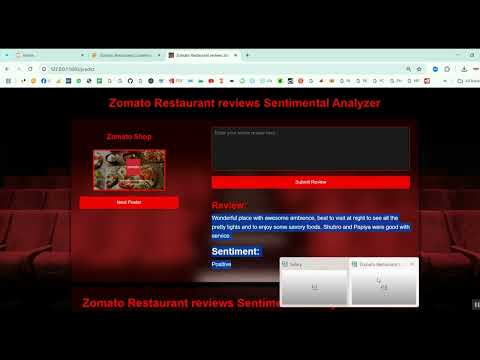
Zomato Restaurant Reviews Sentimental Analyzer in Python Projects
Zomato Restaurant Reviews Sentimental Analyzer in Python Projects
र 1000
⭐ Featured
⭐ Featured
AI & ML Models
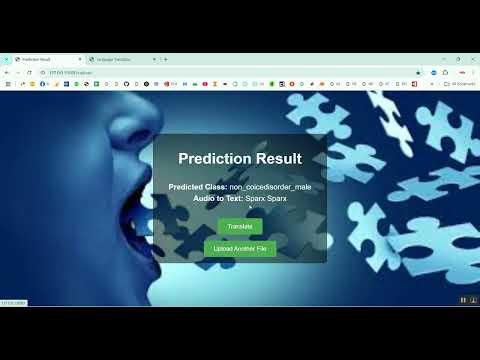
Voice Disorder Prediction using Audio Dataset in Python Projects
Voice Disorder Prediction using Audio Dataset in Python Projects
र 1000
AI & ML Models
Vitamin Deficiency Detection Using Image Processing in Python Projects
Vitamin Deficiency Detection Using Image Processing in Python Projects
र 1000