Django Projects
0.0 (0 reviews) • 0 downloads
Brain Tumor Segmentation Using Simple CNN Console in Python Projects
र 1000
Brain Tumor Segmentation Using Simple CNN Console in Python Projects
Technical Details
Domain : Python
Database : Sqlite
Tools : Anaconda
Run Tools: VS Code
Database : Sqlite
Tools : Anaconda
Run Tools: VS Code
Secure Payment
Instant Download
GST Invoice
24/7 Support
About This Product
Brain Tumor Segmentation Using Simple CNN Console in Python Projects
Abstract
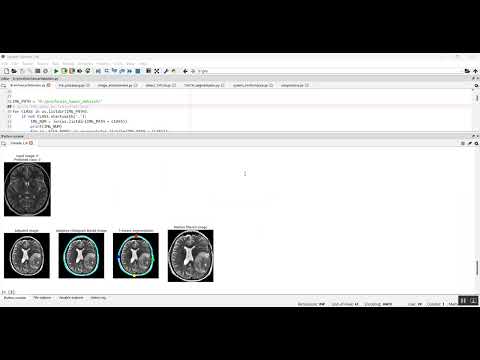
Brain tumor segmentation is a vital task in medical image analysis, as it aids in early diagnosis and effective treatment planning. Traditional manual segmentation from MRI scans is tedious and prone to human error. This project, Brain Tumor Segmentation Using Simple CNN Console in Python, focuses on developing a lightweight deep learning model using a simple Convolutional Neural Network (CNN) architecture for segmenting tumor regions in brain MRI images. The system runs through a Python console interface without requiring heavy frameworks, making it accessible and easy to use for research and educational purposes. The CNN is trained on MRI datasets, where input images are preprocessed, features are automatically extracted, and segmentation masks are generated to highlight tumor regions. The approach provides an efficient and cost-effective solution for automated brain tumor detection with reasonable accuracy, assisting medical practitioners in decision-making.
Existing System
Existing brain tumor segmentation systems rely heavily on manual annotations by radiologists or semi-automatic methods like thresholding, clustering (K-means, Fuzzy C-Means), and edge detection. While these methods provide initial insights, they often fail to handle noise, low contrast, and irregular tumor boundaries. More advanced approaches such as U-Net and deep CNNs achieve higher accuracy but require complex architectures, high computational resources, and GPU support, which may not be practical in resource-constrained settings. Hence, there is a need for a simpler yet effective system that balances performance with efficiency.
Proposed System
The proposed system introduces a simple CNN-based segmentation model that runs directly through the Python console, making it lightweight and easy to execute. The workflow includes image preprocessing (grayscale conversion, normalization, and resizing), CNN training with convolutional and pooling layers to learn spatial features, and mask generation for tumor segmentation. Unlike heavy architectures, the simple CNN is designed with fewer layers, ensuring faster training and inference while still achieving good segmentation results. The system provides pixel-level classification of tumor vs. non-tumor regions and outputs the segmentation masks in the console environment. Compared to existing systems, this approach offers simplicity, accessibility, faster execution, and low hardware requirements, making it suitable for academic projects, demonstrations, and small-scale clinical assistance.
Abstract
Brain tumor segmentation is a vital task in medical image analysis, as it aids in early diagnosis and effective treatment planning. Traditional manual segmentation from MRI scans is tedious and prone to human error. This project, Brain Tumor Segmentation Using Simple CNN Console in Python, focuses on developing a lightweight deep learning model using a simple Convolutional Neural Network (CNN) architecture for segmenting tumor regions in brain MRI images. The system runs through a Python console interface without requiring heavy frameworks, making it accessible and easy to use for research and educational purposes. The CNN is trained on MRI datasets, where input images are preprocessed, features are automatically extracted, and segmentation masks are generated to highlight tumor regions. The approach provides an efficient and cost-effective solution for automated brain tumor detection with reasonable accuracy, assisting medical practitioners in decision-making.
Existing System
Existing brain tumor segmentation systems rely heavily on manual annotations by radiologists or semi-automatic methods like thresholding, clustering (K-means, Fuzzy C-Means), and edge detection. While these methods provide initial insights, they often fail to handle noise, low contrast, and irregular tumor boundaries. More advanced approaches such as U-Net and deep CNNs achieve higher accuracy but require complex architectures, high computational resources, and GPU support, which may not be practical in resource-constrained settings. Hence, there is a need for a simpler yet effective system that balances performance with efficiency.
Proposed System
The proposed system introduces a simple CNN-based segmentation model that runs directly through the Python console, making it lightweight and easy to execute. The workflow includes image preprocessing (grayscale conversion, normalization, and resizing), CNN training with convolutional and pooling layers to learn spatial features, and mask generation for tumor segmentation. Unlike heavy architectures, the simple CNN is designed with fewer layers, ensuring faster training and inference while still achieving good segmentation results. The system provides pixel-level classification of tumor vs. non-tumor regions and outputs the segmentation masks in the console environment. Compared to existing systems, this approach offers simplicity, accessibility, faster execution, and low hardware requirements, making it suitable for academic projects, demonstrations, and small-scale clinical assistance.
Customer Reviews (0)
No reviews yet. Be the first!
Related Products
⭐ Featured
⭐ Featured

Django Projects
Music Event Booking App in Django Python
Music Event Booking App in Django Python
र 1000
⭐ Featured
Django Projects
Multi Server Management System in Django Python
Multi Server Management System in Django Python
र 1000
⭐ Featured

Django Projects
Multi Authority Access Control in Django Python
Multi Authority Access Control in Django Python
र 1000