AI & ML Models
0.0 (0 reviews) • 0 downloads
Brain Consciousness Prediction Using EEG ML Classification in Python Projects
र 1000
Brain Consciousness Prediction Using EEG ML Classification in Python Projects
Technical Details
Domain : Python
Database : Sqlite
Tools : Anaconda
Run Tools: VS Code
Database : Sqlite
Tools : Anaconda
Run Tools: VS Code
Secure Payment
Instant Download
GST Invoice
24/7 Support
About This Product
Brain Consciousness Prediction Using EEG ML Classification in Python Projects
Abstract
Brain consciousness prediction is an emerging area of neuroscience and artificial intelligence that focuses on assessing levels of consciousness from brain activity patterns. Electroencephalogram (EEG) signals are widely used due to their non-invasive nature and ability to capture electrical activity in the brain. This project, Brain Consciousness Prediction Using EEG ML Classification in Python, aims to build a machine learning framework that can classify EEG signals into different consciousness states such as awake, drowsy, or unconscious. Using Python libraries like NumPy, Pandas, Scikit-learn, TensorFlow/Keras, and Matplotlib, EEG data is preprocessed, features are extracted (such as power spectral density, wavelet transforms, and statistical measures), and machine learning classifiers (Random Forest, SVM, Logistic Regression, or deep neural networks) are trained to predict consciousness states. The system has applications in healthcare monitoring, anesthesia management, and brain injury assessment.
Existing System
Traditional systems for consciousness assessment rely on manual observation, clinical scoring systems (e.g., Glasgow Coma Scale), or invasive monitoring techniques. While useful, these methods are often subjective, time-consuming, and less reliable for continuous real-time monitoring. Some research-based EEG analysis systems exist, but many rely on manual feature engineering and simple threshold-based detection, which are not scalable or accurate across different patients. Furthermore, existing systems struggle to filter out noise and artifacts in EEG signals, which significantly impacts classification accuracy.
Proposed System
The proposed system introduces a machine learning–based EEG classification model for predicting brain consciousness levels. The process involves signal preprocessing (artifact removal, band-pass filtering), feature extraction (frequency-domain and time-domain features such as alpha, beta, theta, and delta wave analysis), and classification using ML/DL algorithms. Models such as Random Forest, SVM, Gradient Boosting, or CNN-LSTM hybrids can be used to achieve high accuracy. The system is designed in Python to be scalable and adaptable to different EEG datasets. Compared to existing methods, this approach provides objective, automated, and real-time predictions of consciousness states, reducing dependency on manual assessments and improving reliability in clinical environments.
Abstract
Brain consciousness prediction is an emerging area of neuroscience and artificial intelligence that focuses on assessing levels of consciousness from brain activity patterns. Electroencephalogram (EEG) signals are widely used due to their non-invasive nature and ability to capture electrical activity in the brain. This project, Brain Consciousness Prediction Using EEG ML Classification in Python, aims to build a machine learning framework that can classify EEG signals into different consciousness states such as awake, drowsy, or unconscious. Using Python libraries like NumPy, Pandas, Scikit-learn, TensorFlow/Keras, and Matplotlib, EEG data is preprocessed, features are extracted (such as power spectral density, wavelet transforms, and statistical measures), and machine learning classifiers (Random Forest, SVM, Logistic Regression, or deep neural networks) are trained to predict consciousness states. The system has applications in healthcare monitoring, anesthesia management, and brain injury assessment.
Existing System
Traditional systems for consciousness assessment rely on manual observation, clinical scoring systems (e.g., Glasgow Coma Scale), or invasive monitoring techniques. While useful, these methods are often subjective, time-consuming, and less reliable for continuous real-time monitoring. Some research-based EEG analysis systems exist, but many rely on manual feature engineering and simple threshold-based detection, which are not scalable or accurate across different patients. Furthermore, existing systems struggle to filter out noise and artifacts in EEG signals, which significantly impacts classification accuracy.
Proposed System
The proposed system introduces a machine learning–based EEG classification model for predicting brain consciousness levels. The process involves signal preprocessing (artifact removal, band-pass filtering), feature extraction (frequency-domain and time-domain features such as alpha, beta, theta, and delta wave analysis), and classification using ML/DL algorithms. Models such as Random Forest, SVM, Gradient Boosting, or CNN-LSTM hybrids can be used to achieve high accuracy. The system is designed in Python to be scalable and adaptable to different EEG datasets. Compared to existing methods, this approach provides objective, automated, and real-time predictions of consciousness states, reducing dependency on manual assessments and improving reliability in clinical environments.
Customer Reviews (0)
No reviews yet. Be the first!
Related Products
⭐ Featured

AI & ML Models
Zomato Restaurant Reviews Sentimental Analyzer in Python Projects
Zomato Restaurant Reviews Sentimental Analyzer in Python Projects
र 1000
⭐ Featured
⭐ Featured
AI & ML Models
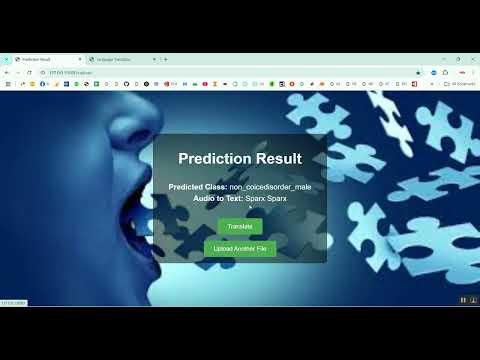
Voice Disorder Prediction using Audio Dataset in Python Projects
Voice Disorder Prediction using Audio Dataset in Python Projects
र 1000

AI & ML Models
Vitamin Deficiency Detection Using Image Processing in Python Projects
Vitamin Deficiency Detection Using Image Processing in Python Projects
र 1000