AI & ML Models
0.0 (0 reviews) • 0 downloads
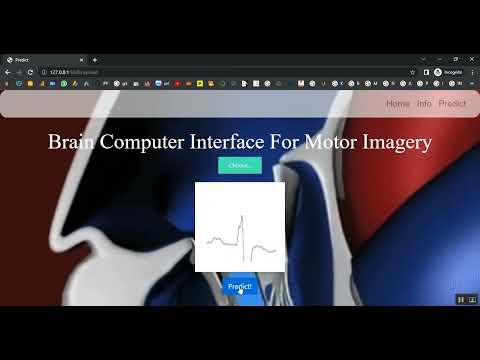
Brain Computer Interface Detection Using EEG Image Dataset in Python Projects
र 1000
Brain Computer Interface Detection Using EEG Image Dataset in Python Projects
Technical Details
Domain : Python
Database : Sqlite
Tools : Anaconda
Run Tools: VS Code
Database : Sqlite
Tools : Anaconda
Run Tools: VS Code
Secure Payment
Instant Download
GST Invoice
24/7 Support
About This Product
Brain Computer Interface Detection Using EEG Image Dataset in Python Projects
Abstract
Brain–Computer Interfaces (BCIs) enable direct communication between the human brain and external devices, offering revolutionary applications in healthcare, neuro-rehabilitation, and assistive technologies. Electroencephalogram (EEG) signals are the most commonly used non-invasive input for BCIs, but their interpretation is complex due to noise, high dimensionality, and variability across individuals. This project, Brain Computer Interface Detection Using EEG Image Dataset in Python, focuses on building a machine learning and deep learning–based system to detect and classify EEG patterns from image-based EEG datasets. The system uses Python libraries such as NumPy, Pandas, Scikit-learn, TensorFlow/Keras, and Matplotlib, where EEG data is preprocessed, transformed into spectrograms or 2D images, and fed into Convolutional Neural Networks (CNNs) for accurate classification. The project highlights how computational intelligence can decode EEG signals effectively for practical BCI applications.
Existing System
Traditional BCI detection methods primarily rely on manual feature engineering and classical machine learning techniques such as SVM, k-NN, or Decision Trees. While these approaches provide some level of EEG pattern classification, they suffer from low accuracy, poor scalability, and inability to generalize across subjects. Furthermore, EEG signals are highly susceptible to noise and artifacts (e.g., muscle activity, eye movement), making detection less reliable. Many existing systems are limited to research labs and are not optimized for real-world applications due to their computational complexity and lack of real-time processing.
Proposed System
The proposed system introduces a deep learning–based EEG image classification approach for BCI detection. EEG signals are first preprocessed and converted into spectrograms or 2D EEG topographic images, which serve as input to CNN models for automated feature extraction and classification. The model is trained to detect specific brain activities (e.g., motor imagery, mental workload, or stimulus response), improving the accuracy of BCI predictions. Additional techniques such as data augmentation, noise filtering, and transfer learning can further enhance performance. Implemented as a Python project, the framework ensures scalability and can be adapted for real-time detection with suitable hardware. Compared to existing methods, the proposed system is more accurate, robust against noise, scalable, and capable of generalizing across multiple subjects, making it suitable for healthcare, assistive devices, and neuroscience research.
Abstract
Brain–Computer Interfaces (BCIs) enable direct communication between the human brain and external devices, offering revolutionary applications in healthcare, neuro-rehabilitation, and assistive technologies. Electroencephalogram (EEG) signals are the most commonly used non-invasive input for BCIs, but their interpretation is complex due to noise, high dimensionality, and variability across individuals. This project, Brain Computer Interface Detection Using EEG Image Dataset in Python, focuses on building a machine learning and deep learning–based system to detect and classify EEG patterns from image-based EEG datasets. The system uses Python libraries such as NumPy, Pandas, Scikit-learn, TensorFlow/Keras, and Matplotlib, where EEG data is preprocessed, transformed into spectrograms or 2D images, and fed into Convolutional Neural Networks (CNNs) for accurate classification. The project highlights how computational intelligence can decode EEG signals effectively for practical BCI applications.
Existing System
Traditional BCI detection methods primarily rely on manual feature engineering and classical machine learning techniques such as SVM, k-NN, or Decision Trees. While these approaches provide some level of EEG pattern classification, they suffer from low accuracy, poor scalability, and inability to generalize across subjects. Furthermore, EEG signals are highly susceptible to noise and artifacts (e.g., muscle activity, eye movement), making detection less reliable. Many existing systems are limited to research labs and are not optimized for real-world applications due to their computational complexity and lack of real-time processing.
Proposed System
The proposed system introduces a deep learning–based EEG image classification approach for BCI detection. EEG signals are first preprocessed and converted into spectrograms or 2D EEG topographic images, which serve as input to CNN models for automated feature extraction and classification. The model is trained to detect specific brain activities (e.g., motor imagery, mental workload, or stimulus response), improving the accuracy of BCI predictions. Additional techniques such as data augmentation, noise filtering, and transfer learning can further enhance performance. Implemented as a Python project, the framework ensures scalability and can be adapted for real-time detection with suitable hardware. Compared to existing methods, the proposed system is more accurate, robust against noise, scalable, and capable of generalizing across multiple subjects, making it suitable for healthcare, assistive devices, and neuroscience research.
Customer Reviews (0)
No reviews yet. Be the first!
Related Products
⭐ Featured

AI & ML Models
Zomato Restaurant Reviews Sentimental Analyzer in Python Projects
Zomato Restaurant Reviews Sentimental Analyzer in Python Projects
र 1000
⭐ Featured
⭐ Featured

AI & ML Models
Voice Disorder Prediction using Audio Dataset in Python Projects
Voice Disorder Prediction using Audio Dataset in Python Projects
र 1000

AI & ML Models
Vitamin Deficiency Detection Using Image Processing in Python Projects
Vitamin Deficiency Detection Using Image Processing in Python Projects
र 1000