AI & ML Models
0.0 (0 reviews) • 0 downloads
Background Image Removal in Python Projects
र 1000
Background Image Removal in Python Projects
Technical Details
Domain : Python
Database : Sqlite
Tools : Anaconda
Run Tools: VS Code
Database : Sqlite
Tools : Anaconda
Run Tools: VS Code
Secure Payment
Instant Download
GST Invoice
24/7 Support
About This Product
Background Image Removal in Python Projects
Abstract
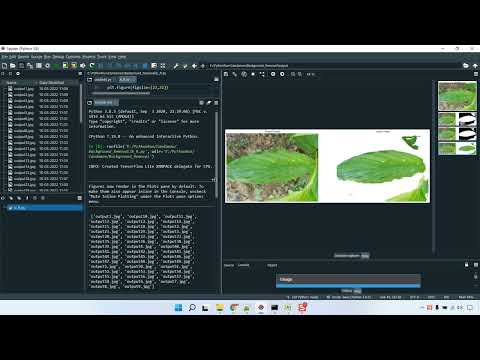
Background removal is a crucial task in computer vision, image processing, and graphics applications. It is widely used in photo editing, object detection, virtual backgrounds, medical imaging, and e-commerce product photography. Manual background editing is time-consuming and requires expert skills. This project, Background Image Removal in Python, proposes an automated system that detects and removes the background of images while retaining the main subject with high precision. The system leverages computer vision techniques and deep learning models such as U-Net, Mask R-CNN, or semantic segmentation CNNs. Implemented using Python with libraries like OpenCV, TensorFlow/Keras, NumPy, and Pillow, the solution provides efficient, scalable, and accurate background removal for a wide range of applications.
Existing System
Traditional background removal methods rely on manual editing tools (e.g., Photoshop, GIMP) or basic image processing techniques such as thresholding, edge detection, or chroma keying (green screen). While effective in controlled environments, these methods fail in complex scenarios where subjects and backgrounds have similar colors, textures, or lighting conditions. Commercial AI-based solutions exist but are often proprietary, expensive, or not customizable for specific use cases. Moreover, traditional systems lack automation and scalability, making them inefficient for large datasets or real-time applications.
Proposed System
The proposed system introduces an automated Python-based background removal framework that combines deep learning segmentation models and classical image processing. Preprocessing steps include resizing, noise reduction, and color normalization. A CNN-based segmentation model (e.g., U-Net or Mask R-CNN) identifies the subject (person, object, or product) and generates a mask, which is then applied to remove or replace the background. OpenCV functions can refine the edges for smooth blending. The final output allows users to either keep a transparent background (PNG format) or replace it with a custom image. Compared to existing systems, this approach provides automation, high accuracy, flexibility, and scalability, making it useful for real-time applications in e-commerce, media, and virtual environments.
Abstract
Background removal is a crucial task in computer vision, image processing, and graphics applications. It is widely used in photo editing, object detection, virtual backgrounds, medical imaging, and e-commerce product photography. Manual background editing is time-consuming and requires expert skills. This project, Background Image Removal in Python, proposes an automated system that detects and removes the background of images while retaining the main subject with high precision. The system leverages computer vision techniques and deep learning models such as U-Net, Mask R-CNN, or semantic segmentation CNNs. Implemented using Python with libraries like OpenCV, TensorFlow/Keras, NumPy, and Pillow, the solution provides efficient, scalable, and accurate background removal for a wide range of applications.
Existing System
Traditional background removal methods rely on manual editing tools (e.g., Photoshop, GIMP) or basic image processing techniques such as thresholding, edge detection, or chroma keying (green screen). While effective in controlled environments, these methods fail in complex scenarios where subjects and backgrounds have similar colors, textures, or lighting conditions. Commercial AI-based solutions exist but are often proprietary, expensive, or not customizable for specific use cases. Moreover, traditional systems lack automation and scalability, making them inefficient for large datasets or real-time applications.
Proposed System
The proposed system introduces an automated Python-based background removal framework that combines deep learning segmentation models and classical image processing. Preprocessing steps include resizing, noise reduction, and color normalization. A CNN-based segmentation model (e.g., U-Net or Mask R-CNN) identifies the subject (person, object, or product) and generates a mask, which is then applied to remove or replace the background. OpenCV functions can refine the edges for smooth blending. The final output allows users to either keep a transparent background (PNG format) or replace it with a custom image. Compared to existing systems, this approach provides automation, high accuracy, flexibility, and scalability, making it useful for real-time applications in e-commerce, media, and virtual environments.
Customer Reviews (0)
No reviews yet. Be the first!
Related Products
⭐ Featured

AI & ML Models
Zomato Restaurant Reviews Sentimental Analyzer in Python Projects
Zomato Restaurant Reviews Sentimental Analyzer in Python Projects
र 1000
⭐ Featured
⭐ Featured

AI & ML Models
Voice Disorder Prediction using Audio Dataset in Python Projects
Voice Disorder Prediction using Audio Dataset in Python Projects
र 1000
AI & ML Models
Vitamin Deficiency Detection Using Image Processing in Python Projects
Vitamin Deficiency Detection Using Image Processing in Python Projects
र 1000