AI & ML Models
0.0 (0 reviews) • 0 downloads
Autoencoder Android Malware in Python Projects
र 1000
Autoencoder Android Malware in Python Projects
Technical Details
Domain : Python
Database : Sqlite
Tools : Anaconda
Run Tools: VS Code
Database : Sqlite
Tools : Anaconda
Run Tools: VS Code
Secure Payment
Instant Download
GST Invoice
24/7 Support
About This Product
Autoencoder Android Malware in Python Projects
Abstract
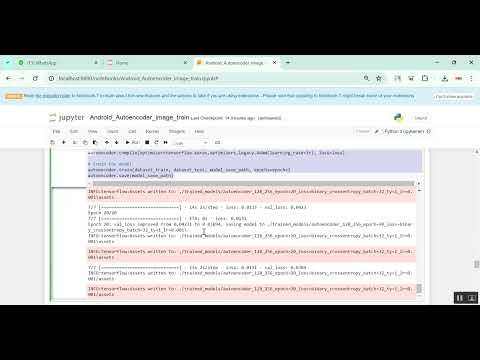
The increasing sophistication of Android malware demands detection methods that generalize beyond known signatures and adapt to novel obfuscation techniques. This project develops an Autoencoder-based Android Malware Detection system in Python that learns compact representations of benign app behavior and flags deviations as potential malware. Static features such as permissions, API-call frequency vectors, intent-filter attributes, and opcode n‑grams are extracted from APKs and converted into numerical feature vectors. A deep autoencoder is trained primarily on benign samples to reconstruct normal feature distributions; apps that produce high reconstruction error are treated as anomalies and ranked for further inspection. Implemented with TensorFlow/Keras and supported by Pandas and NumPy for preprocessing, the system emphasizes lightweight deployment, interpretability through reconstruction diagnostics, and integration with simple dashboards for analyst review.
Existing System
Traditional Android malware detection relies heavily on signature-based antivirus engines and conventional supervised classifiers trained on labeled malware families, which struggle with zero‑day variants and heavy obfuscation. Many static-analysis approaches require extensive manual feature engineering and produce high‑dimensional sparse vectors that make models brittle and slow to update. Dynamic-analysis sandboxes provide deeper behavioral signals but are resource intensive, slow, and risky if not sandboxed properly. In practice, security teams often receive binary labels without clear reasoning, and detection pipelines can miss novel malicious patterns that do not match prior signatures or labeled training examples. This gap motivates unsupervised and semi‑supervised anomaly detection approaches that can surface unknown threats.
Proposed System
The proposed system implements a modular pipeline that performs safe static feature extraction from APK metadata (no executing of app code), transforms features into dense vectors, and trains a deep autoencoder to model benign-app distributions; anomaly scoring is computed by reconstruction error and optionally combined with a lightweight downstream classifier for improved precision. Feature modules include permission encoding, API-call embedding, manifest attribute one‑hoting, and opcode n‑gram hashing; dimensionality reduction (PCA/autoencoder bottleneck) and normalization are used to stabilize training. The detection backend (TensorFlow/Keras) outputs anomaly scores and reconstruction heatmaps to highlight which features contributed most to the anomaly, improving interpretability for analysts. A small Streamlit or Flask UI allows upload of APK feature summaries (not raw APK execution), displays scores, visualizes important features, and supports exporting suspicious samples for further manual or sandboxed dynamic analysis. Emphasis is placed on privacy, safe handling (no unintended app execution), reproducibility, and the ability to update models incrementally as new benign or malicious samples are validated.
Abstract
The increasing sophistication of Android malware demands detection methods that generalize beyond known signatures and adapt to novel obfuscation techniques. This project develops an Autoencoder-based Android Malware Detection system in Python that learns compact representations of benign app behavior and flags deviations as potential malware. Static features such as permissions, API-call frequency vectors, intent-filter attributes, and opcode n‑grams are extracted from APKs and converted into numerical feature vectors. A deep autoencoder is trained primarily on benign samples to reconstruct normal feature distributions; apps that produce high reconstruction error are treated as anomalies and ranked for further inspection. Implemented with TensorFlow/Keras and supported by Pandas and NumPy for preprocessing, the system emphasizes lightweight deployment, interpretability through reconstruction diagnostics, and integration with simple dashboards for analyst review.
Existing System
Traditional Android malware detection relies heavily on signature-based antivirus engines and conventional supervised classifiers trained on labeled malware families, which struggle with zero‑day variants and heavy obfuscation. Many static-analysis approaches require extensive manual feature engineering and produce high‑dimensional sparse vectors that make models brittle and slow to update. Dynamic-analysis sandboxes provide deeper behavioral signals but are resource intensive, slow, and risky if not sandboxed properly. In practice, security teams often receive binary labels without clear reasoning, and detection pipelines can miss novel malicious patterns that do not match prior signatures or labeled training examples. This gap motivates unsupervised and semi‑supervised anomaly detection approaches that can surface unknown threats.
Proposed System
The proposed system implements a modular pipeline that performs safe static feature extraction from APK metadata (no executing of app code), transforms features into dense vectors, and trains a deep autoencoder to model benign-app distributions; anomaly scoring is computed by reconstruction error and optionally combined with a lightweight downstream classifier for improved precision. Feature modules include permission encoding, API-call embedding, manifest attribute one‑hoting, and opcode n‑gram hashing; dimensionality reduction (PCA/autoencoder bottleneck) and normalization are used to stabilize training. The detection backend (TensorFlow/Keras) outputs anomaly scores and reconstruction heatmaps to highlight which features contributed most to the anomaly, improving interpretability for analysts. A small Streamlit or Flask UI allows upload of APK feature summaries (not raw APK execution), displays scores, visualizes important features, and supports exporting suspicious samples for further manual or sandboxed dynamic analysis. Emphasis is placed on privacy, safe handling (no unintended app execution), reproducibility, and the ability to update models incrementally as new benign or malicious samples are validated.
Customer Reviews (0)
No reviews yet. Be the first!
Related Products
⭐ Featured

AI & ML Models
Zomato Restaurant Reviews Sentimental Analyzer in Python Projects
Zomato Restaurant Reviews Sentimental Analyzer in Python Projects
र 1000
⭐ Featured
⭐ Featured

AI & ML Models
Voice Disorder Prediction using Audio Dataset in Python Projects
Voice Disorder Prediction using Audio Dataset in Python Projects
र 1000
AI & ML Models
Vitamin Deficiency Detection Using Image Processing in Python Projects
Vitamin Deficiency Detection Using Image Processing in Python Projects
र 1000