AI & ML Models
0.0 (0 reviews) • 0 downloads
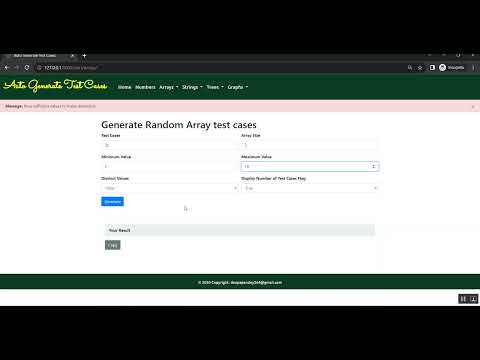
Auto Generative Test Case Django in Python Projects
र 1000
Auto Generative Test Case Django in Python Projects
Technical Details
Domain : Python
Database : Sqlite
Tools : Anaconda
Run Tools: VS Code
Database : Sqlite
Tools : Anaconda
Run Tools: VS Code
Secure Payment
Instant Download
GST Invoice
24/7 Support
About This Product
Auto Generative Test Case Django in Python Projects
Abstract
Software testing is a critical part of the development lifecycle, ensuring code reliability, functionality, and performance. Manual test case creation can be time-consuming, error-prone, and difficult to maintain as applications evolve. This project presents an Auto Generative Test Case System using Django in Python, which automatically generates test cases for web applications based on the codebase and predefined templates. The system analyzes application logic, models, views, and URLs to produce comprehensive test scripts that validate functionality, edge cases, and input-output behavior. Python libraries such as Django, PyTest, Selenium, Pandas, and Faker are used for backend analysis, test generation, and data simulation. By automating test case generation, the system reduces manual effort, increases code coverage, and improves software reliability.
Existing System
In the existing system, software testing largely depends on manual test case writing and execution. Developers or QA engineers write test scripts based on application specifications and user stories, which is time-consuming and often inconsistent. Some automated testing frameworks exist, but they require manual specification of test cases and scripts, limiting scalability and adaptability to code changes. Existing systems struggle to generate comprehensive tests for complex web applications, handle edge cases, or maintain synchronization with evolving codebases. As a result, test coverage is often incomplete, increasing the risk of undetected bugs and system failures.
Proposed System
The proposed system introduces a Python-Django-based framework for automated test case generation. The system scans the web application’s codebase, including models, views, forms, and URLs, to identify potential test scenarios. Using analysis of input fields, validation rules, and business logic, the system generates Python test scripts compatible with PyTest or Django’s test framework. Test data is simulated using libraries such as Faker for realistic input values. Optionally, Selenium integration allows automated browser-based testing for front-end validation. A Django-powered web interface provides an interactive dashboard where developers can view generated test cases, execute them, and monitor test results. By automating the creation, execution, and management of test cases, the system improves test coverage, reduces human effort, accelerates the development cycle, and ensures higher software quality.
Abstract
Software testing is a critical part of the development lifecycle, ensuring code reliability, functionality, and performance. Manual test case creation can be time-consuming, error-prone, and difficult to maintain as applications evolve. This project presents an Auto Generative Test Case System using Django in Python, which automatically generates test cases for web applications based on the codebase and predefined templates. The system analyzes application logic, models, views, and URLs to produce comprehensive test scripts that validate functionality, edge cases, and input-output behavior. Python libraries such as Django, PyTest, Selenium, Pandas, and Faker are used for backend analysis, test generation, and data simulation. By automating test case generation, the system reduces manual effort, increases code coverage, and improves software reliability.
Existing System
In the existing system, software testing largely depends on manual test case writing and execution. Developers or QA engineers write test scripts based on application specifications and user stories, which is time-consuming and often inconsistent. Some automated testing frameworks exist, but they require manual specification of test cases and scripts, limiting scalability and adaptability to code changes. Existing systems struggle to generate comprehensive tests for complex web applications, handle edge cases, or maintain synchronization with evolving codebases. As a result, test coverage is often incomplete, increasing the risk of undetected bugs and system failures.
Proposed System
The proposed system introduces a Python-Django-based framework for automated test case generation. The system scans the web application’s codebase, including models, views, forms, and URLs, to identify potential test scenarios. Using analysis of input fields, validation rules, and business logic, the system generates Python test scripts compatible with PyTest or Django’s test framework. Test data is simulated using libraries such as Faker for realistic input values. Optionally, Selenium integration allows automated browser-based testing for front-end validation. A Django-powered web interface provides an interactive dashboard where developers can view generated test cases, execute them, and monitor test results. By automating the creation, execution, and management of test cases, the system improves test coverage, reduces human effort, accelerates the development cycle, and ensures higher software quality.
Customer Reviews (0)
No reviews yet. Be the first!
Related Products
⭐ Featured

AI & ML Models
Zomato Restaurant Reviews Sentimental Analyzer in Python Projects
Zomato Restaurant Reviews Sentimental Analyzer in Python Projects
र 1000
⭐ Featured
⭐ Featured

AI & ML Models
Voice Disorder Prediction using Audio Dataset in Python Projects
Voice Disorder Prediction using Audio Dataset in Python Projects
र 1000
AI & ML Models
Vitamin Deficiency Detection Using Image Processing in Python Projects
Vitamin Deficiency Detection Using Image Processing in Python Projects
र 1000