AI & ML Models
0.0 (0 reviews) • 0 downloads
Auto Encoder Credit Card Fraud Detection in Python Projects
र 1000
Auto Encoder Credit Card Fraud Detection in Python Projects
Technical Details
Domain : Python
Database : Sqlite
Tools : Anaconda
Run Tools: VS Code
Database : Sqlite
Tools : Anaconda
Run Tools: VS Code
Secure Payment
Instant Download
GST Invoice
24/7 Support
About This Product
Auto Encoder Credit Card Fraud Detection in Python Projects
Abstract
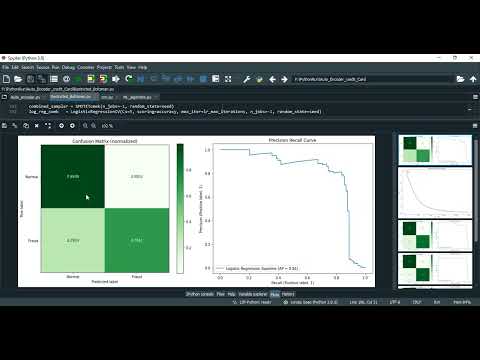
Credit card fraud has become one of the most critical challenges in the digital financial ecosystem due to the rise in online transactions. Traditional fraud detection systems often fail to keep up with evolving fraud patterns, leading to financial losses and customer dissatisfaction. This project, Autoencoder Credit Card Fraud Detection in Python, applies deep learning–based anomaly detection using autoencoders to identify fraudulent transactions. Autoencoders are trained on legitimate transaction data to learn normal spending patterns, and any significant deviation in reconstruction error is flagged as potential fraud. Implemented in Python with libraries such as TensorFlow/Keras, Pandas, NumPy, Matplotlib, and Scikit-learn, the system enables effective detection of fraudulent activities while minimizing false positives, providing an efficient and scalable fraud detection framework.
Existing System
Existing fraud detection systems mostly rely on rule-based algorithms (e.g., flagging unusually large purchases) or traditional machine learning models like decision trees, logistic regression, and random forests. While these methods perform reasonably well, they face challenges when dealing with imbalanced datasets (fraudulent transactions are much fewer than legitimate ones). They also struggle to adapt to new fraud patterns and often generate high false alarm rates, which reduce customer trust. Furthermore, existing models depend heavily on manual feature engineering, which is time-consuming and not robust for dynamic financial environments.
Proposed System
The proposed system introduces an autoencoder-based deep learning model for detecting credit card fraud. Autoencoders work by learning compressed representations of normal transaction data and reconstructing them with minimal error. When fraudulent transactions occur, the reconstruction error is significantly higher, enabling the model to flag them as anomalies. This method reduces the dependency on manual feature engineering and adapts to complex, nonlinear transaction behaviors. The pipeline includes data preprocessing (handling imbalanced data using SMOTE or undersampling), normalization, model training, and evaluation. Compared to existing systems, this approach provides higher accuracy, lower false positives, and better generalization to unseen fraud patterns, making it highly effective for real-world deployment in banking and financial systems.
Abstract
Credit card fraud has become one of the most critical challenges in the digital financial ecosystem due to the rise in online transactions. Traditional fraud detection systems often fail to keep up with evolving fraud patterns, leading to financial losses and customer dissatisfaction. This project, Autoencoder Credit Card Fraud Detection in Python, applies deep learning–based anomaly detection using autoencoders to identify fraudulent transactions. Autoencoders are trained on legitimate transaction data to learn normal spending patterns, and any significant deviation in reconstruction error is flagged as potential fraud. Implemented in Python with libraries such as TensorFlow/Keras, Pandas, NumPy, Matplotlib, and Scikit-learn, the system enables effective detection of fraudulent activities while minimizing false positives, providing an efficient and scalable fraud detection framework.
Existing System
Existing fraud detection systems mostly rely on rule-based algorithms (e.g., flagging unusually large purchases) or traditional machine learning models like decision trees, logistic regression, and random forests. While these methods perform reasonably well, they face challenges when dealing with imbalanced datasets (fraudulent transactions are much fewer than legitimate ones). They also struggle to adapt to new fraud patterns and often generate high false alarm rates, which reduce customer trust. Furthermore, existing models depend heavily on manual feature engineering, which is time-consuming and not robust for dynamic financial environments.
Proposed System
The proposed system introduces an autoencoder-based deep learning model for detecting credit card fraud. Autoencoders work by learning compressed representations of normal transaction data and reconstructing them with minimal error. When fraudulent transactions occur, the reconstruction error is significantly higher, enabling the model to flag them as anomalies. This method reduces the dependency on manual feature engineering and adapts to complex, nonlinear transaction behaviors. The pipeline includes data preprocessing (handling imbalanced data using SMOTE or undersampling), normalization, model training, and evaluation. Compared to existing systems, this approach provides higher accuracy, lower false positives, and better generalization to unseen fraud patterns, making it highly effective for real-world deployment in banking and financial systems.
Customer Reviews (0)
No reviews yet. Be the first!
Related Products
⭐ Featured

AI & ML Models
Zomato Restaurant Reviews Sentimental Analyzer in Python Projects
Zomato Restaurant Reviews Sentimental Analyzer in Python Projects
र 1000
⭐ Featured

⭐ Featured

AI & ML Models
Voice Disorder Prediction using Audio Dataset in Python Projects
Voice Disorder Prediction using Audio Dataset in Python Projects
र 1000

AI & ML Models
Vitamin Deficiency Detection Using Image Processing in Python Projects
Vitamin Deficiency Detection Using Image Processing in Python Projects
र 1000