AI & ML Models
0.0 (0 reviews) • 0 downloads
Autism Eye Data Analysis Jupyter in Python Projects
र 1000
Autism Eye Data Analysis Jupyter in Python Projects
Technical Details
Domain : Python
Database : Sqlite
Tools : Anaconda
Run Tools: VS Code
Database : Sqlite
Tools : Anaconda
Run Tools: VS Code
Secure Payment
Instant Download
GST Invoice
24/7 Support
About This Product
Autism Eye Data Analysis Jupyter in Python Projects
Abstract
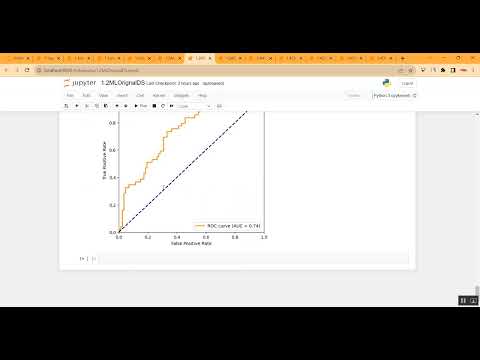
Autism Spectrum Disorder (ASD) is a developmental condition that affects communication, behavior, and social interaction. Recent studies have shown that eye movement and gaze patterns can serve as reliable biomarkers for detecting autism in children and adults. This project, Autism Eye Data Analysis in Jupyter using Python, focuses on analyzing eye-tracking data to identify potential indicators of autism. Using datasets containing gaze points, fixation times, and saccade patterns, the project applies exploratory data analysis (EDA) and machine learning techniques to classify subjects as autistic or non-autistic. Implemented in Jupyter Notebook, the system leverages Python libraries such as Pandas, NumPy, Matplotlib, Seaborn, Scikit-learn, and TensorFlow/Keras to preprocess, visualize, and model the data. The project demonstrates how computational approaches can support early and non-invasive autism detection.
Existing System
Current autism detection methods primarily depend on clinical observation, behavioral questionnaires, and psychological evaluations conducted by specialists. While effective, these methods are time-consuming, subjective, and costly, often leading to late diagnosis. Some research has explored basic eye-tracking studies, but most use manual analysis of gaze data, which is limited in scalability and accuracy. Existing computational models either use simple statistical methods or small datasets, which restrict their ability to generalize to diverse populations. Thus, traditional systems are unable to provide automated, real-time, and data-driven solutions for early autism detection.
Proposed System
The proposed system introduces a Python-based automated analysis of eye-tracking data to support autism detection. Using Jupyter Notebook for interactive experimentation, the project applies data preprocessing (handling missing values, normalizing gaze data), exploratory visualization (heatmaps, scatter plots of gaze distribution), and machine learning/deep learning techniques (SVM, Random Forest, CNN/LSTM) for classification. The model learns to differentiate unique gaze patterns in autistic individuals, such as reduced fixation on faces or atypical attention shifts, compared to non-autistic individuals. This approach provides automation, higher accuracy, and non-invasive diagnosis support compared to traditional methods. The system can be extended for early screening tools, clinical support systems, and assistive technologies for autism research.
Abstract
Autism Spectrum Disorder (ASD) is a developmental condition that affects communication, behavior, and social interaction. Recent studies have shown that eye movement and gaze patterns can serve as reliable biomarkers for detecting autism in children and adults. This project, Autism Eye Data Analysis in Jupyter using Python, focuses on analyzing eye-tracking data to identify potential indicators of autism. Using datasets containing gaze points, fixation times, and saccade patterns, the project applies exploratory data analysis (EDA) and machine learning techniques to classify subjects as autistic or non-autistic. Implemented in Jupyter Notebook, the system leverages Python libraries such as Pandas, NumPy, Matplotlib, Seaborn, Scikit-learn, and TensorFlow/Keras to preprocess, visualize, and model the data. The project demonstrates how computational approaches can support early and non-invasive autism detection.
Existing System
Current autism detection methods primarily depend on clinical observation, behavioral questionnaires, and psychological evaluations conducted by specialists. While effective, these methods are time-consuming, subjective, and costly, often leading to late diagnosis. Some research has explored basic eye-tracking studies, but most use manual analysis of gaze data, which is limited in scalability and accuracy. Existing computational models either use simple statistical methods or small datasets, which restrict their ability to generalize to diverse populations. Thus, traditional systems are unable to provide automated, real-time, and data-driven solutions for early autism detection.
Proposed System
The proposed system introduces a Python-based automated analysis of eye-tracking data to support autism detection. Using Jupyter Notebook for interactive experimentation, the project applies data preprocessing (handling missing values, normalizing gaze data), exploratory visualization (heatmaps, scatter plots of gaze distribution), and machine learning/deep learning techniques (SVM, Random Forest, CNN/LSTM) for classification. The model learns to differentiate unique gaze patterns in autistic individuals, such as reduced fixation on faces or atypical attention shifts, compared to non-autistic individuals. This approach provides automation, higher accuracy, and non-invasive diagnosis support compared to traditional methods. The system can be extended for early screening tools, clinical support systems, and assistive technologies for autism research.
Customer Reviews (0)
No reviews yet. Be the first!
Related Products
⭐ Featured

AI & ML Models
Zomato Restaurant Reviews Sentimental Analyzer in Python Projects
Zomato Restaurant Reviews Sentimental Analyzer in Python Projects
र 1000
⭐ Featured
⭐ Featured
AI & ML Models
Voice Disorder Prediction using Audio Dataset in Python Projects
Voice Disorder Prediction using Audio Dataset in Python Projects
र 1000
AI & ML Models
Vitamin Deficiency Detection Using Image Processing in Python Projects
Vitamin Deficiency Detection Using Image Processing in Python Projects
र 1000