AI & ML Models
0.0 (0 reviews) • 0 downloads
Autism Eye Data Analysis Jupyter in Python Projects
र 1000
Autism Eye Data Analysis Jupyter in Python Projects
Technical Details
Domain : Python
Database : Sqlite
Tools : Anaconda
Run Tools: VS Code
Database : Sqlite
Tools : Anaconda
Run Tools: VS Code
Secure Payment
Instant Download
GST Invoice
24/7 Support
About This Product
Autism Eye Data Analysis Jupyter in Python Projects
Abstract
Eye movement and gaze behavior are important indicators for detecting Autism Spectrum Disorder (ASD), as individuals with autism often exhibit atypical visual attention patterns. This project presents an Autism Eye Data Analysis System using Python in Jupyter Notebook, which analyzes eye-tracking datasets to identify patterns associated with ASD. The system uses statistical and machine learning techniques to process eye movement features such as fixation duration, saccade patterns, and gaze coordinates. Python libraries including Pandas, NumPy, Matplotlib, Seaborn, and Scikit-learn are utilized for data preprocessing, visualization, and model development. By systematically analyzing eye-tracking data, the system supports early detection of autism, helps researchers understand behavioral patterns, and provides actionable insights for clinicians and caregivers.
Existing System
Existing systems for autism detection often rely on clinical observation, questionnaires, and behavioral assessments such as ADOS or ADI-R. While eye-tracking technology has been used in research, analysis of eye data is usually manual or limited to simple statistical measures, making it time-consuming and less scalable. Traditional methods may fail to capture complex patterns or subtle differences in gaze behavior that are indicative of ASD. Additionally, many systems do not integrate machine learning approaches to classify or predict autism risk based on eye movement data, limiting their predictive accuracy and applicability for early screening.
Proposed System
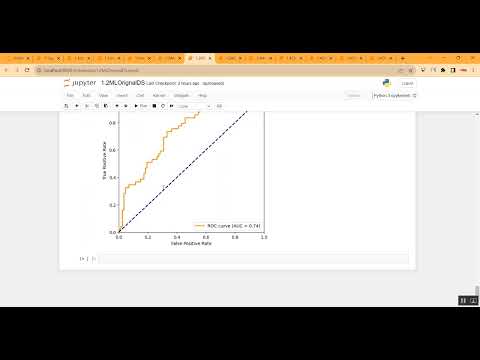
The proposed system introduces a Python-based machine learning framework for autism detection using eye-tracking data. Eye movement datasets are preprocessed to handle missing values, normalize coordinates, and extract relevant features such as fixation duration, saccade velocity, blink rate, and gaze heatmaps. Exploratory Data Analysis (EDA) is conducted to visualize trends and correlations using plots, heatmaps, and scatter charts in Jupyter Notebook. Machine learning algorithms such as Random Forest, Support Vector Machines (SVM), and Logistic Regression are applied to classify individuals as autistic or non-autistic based on extracted features. The system also evaluates model performance using metrics like accuracy, precision, recall, and F1-score. By providing visualizations and predictive analysis in an interactive Jupyter Notebook environment, this approach enables researchers, clinicians, and caregivers to efficiently analyze eye data, understand behavioral patterns, and support early intervention for autism.
Abstract
Eye movement and gaze behavior are important indicators for detecting Autism Spectrum Disorder (ASD), as individuals with autism often exhibit atypical visual attention patterns. This project presents an Autism Eye Data Analysis System using Python in Jupyter Notebook, which analyzes eye-tracking datasets to identify patterns associated with ASD. The system uses statistical and machine learning techniques to process eye movement features such as fixation duration, saccade patterns, and gaze coordinates. Python libraries including Pandas, NumPy, Matplotlib, Seaborn, and Scikit-learn are utilized for data preprocessing, visualization, and model development. By systematically analyzing eye-tracking data, the system supports early detection of autism, helps researchers understand behavioral patterns, and provides actionable insights for clinicians and caregivers.
Existing System
Existing systems for autism detection often rely on clinical observation, questionnaires, and behavioral assessments such as ADOS or ADI-R. While eye-tracking technology has been used in research, analysis of eye data is usually manual or limited to simple statistical measures, making it time-consuming and less scalable. Traditional methods may fail to capture complex patterns or subtle differences in gaze behavior that are indicative of ASD. Additionally, many systems do not integrate machine learning approaches to classify or predict autism risk based on eye movement data, limiting their predictive accuracy and applicability for early screening.
Proposed System
The proposed system introduces a Python-based machine learning framework for autism detection using eye-tracking data. Eye movement datasets are preprocessed to handle missing values, normalize coordinates, and extract relevant features such as fixation duration, saccade velocity, blink rate, and gaze heatmaps. Exploratory Data Analysis (EDA) is conducted to visualize trends and correlations using plots, heatmaps, and scatter charts in Jupyter Notebook. Machine learning algorithms such as Random Forest, Support Vector Machines (SVM), and Logistic Regression are applied to classify individuals as autistic or non-autistic based on extracted features. The system also evaluates model performance using metrics like accuracy, precision, recall, and F1-score. By providing visualizations and predictive analysis in an interactive Jupyter Notebook environment, this approach enables researchers, clinicians, and caregivers to efficiently analyze eye data, understand behavioral patterns, and support early intervention for autism.
Customer Reviews (0)
No reviews yet. Be the first!
Related Products
⭐ Featured

AI & ML Models
Zomato Restaurant Reviews Sentimental Analyzer in Python Projects
Zomato Restaurant Reviews Sentimental Analyzer in Python Projects
र 1000
⭐ Featured
⭐ Featured

AI & ML Models
Voice Disorder Prediction using Audio Dataset in Python Projects
Voice Disorder Prediction using Audio Dataset in Python Projects
र 1000

AI & ML Models
Vitamin Deficiency Detection Using Image Processing in Python Projects
Vitamin Deficiency Detection Using Image Processing in Python Projects
र 1000